
Review · BISHKEK
Bishkek : USSR History , Soviet Architects , Statues & Mosaics
Bishkek’s Soviet past is not locked inside a museum. It is spread across squares, parks, theaters, mosaics, statues, and government buildings. This tour brings those pieces together, from the grand Ala-Too Square to a textile-factory mosaic celebrating working women.
I like the way the route connects Soviet design with Kyrgyz identity, especially through the Manas statue, the national flag, and the contrast between Communist monuments and older nomadic traditions. I also like the human scale of the walk. Guides Anna and Alex are praised for clear historical explanations, and one reported tour lasted three and a half hours.
The main drawback is the pace at the individual stops. Many are scheduled for only five minutes, so you will often hear the story, take a few photographs, and move on. If you want long museum visits or time inside every building, $49 may feel less attractive.
Key points to know before booking
- A walking tour of Soviet Bishkek: The route links central squares, parks, monuments, mosaics, and civic buildings over roughly 3 to 4 hours.
- A useful guide to Kyrgyz identity: You learn about the flag, nomadic traditions, Manas, and the country’s years under Russian and Soviet rule.
- Strong visual appeal: Expect Socialist Modernist buildings, Stalin-era design, public art, statues, and a striking mosaic on a textile factory.
- Short stops, steady movement: Most listed stops last five or ten minutes, so the tour favors explanation and city orientation over lengthy visits.
- Small to medium group size: The maximum group size is 25 people, with group discounts available.
- Good guide reports: Anna receives special praise for patient explanations, while Alex is described as friendly and well informed about buildings and monuments.
Why Bishkek’s Soviet story works best on foot
Bishkek changed greatly during the Russian Imperial and Soviet periods. The city was known as Frunze for more than sixty years, named after Bolshevik military leader Mikhail Frunze. Its streets, public squares, parks, and civic buildings were reshaped according to Soviet planning.
That transformation is what makes this experience useful. You are not simply looking at an old statue and hearing a date. You are learning how public space was used to express political power, national identity, military memory, workers’ ideals, and loyalty to the Soviet state.
The route also shows what survived after 1991. Some Soviet monuments were removed, including statues that once dominated central spaces. Others remained, sometimes alongside new Kyrgyz symbols. That contrast gives the walk more meaning than a simple architecture tour.
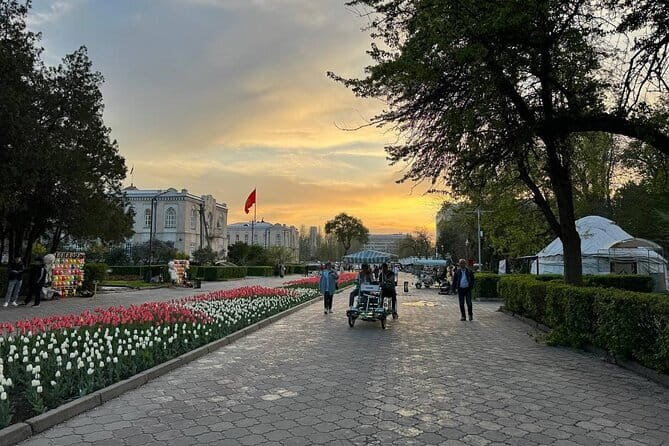
The experience begins at the Paramount Kyrgyz Republic Flag on Chuy Avenue and ends at the same meeting point. The precise order may vary, but the route covers a compact central section of Bishkek. The tour is best understood as an outdoor history lesson with stops at cultural buildings and public monuments.
More Bauhaus and Brutalist Architecture Tours in the world:
- Brutalist Tbilisi: Urban exploration and untold stories
★ 5.0 · 82 reviews - London: Brutalist Architecture & History Walking Tour
★ 4.8 · 42 reviews - Le Corbusier’s Chandigarh : A Complete Architecture Tour
★ 4.7 · 25 reviews
Ala-Too Square and the changing center of power
Ala-Too Square is the natural place to begin. It is the center of Bishkek and one of the clearest places to see how the city’s public image changed after the Soviet period.
Here you examine Soviet-era buildings and learn about statues that were removed after 1991. That detail matters. A city’s history is visible not only in what remains, but also in what has disappeared. The square helps you understand how political symbols can be replaced while the surrounding architecture continues to shape daily life.
The scheduled stop is about ten minutes, so you should use the time well. Look beyond the central monument or flag and notice the scale of the buildings around the square. Your guide provides the political background that photographs alone cannot supply.
From here, the tour moves to the Kyrgyz national flag. This is a short stop, only about five minutes, but it adds an important local perspective. You learn about the flag’s colors and emblem, as well as the nomadic traditions connected to Kyrgyz identity.
That shift is one of the best features of the experience. The walk does not treat Kyrgyzstan as a blank Soviet canvas. It shows how national culture existed before Soviet rule and continued after it.
Manas, cinema, and public art
The Manas statue introduces one of the country’s best-known heroic figures. Your guide explains Manas’s life and importance to the Kyrgyz nation. The stop is brief, but it gives you a useful counterpoint to Lenin, Marx, and Engels later in the route.
Manas is not simply another statue in a city square. His presence points to a cultural tradition rooted in Kyrgyz national identity, while many Soviet monuments represent a wider political system. Seeing both types of public sculpture in one walk helps you read Bishkek’s streets with greater care.
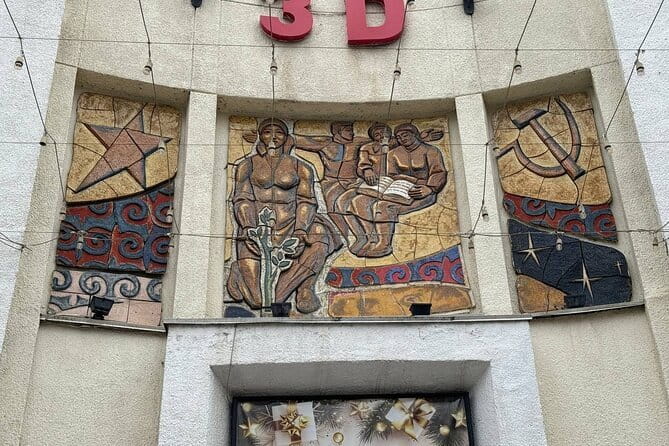
The next stop is Ala-Too Cinema, established in the early 1960s. It is described as the oldest movie theater in Kyrgyzstan, and its mosaics are the main reason to pause here.
This is a good example of what makes Soviet-era architecture worth seeing in person. The building is not only about its function as a cinema. The mosaic turns a public building into a piece of visual messaging. You can expect a quick explanation and time to examine the exterior, rather than a full film or extended indoor visit.
Museums, theaters, and Soviet cultural planning
The route includes a museum containing thousands of objects connected with Kyrgyz cultural heritage. The collection covers material from antiquity through the end of the twentieth century, including sculptures and other objects.
The supplied details do not give the museum’s name or say how long you spend inside. Because the stop appears among a route filled with short visits, ask your guide at the start whether this section includes entry and how much time is available. That small question can help you set expectations.
The Gapar Aitiev National Museum of Fine Arts is another cultural stop. The building itself is part of the appeal, and you hear about art brought by well-known Russian artists. The listed stop lasts five minutes, so this is likely more of an architectural and historical introduction than a full gallery visit.
The Opera and Ballet Theater, also known as the Maldybaev Opera and Ballet Theater, adds another layer. It opened in Bishkek in 1937 as a Musical Drama Theater and later became an important performance venue.
A five-minute stop will not allow time for a performance or a full inspection of the interior. Still, the theater helps explain how Soviet authorities used music, drama, and ballet to develop formal cultural institutions. It also shows that Soviet planning was not limited to administrative offices and monuments. The arts were part of the public program.
More History Walks around the world:
- Chicago in a Day: Food, History & Architecture Walking Tour
★ 5.0 · 1,153 reviews - Charleston’s Best Highlights: History, Culture & Architecture
★ 5.0 · 422 reviews - Palm Springs Modernism Architecture & History Bike Tour
★ 5.0 · 359 reviews - Charleston: History and Architecture Guided Walking Tour
★ 4.8 · 349 reviews
Victory Square and the memory of war
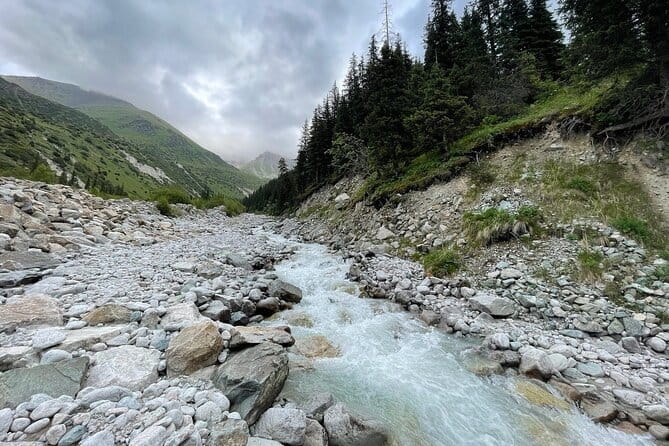
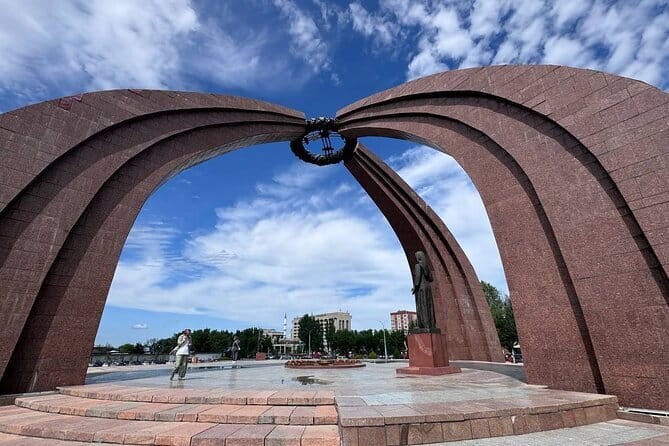
Victory Square was created in 1985 to mark the fortieth anniversary of the end of the Second World War in Europe. It is dedicated to victory over Nazi Germany and serves as a public memorial in Bishkek.
The stop lasts about ten minutes, enough for a focused explanation of the memorial’s purpose and a look at its design. Your guide connects the square to Soviet war memory, a subject that shaped public ceremonies, monuments, school lessons, and family stories across the former Soviet Union.
For me, this is one of the more important stops because it shows how history was presented through public space. Victory monuments were designed to be seen by everyone, not just by museum visitors. They also carried a strong emotional message about sacrifice and national duty.
You may want to bring a phone or camera, but keep the focus on the guide’s explanation. A photograph records the structure. The historical context explains why it is there.
The library, Marx and Engels, and Lenin

The National Library of the Kyrgyz Republic was founded in 1934 and serves as the country’s legal deposit and copyright agency. Its collection contains six million documents in 89 languages.
The stop is scheduled for five minutes, so you should not expect a library tour. Instead, the building provides a chance to discuss Soviet education, publishing, literacy, and the role of state institutions. A national library is a quieter symbol than a statue, but it tells you how knowledge was organized and distributed.
The monument to Karl Marx and Friedrich Engels brings the tour back to Communist ideology. Your guide can place the pair in the context of The Communist Manifesto, written jointly between December 1847 and January 1848 and first published on February 21, 1848.
This is a useful stop for anyone interested in the ideas behind the buildings and symbols you have already seen. Soviet design was not merely decorative. It was tied to a political system with its own theory of work, class, history, and government.
The Lenin statue offers another important contrast. It was erected in 1984 during the sixtieth anniversary of the Kyrgyz Soviet Socialist Republic. After the fall of Communism in 1991, Lenin statues were removed in many places, but this one remained in Bishkek.
That fact gives the stop a sharper edge. You are looking at an object that survived a major political change. Your guide explains its place in the city and the broader story of Soviet symbols after independence.
Panfilov Park and the city’s green spaces
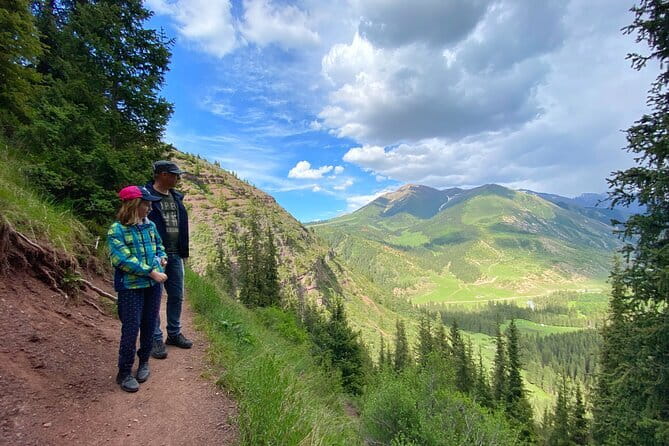
Panfilov Park lies near Old Square and Manas Square. It is named for Ivan Panfilov, a Hero of the Soviet Union and chairman of the Military Committee of the Kirghiz SSR.
The park matters because Bishkek’s Soviet transformation was not only about concrete and monumental buildings. Parks and green spaces were also built into the city. They offered room for recreation, ceremonies, memorials, and daily public life.
The stop is listed at five minutes, but the park also serves as a natural walking section between more formal monuments. Wear comfortable shoes and expect to keep moving. There is no promise of a long rest stop, food break, or café visit, so plan those separately.
The textile-factory mosaic and the power of workers
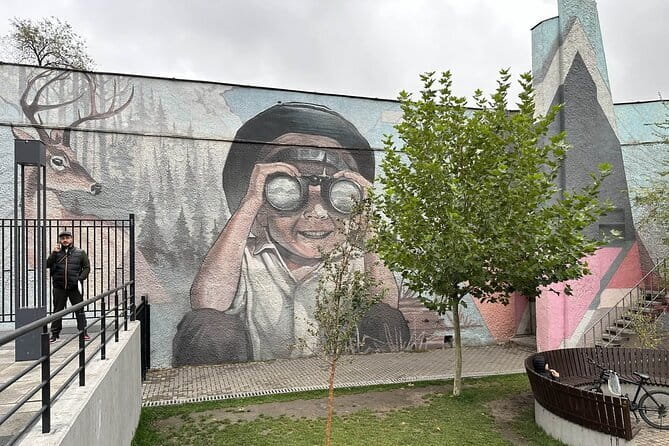
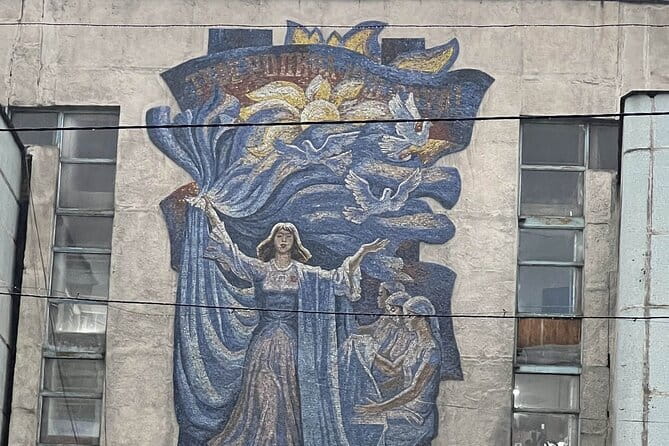
One of the most distinctive stops is a large mosaic on a textile factory. Its subject is the power of working women and their contribution to Soviet society.
This is exactly the kind of public art that can be easy to miss if you explore Bishkek without a guide. The artwork was placed on an industrial building, not inside a gallery. It presented work as heroic and collective, with women shown as part of the force that made the Soviet nation strong.
The stop lasts about five minutes, but the image deserves a careful look. Notice how the artwork turns an ordinary workplace into a political and social statement. You also get a glimpse of how Soviet public art addressed gender, labor, and national progress.
Philharmonic Hall and Stalin-era Bishkek
The Toktogul Satylganov Philharmonic Hall introduces the city’s musical life. The Philharmonic Society was founded on October 7, 1936, based on an orchestra of folk instruments. For years, it did not have its own concert hall, and performances took place in other venues.
The building and institution show how local musical traditions were placed within an organized Soviet cultural system. The combination of folk instruments and formal state-supported performance is especially useful for understanding how Kyrgyz culture was presented during the Soviet period.
The final major stop is Bishkek City Hall, the mayor’s building. It is described as a distinctive example of Stalin-era architecture.
Stalin-era design tends to be formal, imposing, and carefully planned. At City Hall, you see how municipal power was given a grand physical setting. The stop lasts ten minutes, allowing a little more time than most of the monuments and statues.
The remaining time is used for the walking circuit, sightseeing, and exploration. That wording matters because the route is not a strict sequence of long guided visits. You are moving through the city, with the guide using key places to explain the larger story.
What $49 buys you
At $49 per person, this is not a bargain-priced stroll, but it can be good value if you want structure and explanation. The route covers a large number of sites, and the guide’s role is the main reason to pay rather than walk to the same squares on your own.
You receive the guide, all listed fees and taxes, recommendations for places in Kyrgyzstan, and suggestions for local food spots. Food and drinks are not included. Neither is insurance, and the vehicle is not air-conditioned.
Transportation is worth noting. No air-conditioned vehicle is provided, and the experience begins and ends at the same central meeting point. The information points to a walking-focused tour rather than a private drive between sights.
A maximum of 25 people keeps the group from becoming enormous, though 25 is still large enough that you may need to stay close to the guide. Group discounts are available. The tour is often booked about 37 days ahead, which suggests you should reserve early if your Bishkek dates are fixed.
The experience has a 4.4 rating from seven reviews, with particular praise for the guides. Anna is described as patient and strong on history and geography. Alex is described as friendly and effective at explaining the meaning of buildings, monuments, and mosaics. You can ask for a preferred guide, but the available information does not guarantee that person will lead your departure.
Who should book this Bishkek walk?
I would choose this tour if you want a clear introduction to Bishkek and do not already know much about Soviet architecture or Kyrgyz political history. It suits first-time visitors, architecture fans, students of twentieth-century history, and anyone curious about how a Central Asian capital changed after 1991.
It also works well early in your stay. The guide’s recommendations for other Kyrgyzstan sights and local food can help you plan the rest of your visit.
You may want a different arrangement if your main goal is extended museum time, indoor sightseeing, or a relaxed photography walk. The stops are short, and the tour covers many places. Its strength is the connection between them, not deep time at one building.
The route is suitable for most people, according to the supplied booking information, but comfort still matters. You will be on foot for several hours, with stops in parks and public squares. Bring water, protect yourself from the weather, and wear shoes suited to city walking.
Free cancellation is available if you cancel at least 24 hours before the start time. Changes or cancellations inside that period are not accepted for a refund.
Should you book it?
Book this experience if you want Bishkek’s Soviet past explained through real streets, statues, mosaics, and public buildings. The strongest reasons are the range of sites, the link between Soviet rule and Kyrgyz identity, and the guide-led context that makes small details easier to understand.
At $49, it is best value for someone who wants a guided overview rather than a series of long admissions. Request Anna or Alex if possible, ask how much museum access is planned, and expect a steady walking route with short stops. If that sounds right, this is a practical way to get your bearings and see a side of Bishkek that is easy to miss on your own.
FAQ
Where does the tour start?
The tour starts at the Paramount Kyrgyz Republic Flag on Chuy Avenue in Bishkek.
Where does the tour end?
The activity ends back at the meeting point.
How long does the tour last?
The tour lasts approximately 3 to 4 hours. One described experience lasted three and a half hours.
How much does the tour cost?
The listed price is $49 per person. Group discounts are available.
How large is the group?
The maximum group size is 25 people.
Are food and drinks included?
No. Food and beverages are not included in the price.
Is transportation included?
No air-conditioned vehicle is included. The route is centered on walking between Bishkek sights.
What happens if I need to cancel?
You can receive a full refund if you cancel at least 24 hours before the experience begins. Cancellations or changes made less than 24 hours before the start time are not accepted for a refund.
New to the itinerary around the world
- Washington, DC: Georgetown Architecture Walking Tour★ 5.0 · 8 reviews
- Wilmington History and Architecture Tour★ 4.8 · 18 reviews
- Walk & Discover KL’s Architectural and Heritage Gems★ 5.0 · 7 reviews
- Washington DC: Dupont Circle & Embassy Row Architecture Tour★ 5.0 · 6 reviews
- New Orleans : Garden District Architecture Walking tour★ 4.8 · 5 reviews
- Unveiling Brno: History, Culture & Architectural Delights★ 5.0 · 2 reviews
- Vicenza: Palladian Architecture Private Walking Tour★ 3.3 · 3 reviews
- Private Colonial Williamsburg Architectural Tour★ 5.0 · 5 reviews
Bauhaus and Brutalist Architecture Tours, compared.
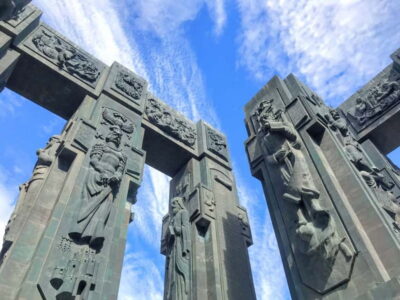
Brutalist Tbilisi: Urban exploration and untold stories
Read our review →
Le Corbusier’s Chandigarh : A Complete Architecture Tour
Read our review →
Architecture of New Belgrade – Brutalism Decoded
Read our review →
Secret Split: Socialist Architecture & brutalism – Urban Utopia
Read our review →
Tashkent Soviet Architecture (Modernism) and Subway station tour.
Read our review →
Belgrade: Space architecture tour – brutalist architecture
Read our review →
USSR History, Soviet Architects ,Statues & Mosaics
Read our review →Other lists with this tour