
Review · WASHINGTON DC
Washington, DC: Georgetown Architecture Walking Tour
Georgetown’s best stories are written into its buildings. On this leisurely 150-minute walk, you’ll move from the C&O Canal and old merchant houses to churches, schools, university buildings, and the Potomac waterfront, seeing how a working port became one of Washington’s grandest neighborhoods.
I like the tour’s clear focus on architecture and its manageable pace. I also like that it reaches beyond the postcard streets to places such as the Lydia English Seminary School for Girls, Alexander Graham Bell’s Volta Laboratory site, and the old streetcar depot now called the Car Barn. The main consideration is simple: you’ll walk about 2 miles outdoors, rain or shine, so good shoes and weather-ready clothing matter.
Key points at a glance
- Trace Georgetown’s port-town past: Follow the Chesapeake and Ohio Canal and learn how goods reached communities along the Potomac.
- See houses with stories attached: The Laird-Dunlop House, Newton D. Baker House, and Grafton Tyler Double House give the walk a strong residential focus.
- Visit unusual local landmarks: Pomander Walk, the Yellow Tavern, and Cady’s Alley add variety beyond standard sightseeing.
- Connect buildings with famous names: The route includes Alexander Graham Bell’s Volta Laboratory site, Georgetown Preparatory School, Healy Hall, and the University Library.
- Meet at an easy Georgetown landmark: Start outside Baked & Wired, where your guide wears a DC Design Tour T-shirt.
- Plan for a weatherproof walk: The tour lasts 150 minutes, operates in rain unless conditions are dangerous, and costs $43 per person.
Why Georgetown works so well on foot
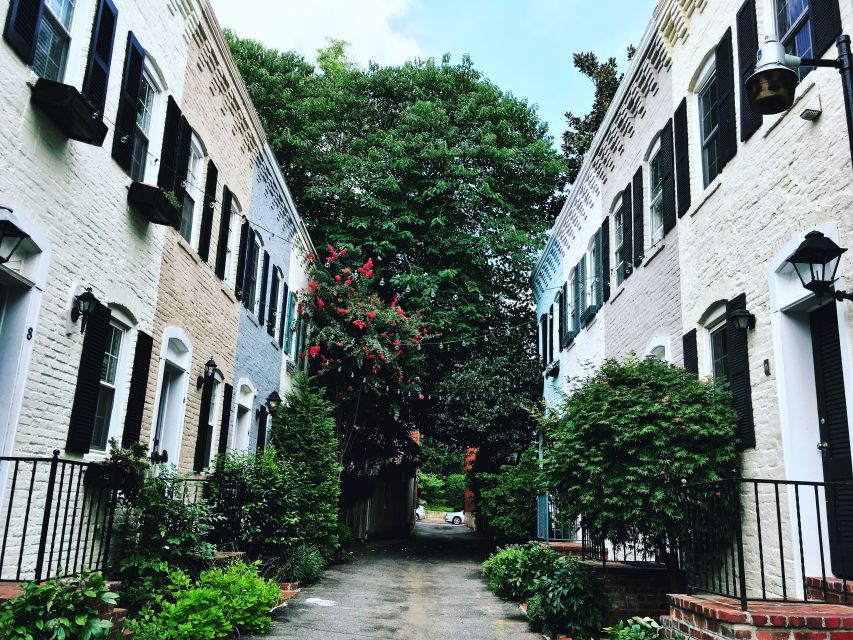
Georgetown can look polished and almost too tidy at first glance. Its brick sidewalks, old houses, and upscale shops make it easy to see only the surface. A walking tour gives you a better way in by explaining why the neighborhood developed as it did and how its buildings reflect different periods of local life.
The central idea is Georgetown’s change from a practical port community to a sought-after residential and academic district. The route uses buildings to tell that story, rather than asking you to memorize a long list of dates. You’ll hear about trade, education, religion, technology, and local institutions as you move through the streets.
That approach suits Georgetown particularly well. The neighborhood has no single grand monument that explains everything. Instead, its character comes from small details: a house façade, a former school, a narrow lane, an old tavern, or an academic building that still serves its original purpose.
You should also expect a relaxed pace. The tour covers around 2 miles in two and a half hours, giving your guide time to explain what you’re seeing. This is not a race through Georgetown’s highlights. It is better suited to someone who wants context and stories along with the views.
More Walking Tours in the USA
- The Official Art Deco Walking Tour by The Miami Design Preservation League
★ 5.0 · 1,580 reviews - Chicago in a Day: Food, History & Architecture Walking Tour
★ 5.0 · 1,153 reviews - Miami South Beach Art Deco Walking Tour
★ 5.0 · 1,039 reviews
Starting beside Baked & Wired and the C&O Canal
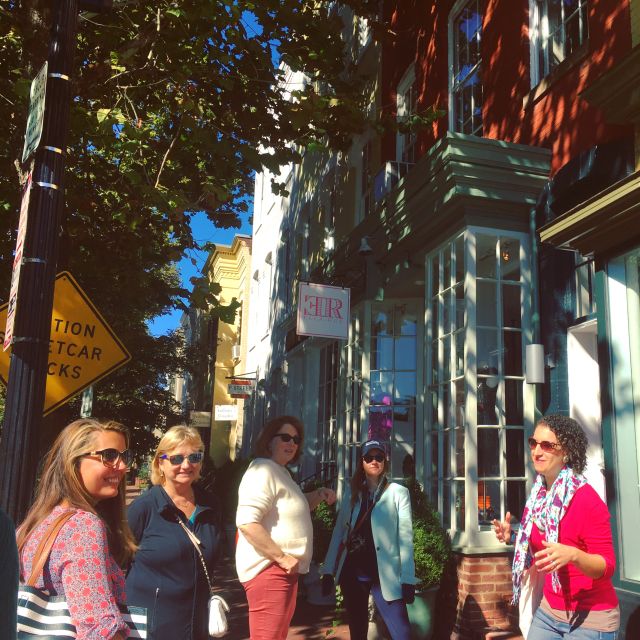
Your meeting point is outside Baked & Wired, a centrally located Georgetown café. Arrive five minutes early. The walk leaves on time, and you’ll identify your guide by a DC Design Tour T-shirt.
Beginning here is practical because Georgetown is compact but easy to enter from several directions. You can reach the meeting point before the tour without needing to find a remote office or check in at a large attraction. After meeting your guide, the group heads toward the Chesapeake and Ohio Canal.
The canal is an important first stop because it shows Georgetown in working mode. It connected communities along the Potomac with markets and goods, giving the neighborhood an economic purpose before it became known mainly for elegant homes and university life.
I like this opening because it puts the architecture into context. You are not simply looking at old buildings and being told that they are old. You begin with the trade route that helped Georgetown grow, then see how wealth and status appeared in the structures around it.
The canal section should also help you settle into the tour’s rhythm. You’ll be outside, walking at a steady but easy pace, with stops for explanation. Bring water, particularly on warm days, since the tour does not include refreshments.
Historic houses and Georgetown’s climb in status
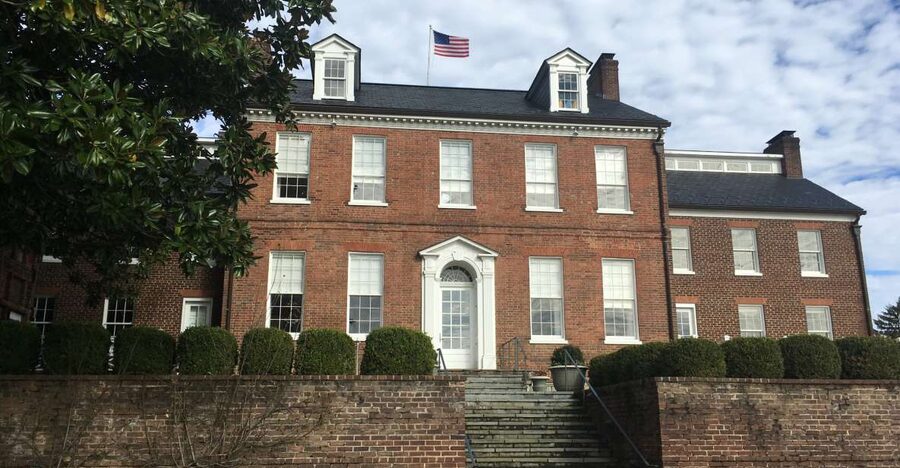
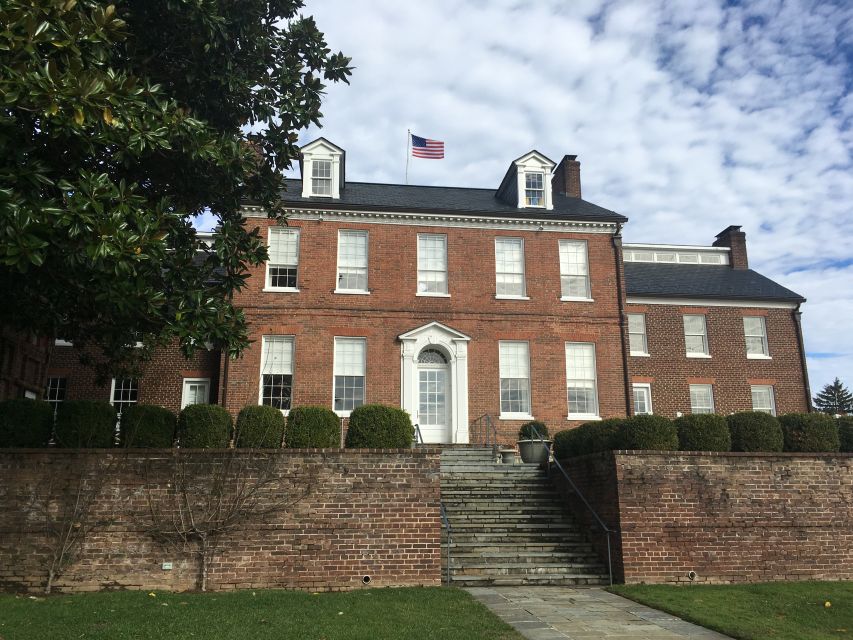
The Laird-Dunlop House and Newton D. Baker House bring the story down to the level of individual residences. These stops are useful because Georgetown’s past is not only about public institutions. Homes reveal who had money, influence, and a reason to build in this part of Washington.
Your guide will point out architectural details and connect them to the neighborhood’s rise. The tour’s idea of a rags to riches story becomes easier to understand when you see domestic buildings alongside the old canal and commercial routes.
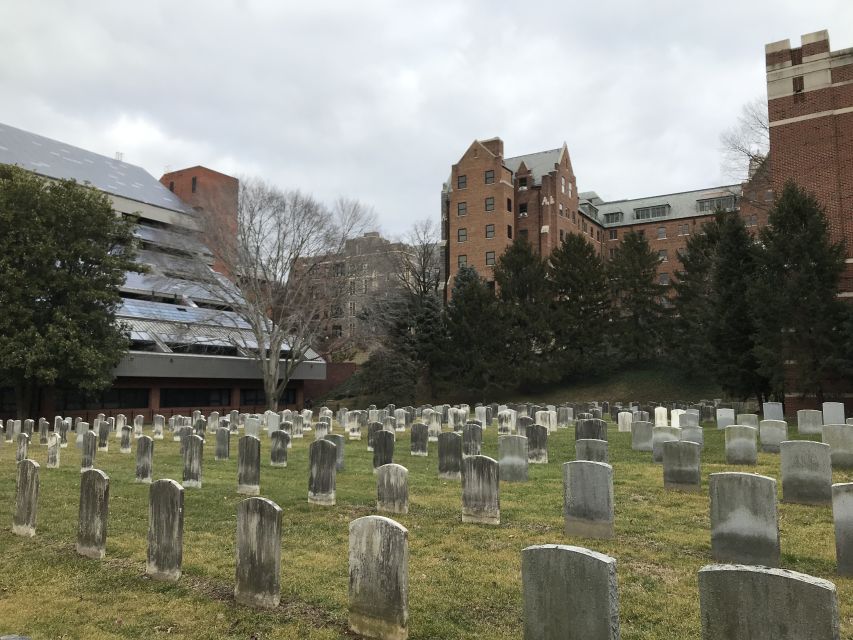
Next comes the Lydia English Seminary School for Girls, a boarding school that served the upper class. This is one of the more revealing stops because it opens a window onto education and social position. A school like this tells you that Georgetown was not simply a place where merchants stored goods. It was also a community where families invested in status and learning.
You should not expect to enter every building on the route. The experience is an outdoor walking tour, so much of the value comes from seeing façades and listening to the guide explain what happened there. If you enjoy interiors and museum displays more than street-level observation, the format may feel limited. For architecture fans, though, the street itself is the exhibit.
The Grafton Tyler Double House and Christ Episcopal Church
The Grafton Tyler Double House provides another chance to see how Georgetown’s homes were arranged and how neighboring residences could share a larger architectural presence. The name alone hints at a useful lesson: not every historic house was built as a completely separate mansion.
The stop also gives your guide a chance to talk about the people connected with these buildings and the social world they represent. Details like this are easy to miss on a self-guided walk, especially when several houses use similar brickwork and proportions.
You’ll then pass Christ Episcopal Church. Religious buildings help fill in the picture of community life, giving the route a change of scale after the residential houses. The church is part of the neighborhood’s long institutional story, alongside schools and university buildings later in the walk.
I would pay attention here to the contrast between private and public architecture. A house tells you about one family or household. A church tells you about a wider community. The tour works best when you notice these shifts rather than treating each stop as an isolated photo opportunity.
Same streets, read through a different style:
- Chicago Architecture River Cruise
★ 5.0 · 15,756 reviews - Chicago River 90-Minute Architecture Tour
★ 4.5 · 9,629 reviews - Chicago River: 1.5-Hour Guided Architecture Cruise
★ 4.8 · 8,046 reviews - Chicago Architecture Center River Cruise aboard First Lady
★ 5.0 · 5,536 reviews
Hyde-Addison School and the Yellow Tavern
The Hyde-Addison School adds another educational stop, but with a different role from the Lydia English Seminary School for Girls. Together, the two locations show that Georgetown’s schools served different groups and purposes over time.
This is where the tour’s broad range becomes valuable. You are not looking only at grand university buildings. You are also seeing places tied to everyday education, neighborhood life, and the way public institutions shaped the area.
The historic Yellow Tavern, also called the White Horse Tavern, brings the route back to food, drink, lodging, and social exchange. Taverns were practical places in an older urban district. They served people moving through the neighborhood and helped create the informal public life that grand houses and churches could not provide.
The two names can be confusing, so this is a good moment to listen closely to the explanation rather than relying on a quick photograph. The stop adds character because it reminds you that Georgetown’s past included ordinary meeting places, not just polished architecture.
Pomander Walk and its tiny pastel row houses
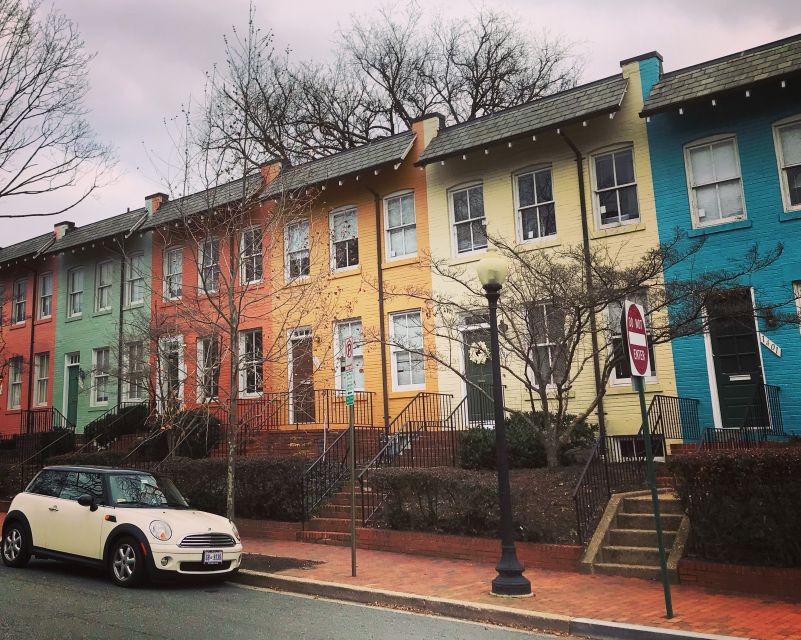
Pomander Walk is one of the tour’s more visually distinctive stops. The route passes a group of tiny, pastel row houses that look different from the larger brick residences elsewhere in Georgetown.
This is the kind of place that benefits from a guide. You can see the unusual scale and color on your own, but the story behind a planned group of small homes gives the scene more meaning. It also breaks up the tour’s emphasis on formal architecture with something more intimate and playful.
Bring your camera, but do not assume every stop allows unlimited time for photographs. One past participant specifically wished the group had waited a few extra minutes for pictures. That is a fair point: on a walking tour, the guide has to keep the group moving, and some locations invite more photos than the schedule may allow.
My advice is to take a quick overall shot first, then listen. If a detail matters to you, ask your guide for a moment when the explanation ends. Guides such as Sam and Ellyn have been noted for adding fun facts to the architectural material, which helps keep the walk from becoming a string of dry building descriptions.
Alexander Graham Bell’s Volta Laboratory
The route later reaches the place where Alexander Graham Bell founded Volta Laboratory. This stop expands the tour beyond Georgetown’s older brick homes and religious buildings. It shows the neighborhood as a setting for scientific and technical work, not merely a historic district frozen in the past.
The connection is especially useful because it gives you another way to understand Georgetown’s development. Commerce, education, religion, domestic life, and innovation all appear on the same walk. You begin to see the neighborhood as a functioning place with many layers rather than one preserved architectural style.
This is also a good example of why a guided route can beat a self-guided stroll. Without context, you might pass the location without knowing its connection to Bell. The guide supplies the link between an ordinary-looking address and a name known far beyond Washington.
Georgetown Preparatory School, Healy Hall, and the University Library
The academic portion of the tour includes Georgetown Preparatory School, Healy Hall, and the University Library. These destinations give the walk a stronger institutional feel after the houses, tavern, and smaller lanes.
Healy Hall is likely to catch your eye because it has the visual weight people expect from a major academic building. The University Library adds another part of the campus story, while Georgetown Preparatory School broadens the education theme beyond the university itself.
You will not spend the whole tour inside the university grounds. The important point is how the academic buildings fit into the surrounding neighborhood. Georgetown’s schools are not separate from its history. They are part of the reason the area remains active, recognized, and culturally important.
The tour also passes The Tombs, giving you a look at campus nightlife. This is a nice change of tone. After hearing about old schools and formal university architecture, you see a place connected with student social life. It keeps the route from presenting Georgetown as nothing but a collection of preserved façades.
The Car Barn and Georgetown’s changing uses
The Car Barn is a renovated streetcar depot. This stop is valuable because it shows how an older transportation building can gain a new life while retaining its place in the neighborhood’s story.
The building connects Georgetown to the practical systems that once moved people through Washington. Earlier, the C&O Canal represented the movement of goods. The Car Barn shifts the focus to street transportation and urban growth.
I like the sequence because it gives you a sense of change over time. Georgetown was shaped by trade routes, schools, homes, churches, taverns, laboratories, and transit. The architecture is not just decorative. It records what the neighborhood needed at different points.
The word renovated matters here. This is not a tour limited to untouched historic buildings. You will see places that have been adapted for later use, which makes the route more relevant to anyone interested in preservation and urban change.
The Francis Scott Key Memorial, Cady’s Alley, and the waterfront
Near the end, the tour reaches the Francis Scott Key Memorial and Cady’s Alley before finishing at the Georgetown Waterfront. These stops help bring together the neighborhood’s literary, commercial, and riverfront sides.
Cady’s Alley adds another change of setting after the academic buildings and older residences. The route shows that Georgetown has continued to adapt, with newer uses occupying spaces connected to older patterns of work and commerce.
The waterfront is a fitting endpoint. Earlier, the C&O Canal introduced Georgetown through trade and transportation. At the end, the Potomac gives you a broader view of the neighborhood’s setting and its relationship with the river.
Because the tour concludes at the waterfront, you can plan to continue your day nearby after the guide departs. The supplied information does not promise a meal stop or extra sightseeing, so plan your own next activity rather than expecting the tour to provide one.
Pace, guides, and the practical details
The tour runs in English with a live local guide. Past tour dates have been led by Sam and Ellyn, both noted for clear explanations, fun facts, and an engaging approach. You cannot assume which guide you will receive, but the format is designed around personal commentary rather than an audio recording.
A 150-minute duration is long enough to cover a substantial part of Georgetown without turning into an all-day commitment. At $43 per person, the value depends on how much you want interpretation. If you only want to photograph the streets, a free self-guided walk will cost less. If you want the reasons behind the buildings and the links between them, the price is easier to justify.
The tour’s strongest value comes from the range of stops. You get canal history, residential architecture, schools, a church, a tavern, a special group of row houses, a science connection, university buildings, nightlife, transportation history, and the waterfront in one route.
Wear comfortable shoes and bring water. The walk covers about 2 miles, and the tour runs in rain unless conditions are dangerous. Weather-appropriate clothing is not a small suggestion here. Georgetown’s streets may be easy to walk, but two and a half hours outside can feel long in poor weather.
The reservation terms are also friendly for changing plans. You can cancel up to 24 hours before the start for a full refund, and you can reserve now and pay later. Check the available starting times when booking.
Who should book this Georgetown walk?
I would recommend it to first-time visitors who want a solid introduction to Georgetown without spending a full day in a museum. It also suits repeat visitors who have walked the main streets before but want to understand the buildings and institutions they passed.
Architecture fans should get the most from the route, especially if they enjoy comparing homes, schools, churches, academic buildings, and converted public structures. It is also a good choice for anyone curious about how a neighborhood changes from working port to wealthy residential district.
Families and mixed-age groups may appreciate the steady pace and the variety of subjects. The walk is not focused on one narrow period, so the stories shift often enough to keep the route moving.
I would think twice if you dislike outdoor walking, need a fully indoor activity, or want generous time at every photo stop. The guide must maintain the route, and one practical suggestion is to ask for a brief pause when you want a picture of a particularly appealing building.
Should you book the Georgetown Architecture Walking Tour?
Book it if you want Georgetown explained rather than simply photographed. For $43, you get two and a half hours with a local guide, a route that reaches well beyond the obvious streets, and a useful thread connecting the canal, homes, schools, technology, university, transit, and waterfront.
Skip it if your priority is complete freedom to wander or if rain would spoil your day. For most visitors who enjoy architecture and local stories, this is a well-planned introduction with enough unusual stops to make the neighborhood feel more layered and memorable.
FAQ
How long does the Georgetown Architecture Walking Tour last?
The tour lasts 150 minutes, or two and a half hours.
How much walking is involved?
The tour covers about 2 miles on foot.
Where does the tour meet?
Meet your guide outside Baked & Wired in Georgetown. The guide will wear a DC Design Tour T-shirt.
What language is the tour conducted in?
The live guided tour is conducted in English.
What should I bring?
Bring comfortable shoes, water, and clothing suited to the weather.
Does the tour operate in bad weather?
The tour operates rain or shine unless conditions are dangerous.
What is included in the price?
A professional local guide is included. The price is $43 per person.
New to the itinerary around the USA
- Wilmington History and Architecture Tour★ 4.8 · 18 reviews
- Washington DC: Dupont Circle & Embassy Row Architecture Tour★ 5.0 · 6 reviews
- New Orleans : Garden District Architecture Walking tour★ 4.8 · 5 reviews
- Private Colonial Williamsburg Architectural Tour★ 5.0 · 5 reviews
- Tulsa: Art Deco Walking Tour of Tulsa★ 5.0 · 8 reviews
- Castle to Capitol: Museums of the National Mall Architecture Tour★ 4.5 · 9 reviews
- Monuments and Memorials Architectural Walking Tour★ 5.0 · 17 reviews
- Saint Augustine Evening Architectural Photo Tour★ 5.0 · 15 reviews
USA Architecture Tours, compared.
Chicago River: 1.5-Hour Guided Architecture Cruise
Read our review →
Chicago Architecture Center River Cruise aboard First Lady
Read our review →
Architecture River Cruise Skip-the-Ticket Line
Read our review →
Chicago River 45-Minute Architecture Tour from Magnificent Mile
Read our review →
45-Minute Family-Friendly Architecture River Cruise
Read our review →Other lists with this tour