
Review · SERBIA
Architecture of New Belgrade – Brutalism Decoded
New Belgrade is where Belgrade’s grand socialist experiment becomes easy to read. This private tour connects bold concrete buildings with the politics and ordinary routines that shaped them, from the Non-Aligned Movement to family life in Block 23. I especially like the close look at Genex Tower and the personal stories about life in the housing blocks during the 1960s, 70s, 80s, and difficult 90s.
I also like the practical format: you meet at the Museum of Contemporary Art, visit five important places, and finish at Sava Center. The main drawback is pace. The tour is advertised at about two and a half hours, but the planned stops are brief, and one poor experience described less than two hours with little explanation. Confirm the start time and allow for a brisk outing rather than a slow architectural seminar.
Key points at a glance
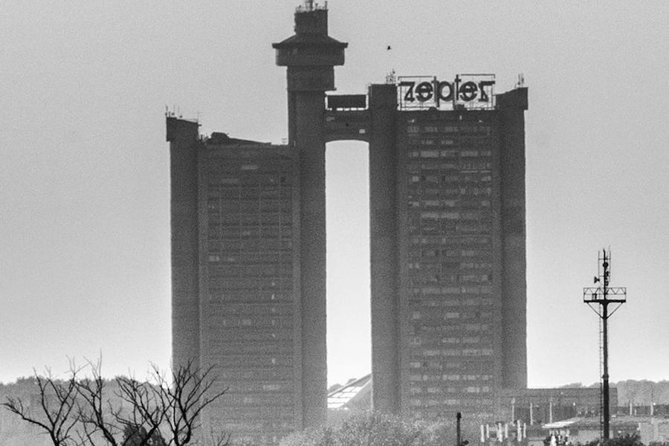
- Genex Tower up close: See Belgrade’s famous Western City Gate, a 30-floor pair of concrete towers with a dramatic skybridge and a place in international architectural writing.
- Architecture with human stories: Learn how schools, kindergartens, sports courts, shops, and apartments worked together inside Block 23.
- A private experience: Only your group takes part, giving you room to ask questions and shape the discussion.
- Modernism beyond gray concrete: The Museum of Contemporary Art uses costly marble facades and unusual 1960s forms that challenge simple ideas about socialist design.
- Politics in public space: The Park of Friendship links New Belgrade to the Non-Aligned Movement and its 1961 founding ceremony.
- A useful finish at Sava Center: Visit a working congress complex built in record time in the late 1970s, with interiors that still feel inventive.
Why New Belgrade deserves a closer look
Most first visits to Belgrade focus on the old fortress, the pedestrian center, and the riverside neighborhoods on the historic side of the Sava. New Belgrade tells a different story. Planned and built largely in the socialist period, it is a broad district of large housing blocks, public institutions, offices, transport routes, and open spaces.
That scale can be hard to understand from a casual walk. Buildings are separated by wide roads and generous stretches of land, so you may notice the size without seeing how the pieces fit together. This tour gives you a framework. It explains not only the shape of the buildings, but also the political aims and daily life behind them.
The focus is brutalism and related forms of modernist concrete architecture. Yet the tour does not treat every building as a plain slab of concrete. The Museum of Contemporary Art introduces polished materials and sculptural volumes. Sava Center shows how a large public building could use concrete, glass, and carefully planned interior spaces for a civic purpose.
You should come with some interest in architecture, modern history, or city planning. You do not need specialist training. The private format is useful here because you can stop to ask why a building looks the way it does, or how people actually used the district.
More Bauhaus and Brutalist Architecture Tours in the world:
- Brutalist Tbilisi: Urban exploration and untold stories
★ 5.0 · 82 reviews - London: Brutalist Architecture & History Walking Tour
★ 4.8 · 42 reviews - Le Corbusier’s Chandigarh : A Complete Architecture Tour
★ 4.7 · 25 reviews
Meeting at the Museum of Contemporary Art
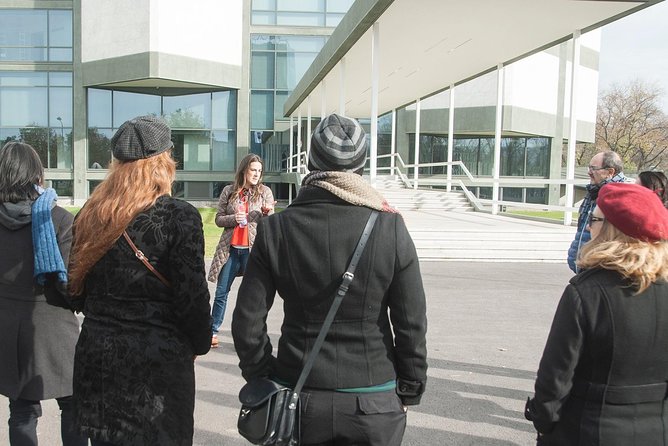
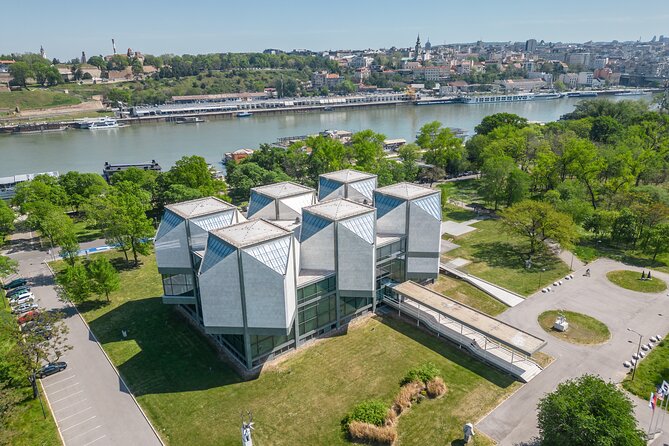
The tour begins in front of the Museum of Contemporary Art at Ušće, at Ušće 10. This is an easy meeting point, and the museum provides a fitting introduction to the subject. You do not simply begin with a giant housing block. You start with a major cultural building from the 1960s.
The museum’s modernist volumes are compact, geometric, and carefully composed. Its marble facades are especially useful for understanding the limits of the usual socialist-architecture stereotype. Socialist public buildings were not all rough concrete structures designed without concern for finish. Here, expensive marble and a strong sculptural form signal cultural ambition.
You should note that admission to the museum is not included. The tour’s museum stop is an exterior architectural visit, based on the information provided. If you want to see the art collections inside, treat that as a separate plan and allow extra time.
The scheduled stop is about 20 minutes. That is enough for an introduction and a close look at the exterior, but not enough for a full architectural lecture or museum visit. If the facade interests you, use the private setting to ask about its materials, form, and place in 1960s Belgrade.
The Park of Friendship and the Non-Aligned story
From the museum, the tour moves to the Park of Friendship, or Park Prijateljstva. The stop lasts about 15 minutes and is free to enter. Its value is less about monumental architecture and more about the political meaning of New Belgrade’s public spaces.
In 1961, heads of state planted trees here as symbols of peace. The event connected Belgrade to the Non-Aligned Movement, which brought together 120 countries. That context matters because Yugoslavia followed a political path that was not simply a copy of the Soviet model or the Western model.
The park gives your guide a chance to explain how international politics shaped the city. New Belgrade was not only a housing project. It was also a stage for a country presenting itself as independent, modern, and active in world affairs.
This is a short stop, so expect a focused explanation rather than a long walk through the park. The setting also helps you see why open space mattered in the planning of New Belgrade. Broad areas between major buildings were part of the design, not leftover ground.
A drive past the Government Building
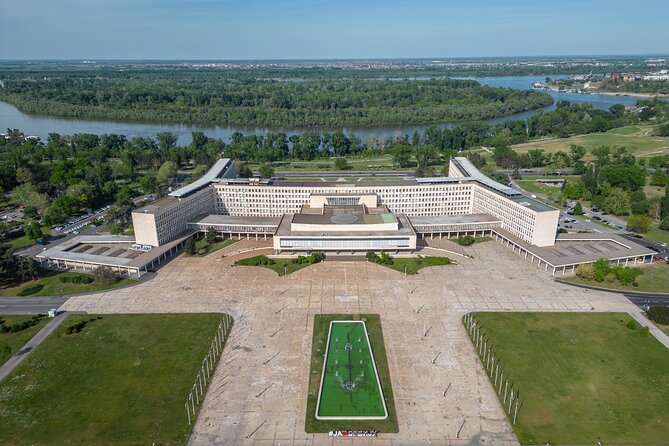
The route includes a drive past the large Government Building. It is not listed as a full numbered stop, so you should expect to see it from the route rather than spend a long period walking around it.
The building reflects an earlier phase of Yugoslav politics. Construction began before the country’s break away from Stalin, and the political shift happened while the project was still underway. That makes the building a useful visual marker of change. Its story shows that architecture can record a political turn even when the concrete work continues.
This brief pass-by is one reason the private vehicle portion matters. New Belgrade’s major sites are spread out, and the ride lets you connect them without spending the whole experience walking beside wide roads. The tradeoff is that you may not get much time to study this particular building.
More Architecture Tours around the world:
- Chicago Architecture River Cruise
★ 5.0 · 15,756 reviews - Chicago River 90-Minute Architecture Tour
★ 4.5 · 9,629 reviews - Chicago River: 1.5-Hour Guided Architecture Cruise
★ 4.8 · 8,046 reviews - Barcelona: Park Güell and Gaudí House Museum Entry Ticket
★ 4.5 · 6,326 reviews
Genex Tower, the Western City Gate
The stop at Narodnih heroja 45 brings you close to Genex Tower, also called the Western City Gate of Belgrade. This is likely the tour’s most immediately memorable building. The 30-floor complex uses two tall structures linked by a high passage, creating a strong gateway effect at the western entrance to the city.
You get about 20 minutes here, with no admission charge. That should give you time to take in the composition, photograph the tower, and hear why it matters in architectural terms. Built about 40 years before the tour information was written, it was described as the first smart building in the Balkans and received attention in international architecture reviews.
The term smart building may sound modern, but here it refers to the building’s advanced planning and technology for its period. Ask your guide what systems earned it that description, since the supplied tour details do not spell them out.
Genex Tower is also a good example of why a local guide helps. From a distance, you may see an imposing pair of towers. With context, you can read the building as infrastructure, symbol, and urban gateway. The shape was not an accidental oddity. It gave the western approach to Belgrade a clear visual identity.
The tower is a close-up stop, but do not expect a visit inside. No interior admission is included, and the stop is designed around the exterior and its architectural story.
Sava Center and the late 1970s
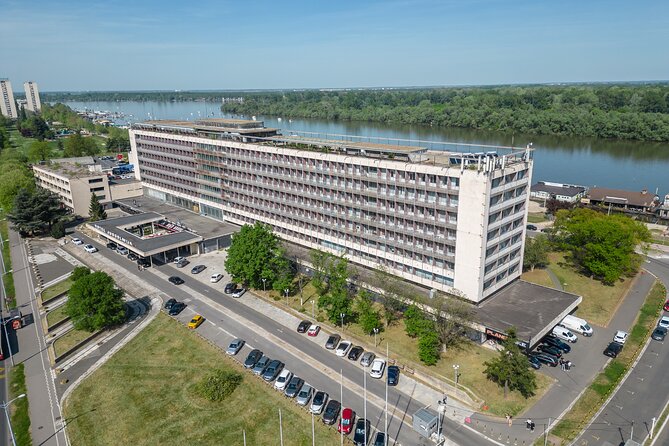
The tour finishes at Sava Center, at Milentija Popovića 9. This large congress center was built in record time at the end of the 1970s and was the first building of its type in this part of Europe.
Its importance lies partly in its function. Sava Center was designed for major conferences and remains in use. It represents Yugoslavia’s wish to host international events at a serious scale, not simply to provide offices or apartments.
You receive about 15 minutes here. That is enough for a concise look at the building and selected interior solutions, but you should not expect a full guided tour of every hall. The information provided describes the interiors as surprisingly well designed and still fresh after 40 years. That is worth paying attention to, especially if you usually think of brutalism as an exterior style only.
The ending works well because Sava Center shifts the focus from residential planning to public events. It also gives you a clear finish point near public transportation. If you want to continue exploring New Belgrade afterward, you can use the center as your next reference point.
Block 23 and the idea of a complete neighborhood
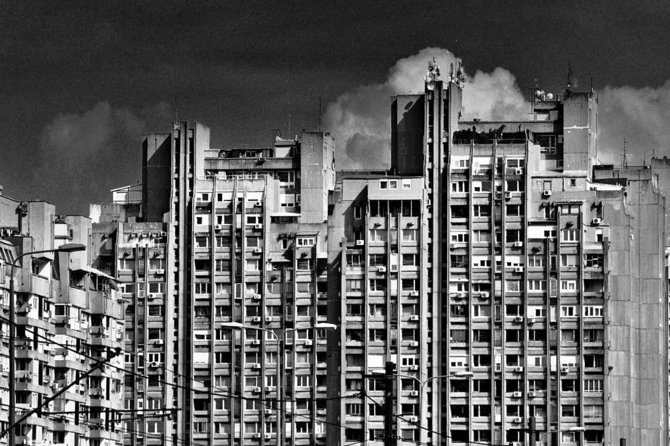
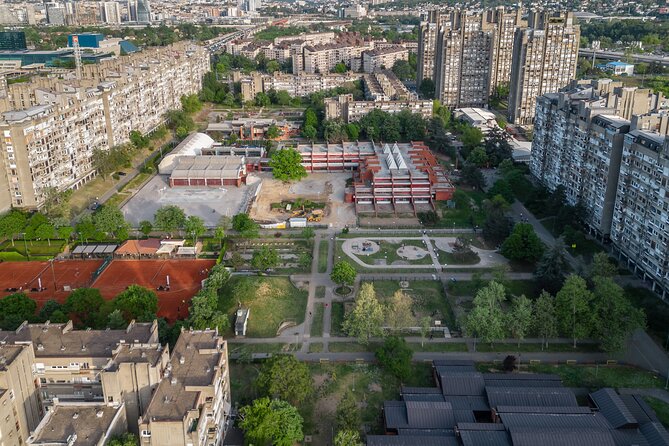
The final numbered stop is Primary School Laza Kostić in Block 23. This is where the tour moves closest to everyday life. Block 23 is presented as the most representative public housing project on the route, built in a style described as concrete expressionism.
The important point is not just the appearance of the apartment towers. The block was planned as a complete neighborhood, with housing, a school, a kindergarten, sports courts, and a small shopping mall. In theory, residents could handle much of daily life without crossing the whole city.
That arrangement helps you understand the ambition of New Belgrade. The district was meant to provide more than shelter. It was designed as a social system, with essential services placed near homes. You can look at the school and surrounding buildings with that idea in mind.
This stop also carries the strongest personal element. Guide Xenia has shared stories about life in the blocks during their golden decades of the 1960s, 70s, and 80s, along with the much harder experience of the 1990s. Those details can make a large housing project feel less abstract. You begin to picture school days, shopping, sports, neighbors, and the changes that came with political and economic crisis.
The stop is scheduled for about 15 minutes. That is short for a block with so much to discuss. Still, it may be the part that gives the tour its human scale. If you care more about how people lived than about facade details, ask for extra explanation here.
How much does the private tour offer for $86.42?
At $86.42 per person, this is not a budget sightseeing walk. The price makes more sense if you value a private guide, transportation between scattered sites, and a focused subject that is difficult to piece together on your own.
You are paying for interpretation as much as access. The buildings are visible from public roads, and you could photograph Genex Tower or Sava Center without a ticket. The harder task is connecting those places to Yugoslav politics, Non-Aligned diplomacy, planning ideas, and daily life in the blocks.
The private format improves the value for people who ask questions or want to set the pace. It also avoids the broad, one-size-fits-all commentary common on large group outings. You should not expect a museum ticket, a long interior visit, or an all-day architectural study at this price. Think of it as a compact guided introduction.
The overall rating is 4.6 from 24 ratings, with 92 percent recommending the experience. The strongest praise centers on the guide’s timing, personal approach, and ability to explain how people lived inside the buildings. One very negative account described a tour that lasted less than two hours and felt poorly prepared. Since the planned stops are already brief, confirm the expected duration when you book and make sure you arrive on time.
Timing, transport, and who should book
The experience lasts approximately two hours and 30 minutes. The listed stop times add up to about 85 minutes, so the remaining time is used for travel and transitions between sites. That is sensible for New Belgrade, where the attractions are spread across a large planned district.
You meet at the Museum of Contemporary Art and finish at Sava Center. Both points are near public transportation. The end point is useful if you want to continue around New Belgrade or return toward central Belgrade.
Most people can participate, according to the provided details. The tour is private, offered in English, and uses a mobile ticket. Confirmation arrives at booking. Free cancellation is available if you cancel at least 24 hours before the local start time. Changes or cancellations inside that window are not accepted for a refund.
I would recommend this for:
- Architecture fans who want more than old churches and fortress walls
- Visitors curious about Yugoslavia and the Non-Aligned Movement
- People who prefer a private guide to a large group
- Anyone interested in how schools, shops, sports, and housing were planned together
- Repeat visitors looking for a different side of Belgrade
I would be more cautious if you want long interior visits, a relaxed walking pace, or a broad city history tour. The subject is specific, and the schedule moves quickly.
Should you book Architecture of New Belgrade?
Book it if Genex Tower, socialist modernism, and the practical design of public housing sound more interesting than another standard city-center walk. The strongest reason to go is the link between architecture and ordinary life. You do not just see concrete forms. You learn what the blocks tried to provide and how their meaning changed over time.
The private format and guide Xenia’s personal stories add real value, especially at Block 23. The Museum of Contemporary Art, Park of Friendship, Government Building, Genex Tower, Sava Center, and Laza Kostić School also give the outing a clear arc from culture and diplomacy to housing and public life.
Book with realistic expectations. This is a compact two-and-a-half-hour introduction, not a full-day study of every New Belgrade building. Confirm the timing, arrive at the museum on schedule, and use the private setting to ask questions. If you do that, the price is reasonable for a specialized, off-center look at how Belgrade grew in the socialist era.
FAQ
Where does the tour begin?
The tour begins in front of the Museum of Contemporary Art at Ušće 10 in Belgrade.
Where does the tour end?
The tour ends at Sava Center, at Milentija Popovića 9, Belgrade 11000.
How long does the experience last?
The stated duration is approximately two hours and 30 minutes.
Is the tour offered in English?
Yes. The tour is offered in English.
Is this a private tour?
Yes. Only your group participates in the activity.
How many buildings will I visit?
The tour includes visits to five buildings along the route, including the Museum of Contemporary Art, Genex Tower, Sava Center, and Primary School Laza Kostić. You also drive past the Government Building.
Is admission to the Museum of Contemporary Art included?
No. Admission to the Museum of Contemporary Art is not included. The tour begins outside the museum and examines its architecture.
Is there a fee to enter the Park of Friendship, Genex Tower, Sava Center, or Primary School Laza Kostić?
The provided tour details list admission as free for these stops.
Can I cancel for a full refund?
Yes, if you cancel at least 24 hours before the experience’s local start time. Cancellations or changes made less than 24 hours before the start are not refunded.
New to the itinerary around the world
- Washington, DC: Georgetown Architecture Walking Tour★ 5.0 · 8 reviews
- Wilmington History and Architecture Tour★ 4.8 · 18 reviews
- Walk & Discover KL’s Architectural and Heritage Gems★ 5.0 · 7 reviews
- Washington DC: Dupont Circle & Embassy Row Architecture Tour★ 5.0 · 6 reviews
- New Orleans : Garden District Architecture Walking tour★ 4.8 · 5 reviews
- Unveiling Brno: History, Culture & Architectural Delights★ 5.0 · 2 reviews
- Vicenza: Palladian Architecture Private Walking Tour★ 3.3 · 3 reviews
- Private Colonial Williamsburg Architectural Tour★ 5.0 · 5 reviews
Bauhaus and Brutalist Architecture Tours, compared.
Brutalist Tbilisi: Urban exploration and untold stories
Read our review →
Le Corbusier’s Chandigarh : A Complete Architecture Tour
Read our review →
Secret Split: Socialist Architecture & brutalism – Urban Utopia
Read our review →
Tashkent Soviet Architecture (Modernism) and Subway station tour.
Read our review →
Belgrade: Space architecture tour – brutalist architecture
Read our review →
USSR History, Soviet Architects ,Statues & Mosaics
Read our review →
Brutal Tbilisi — Night Edition: Dark Side of Soviet Architecture
Read our review →Other lists with this tour