
Review · ITALY
Caprarola: Villa Farnese, masterpiece of Renaissance architecture
Palazzo Farnese is the kind of place that rewards curiosity. From the outside, it looks like a severe pentagonal fortress above Caprarola. Inside, it opens into a lavish world of painted ceilings, grand stairways, maps, symbols, and rooms built to impress powerful cardinals and popes. Vignola’s design is the real star, but the frescoes give the building its voice.
I like the way this visit joins architecture with art, rather than treating the palace as a pretty shell. I also like the chance to finish in the Italian Renaissance gardens, where fountains, statues, cypress trees, and chestnut woods offer a change of pace after the crowded rooms.
The main drawback is its location. This is not a Rome attraction, and the palace is in Caprarola near Viterbo, roughly 60 kilometers from Rome. You need to reach the meeting point yourself, and the narrow streets can make driving stressful. The palace also has very little furniture, so this suits you best if painted walls, architecture, and history matter more than period furnishings.
Key points to know before booking
- Vignola’s pentagonal design: See one of Italy’s most unusual Renaissance residences, built with the stern shape of a fortress.
- Frescoes in nearly every room: Painted walls and ceilings carry classical, religious, geographic, and political themes.
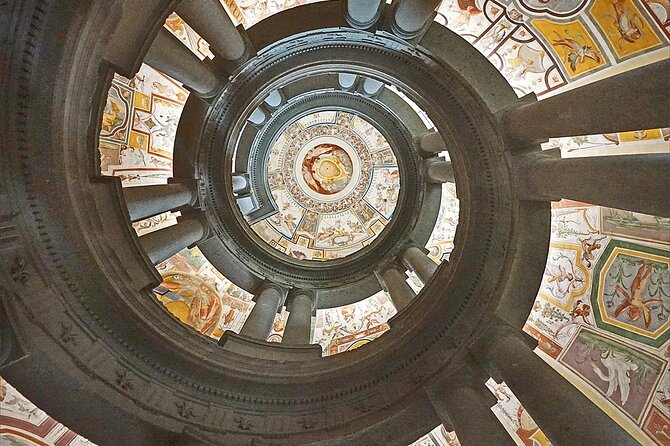
- The grand Scala Regia: Follow the ceremonial staircase associated with Cardinal Alessandro Farnese.
- The Hall of Angels and map room: Listen for the famous echo, then study the sixteenth-century view of the known world.
- Gardens above Caprarola: Continue outdoors to fountains, statues, woodland, cypress trees, and an upper hunting lodge.
- Private English-language format: Your group tours alone, with admission included and a visit lasting about 90 minutes.
Why Palazzo Farnese feels different from an ordinary villa
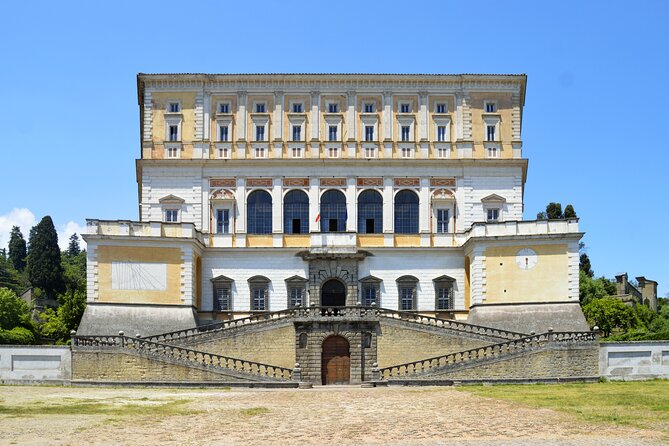
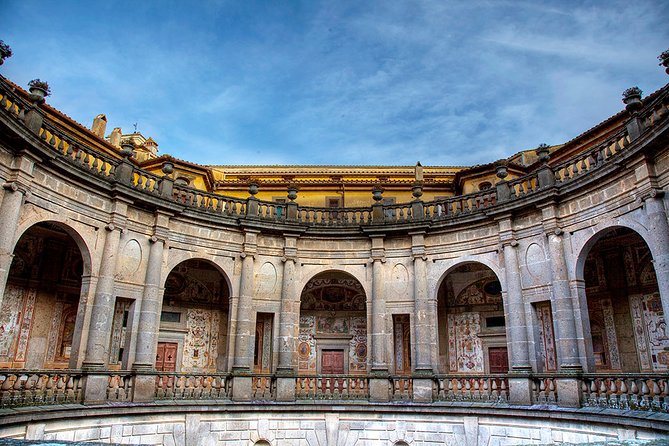
Many Italian palaces are long, formal blocks set in a square. Palazzo Farnese takes another approach. Its five-sided plan gives it the look of a military stronghold, an important reminder that Renaissance power was not only about comfort and beauty. A cardinal’s home also needed to suggest control.
The building was designed by Giacomo Barozzi da Vignola, one of the leading architects of the Italian Renaissance. His work here is practical and theatrical at the same time. The geometry controls the movement of the building, while the painted rooms turn that structure into a stage for the Farnese family.
You will notice this contrast as soon as you enter. The exterior feels solid and defensive. The inside is filled with scenes, ornaments, symbols, and visual surprises. The effect is not a simple country retreat. It is a carefully planned statement of rank.
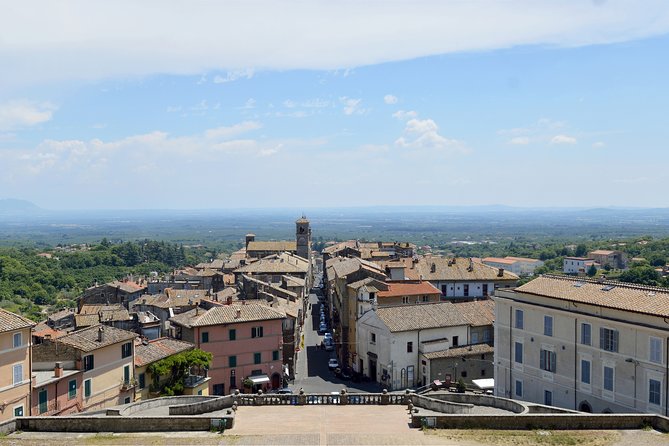
The palace dominates Caprarola and looks out across the surrounding countryside. That position matters. From the terraces and upper areas, you can see why this was an ideal site for a powerful family residence. The setting connects the building to the town below and to the broad views beyond it.
More Architecture Tours around Italy:
- Lecce: Baroque Architecture and Underground Walking Tour
★ 4.6 · 1,248 reviews - Experience Florence’s Art and Architecture on a Walking Tour
★ 5.0 · 318 reviews - Palermo: Art and Architecture Walking Tour
★ 4.7 · 136 reviews
Following Vignola’s staircase into the palace
One of the first major sights is the Scala Regia, or royal staircase. This is not a narrow service stair hidden away at the back of the house. It was designed as a grand arrival route for Cardinal Alessandro Farnese and is part of the palace’s showmanship.
As you climb, look at how architecture, painting, and movement work together. The staircase was meant to make a visitor feel important, but also to remind that visitor who held power. It is one of those places where the route through a building is as meaningful as the room at the end.
The stairway is especially useful for understanding Vignola’s approach. He did not simply add decoration to an existing structure. He shaped the whole experience, from the building’s unusual outline to the way a person approaches the main apartments.
A guide can make a real difference here. Serena is the guide specifically named in the tour feedback, and her explanations are described as particularly helpful in connecting the images with the palace’s history and purpose. If she is leading your visit, you can expect detailed context rather than a quick list of room names. Since the tour is private, you can also ask about details that catch your eye.
The frescoed rooms, from classical scenes to political power
The state rooms and reception halls are the heart of the visit. They are decorated with sixteenth-century frescoes and grotesques, and the painted surfaces cover walls and ceilings with little empty space. You may find classical figures beside religious references, allegories, decorative patterns, and scenes meant to praise the Farnese family.
There is little furniture inside. That can initially make the rooms feel bare, especially if you expect a palace filled with beds, cabinets, tapestries, and tables. In practice, the lack of furniture lets the painted architecture take over. Your attention goes upward and outward, to ceilings, wall panels, painted columns, and the shape of each room.
You should plan to look slowly. A quick walk through will show you color and scale, but not much meaning. The images were chosen for a reason, and a guide can explain how they relate to family ambition, religious authority, classical learning, and the public image of the Farnese.
The range of subjects is one of the palace’s strongest features. This is not a building decorated with one repeated pattern. Each room has its own mood and visual program, so the visit keeps changing as you move through it.
The Hall of Angels and the palace’s theatrical tricks
The Sala degli Angeli, or Hall of the Angels, is known for its echo. The room adds a playful touch to an otherwise formal palace, and you may notice the sound carrying in an unexpected way.
This is a small detail, but it helps you understand how carefully the building was planned. Palazzo Farnese was designed to impress through more than size. Perspective, sound, height, movement, and decoration all had a role.
The reception areas also show how the palace worked as a place for ceremony. These were not merely private living rooms. They were spaces for receiving important people, presenting authority, and displaying the education and taste expected of a Renaissance court.
I would give yourself time to stand still in these rooms. The palace is easy to approach as a series of grand pictures, but the better experience comes from noticing how the rooms direct your eyes and control your route.
Same streets, read through a different style:
- Naples: San Gaudioso Catacombs Guided Tour
★ 4.7 · 1,105 reviews - Best of Bologna in one day : Food, architecture, art and history
★ 5.0 · 27 reviews - Private Tour: Venice Art and Architecture Walking Tour
★ 4.0 · 22 reviews - City Walk with Architect: Private walking tour of Rome
★ 5.0 · 22 reviews
The map room and the Farnese view of the world
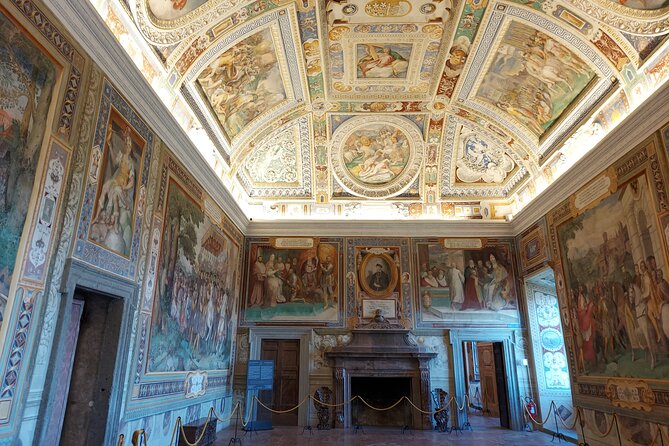
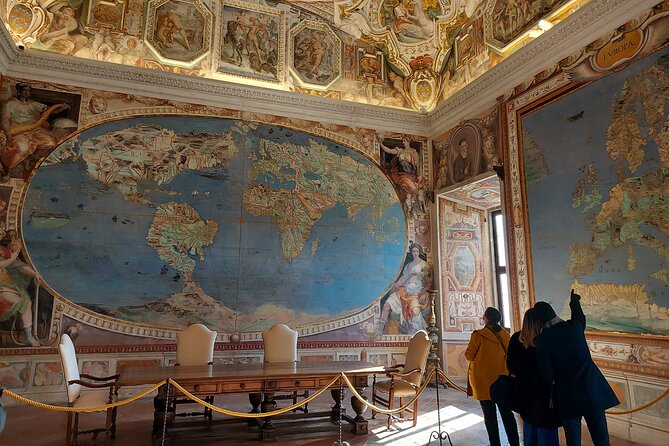
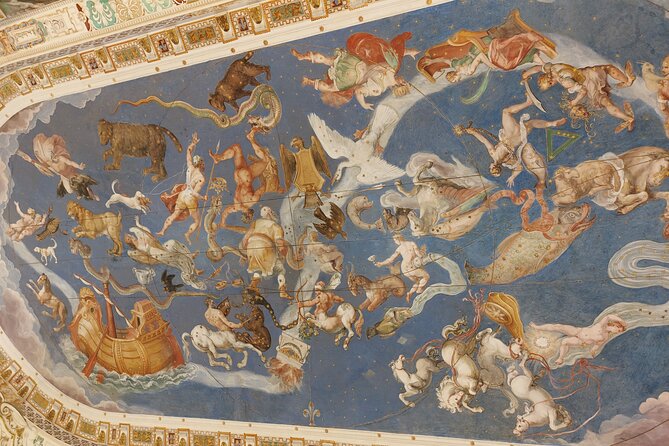
The room that often stays with visitors longest is the map room, decorated with maps dating from around 1573. It reflects the geographic knowledge available in the late sixteenth century and gives you a clear look at how the papacy and powerful church families viewed the wider world.
The map paintings are valuable for two reasons. First, they are visually striking. Second, they show that geography was part of political power. To display maps of continents and distant regions was to display access to information, education, and authority.
You can also use this room to put the rest of the palace in context. The Farnese were not simply commissioning decoration for decoration’s sake. The rooms present a family connected with church power, learning, diplomacy, and public influence.
A guide is especially useful here. Without explanation, you may see a beautiful painted map and move on. With context, you can pay attention to what is included, what is missing, and how the room presents the world as it was understood at the time.
From the palace to the Renaissance gardens
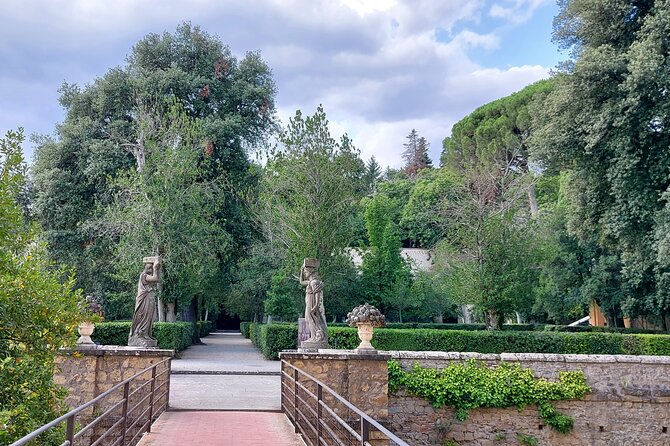
The visit ends in the gardens, and this is a welcome change after the enclosed, highly decorated rooms. You will see statues, fountains, cypress trees, chestnut woods, and paths leading toward the upper garden areas.
The gardens are not just an ornamental afterthought. They extend the palace’s design into the open air, using terraces and height to connect the residence with the surrounding countryside. The climb to the smaller upper villa or hunting lodge is worth considering if you have the time and energy.
The outdoor areas do have limitations. Some parts may be closed for restoration, and fountains or water features may not always be operating. Maintenance of statues and garden details can also be uneven. You should come for the architecture, frescoes, and setting first, with the garden as an added part of the experience rather than a perfectly maintained formal park.
Even so, I would not skip the gardens. They provide the best chance to pause, enjoy the views, and see how the palace was meant to relate to the land around it.
What the 90-minute tour includes
The advertised visit lasts about one hour and 30 minutes. That is enough time for the main palace route and a look at the gardens, but it is not a full-day exploration of every corner of the property.
Admission to Palazzo Farnese is included. The format is private, so only your own group participates. That matters if you want to ask questions, move at a comfortable pace, or focus on particular rooms rather than follow a large group.
Some people have spent two hours or more around the palace, especially when exploring the gardens independently after the guided portion. If you are interested in the upper garden and hunting lodge, allow extra time beyond the stated 90 minutes.
The experience is offered in English. Confirmation is normally sent at booking, though reservations made within two days of the visit may require up to 48 hours for confirmation, subject to availability.
Getting to Caprarola without a wrong turn
Pay close attention to the location. The meeting point is Via Filippo Nicolai 1, 01032 Caprarola, in the province of Viterbo. The attraction is not in Rome, despite the fact that many visitors combine it with a Rome-based trip.
Caprarola is about 60 kilometers from Rome, and the palace is in the town near Lake Bracciano and Viterbo. The information provided for the tour indicates that the site is most accessible by car. You should not assume that the booking includes transport, a transfer from Rome, or a return ride.
Driving into the town can involve narrow streets, so allow extra time and check your route carefully. The meeting point is clearly tied to Caprarola, and a simple reading of the address is important. If you arrive at the wrong city, the tour cannot solve that problem at the last minute.
This is one of those outings where planning matters almost as much as the ticket. Save the address, check the route before departure, and make sure everyone in your group knows that the destination is Caprarola, not central Rome.
Is $138.16 good value?
At $138.16 per person, this is not a low-cost palace admission. The value depends on what you are buying. You are paying for a private English-language experience, not only entry to the building.
If you would otherwise enter alone, read limited signs, and miss the meaning behind the frescoes, the guide can make the difference between seeing decoration and understanding the building. That matters particularly in the map room, the ceremonial staircase, and the rooms filled with classical and religious references.
The price is harder to justify if you only want a quick look at the palace and do not need explanation. The visit itself is relatively short, and the building’s lack of furnishings may disappoint you if you prefer domestic interiors.
Group discounts may be available, so check the final price for your party before deciding. For a small group that values private guiding and has a strong interest in Renaissance art, the cost can make sense. For a solo visitor focused mainly on a low admission price, it may feel high.
Who should book this Caprarola visit?
I would recommend it to you if you enjoy Renaissance architecture, frescoes, church history, symbolic art, or unusual historic buildings. It is also a good choice if you have already seen Italy’s headline sights and want a quieter day trip with a strong sense of place.
Families can take part, since most people can participate, but younger children may have limited patience for a palace with few furnishings. The gardens provide a change of scene, and the echo in the Hall of Angels can add a memorable moment.
Art-minded visitors will get the most from the tour. You do not need a specialist background, but you should be willing to look closely and listen to explanations. The palace rewards attention more than speed.
You should think twice if you are staying in Rome without a car, have only a short window between city sights, or expect a furnished royal residence. The distance, meeting point, and narrow roads make this a planned excursion rather than a casual stop.
Should you book Palazzo Farnese in Caprarola?
Book this tour if you want a focused, private introduction to one of Italy’s most unusual Renaissance palaces. The strongest reasons are Vignola’s pentagonal design, the frescoes that fill the state rooms, the map room, the grand staircase, and the gardens that carry the visit outdoors.
I would choose the guided format over a bare visit if you are not already familiar with Renaissance symbolism. The paintings can look overwhelming at first, and good explanations help you see how architecture, art, geography, and Farnese power fit together.
Skip it if you need a Rome-centered activity or if the $138.16 price does not suit your budget. If you do book, remember the essential point: you are going to Caprarola near Viterbo, not Rome. Free cancellation is available up to 24 hours before the start time, but changes or cancellations made later are not accepted for a refund.
FAQ
Where is Palazzo Farnese located?
Palazzo Farnese is in Caprarola, near Viterbo, in Italy. The meeting point is Via Filippo Nicolai 1, 01032 Caprarola VT, Italy.
Is Palazzo Farnese in Rome?
No. The palace is in Caprarola, about 60 kilometers from Rome. The meeting point and activity are in Caprarola, not in the city of Rome.
How long does the tour last?
The scheduled experience lasts approximately one hour and 30 minutes. You may need extra time if you want to explore the gardens and upper areas independently.
What is included in the price?
Entry tickets to Palazzo Farnese in Caprarola are included. The listed price is $138.16 per person.
Is the tour private?
Yes. Only your group participates in the private tour or activity.
Is the tour offered in English?
Yes. The experience is offered in English.
Is transportation to Caprarola included?
The provided details include palace admission but do not list transportation. You should arrange your own way to the meeting point.
Can most people participate?
Yes. The activity information states that most people can participate.
What is the cancellation policy?
You can cancel up to 24 hours before the experience starts for a full refund. Cancellations or changes made less than 24 hours before the start time are not accepted for a refund.
New to the itinerary around Italy
- Vicenza: Palladian Architecture Private Walking Tour★ 3.3 · 3 reviews
- Architectural Milan: Private Tour with a Local Expert★ 4.5 · 2 reviews
- The Architect’s Water★ 4.5 · 11 reviews
- Architectural Florence: Private Tour with a Local Expert★ 5.0 · 3 reviews
- Rione Sanità: tour among street art, architecture, folklore★ 4.5 · 2 reviews
- Palermo Tour: Magnificent Mixture Of Architectural Styles★ 4.2 · 6 reviews
- Discover Coppedè in Rome: Liberty architecture, symbols, and jewels★ 5.0 · 2 reviews
- Bologna: Guided Architecture Walking Tour★ 4.5 · 2 reviews
Italy Architecture Tours, compared.
Lecce: Baroque Architecture and Underground Walking Tour
Read our review →
Experience Florence’s Art and Architecture on a Walking Tour
Read our review →
Best of Bologna in one day : Food, architecture, art and history
Read our review →
City Walk with Architect: Private walking tour of Rome
Read our review →
Private Tour: Venice Art and Architecture Walking Tour
Read our review →
Basilica San Marco and the Pala d’Oro with Architect Guide
Read our review →Other lists with this tour