
Review · ITALY
Lecce: Baroque Architecture and Underground Walking Tour
Lecce’s best lesson is written in stone. This 90-minute walk links the city’s wild Baroque carvings with Roman ruins and an underground Jewish Museum, giving you a useful sense of how several eras fit together. I especially like the route through Santa Croce and Piazza Sant’Oronzo, followed by the grand theatrical setting of Piazza Duomo.
I also like the local touch. Guides such as Max, Massimiliano, Fabrizio, Angela, and others explain the city with stories, humor, and practical context rather than simply naming buildings. The main drawback is that the underground museum is a modest part of the tour, and the walk generally visits church exteriors rather than taking you inside them.
Key points to know before booking
- Three layers of Lecce in 90 minutes: Roman remains, Jewish heritage, and Baroque architecture are all covered.
- Santa Croce is the visual high point: You see the church from outside and learn how to read its crowded stone facade.
- The underground Jewish Museum adds a different side of Lecce: It is more about archaeology and Jewish life than a large collection of religious objects.
- Piazza Duomo is the grand finale: The cathedral, bell tower, seminary, and archbishop’s residence form one carefully framed square.
- Guide quality is a major strength: Max and Massimiliano are often singled out for clear explanations, humor, and an easy pace.
- Plan for a walking introduction, not a church-inspection tour: Entry to the Jewish Museum is included, while church admission may require a separate ticket.
Why this short walk works in Lecce
Lecce can seem like a city built from one continuous block of honey-colored stone. Look closer, and the story gets more interesting. Roman public buildings sit beside Baroque churches. Jewish history survives below the modern street level. Grand palaces line streets that still function as everyday routes.
That is why I find this tour useful early in a stay. In an hour and a half, you get a map of the old center and a set of clues for exploring on your own later. You will know which buildings deserve a second look, which Roman remains to seek out, and why Lecce’s Baroque style feels so different from the more restrained architecture found elsewhere in Italy.
The tour costs $29 per person. That is a fair price if you want a local explanation and the Jewish Museum admission included. It is less compelling if you only want a quick stroll or plan to buy a separate church pass and explore every interior independently.
The experience is offered as a shared group or private tour. The exact meeting point can vary by option, so check your booking details carefully. There is no hotel pickup, and food and drinks are not part of the standard price.
More Walking Tours in Italy
- Experience Florence’s Art and Architecture on a Walking Tour
★ 5.0 · 318 reviews - Palermo: Art and Architecture Walking Tour
★ 4.7 · 136 reviews - City Walk with Architect: Private walking tour of Rome
★ 5.0 · 22 reviews
Santa Croce and the art of Lecce’s Baroque stone
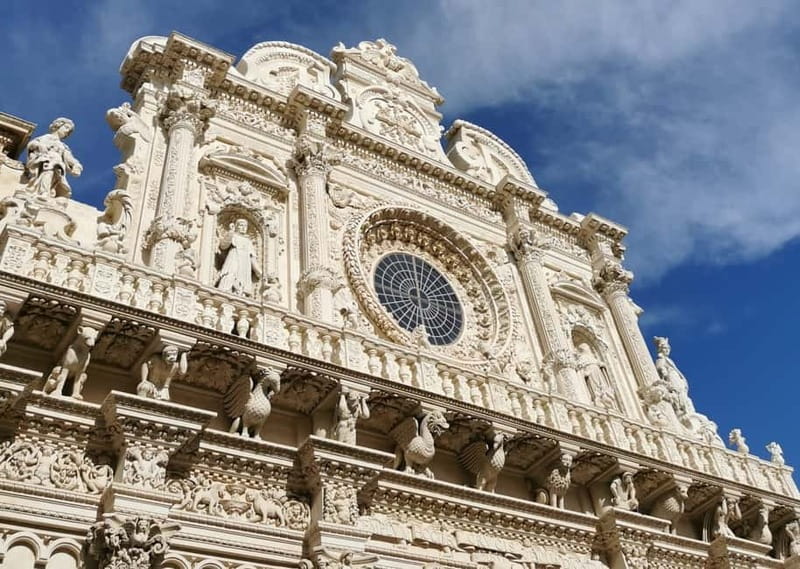
The walk begins with an exterior visit to the Basilica of Santa Croce, one of Lecce’s most striking buildings. The facade is crowded with columns, figures, animals, plants, shields, and curling stonework. It is not a building you absorb in one glance.
This is where a guide earns the walking fee. Without context, the facade can look like decorative overload. With an explanation, you can start to notice the balance between the lower section and the more theatrical upper level, along with the way local limestone allowed craftsmen to carve fine details.
The tour does not normally include entry into Santa Croce. That matters if the interior is your main goal. Some people specifically wish for more church access, and a separate church ticket may be a better choice for you if you want to inspect chapels, paintings, and interiors after the walk.
Still, the outside view gives you the essential introduction. Your guide can point out the character of Lecce’s Baroque style, where decoration is not a side note but the main event. Guides named Max, Antonio, and Massimiliano have been especially effective at adding anecdotes and explaining what you are looking at without turning the stop into a dry lecture.
Piazza Sant’Oronzo and Lecce’s Roman core
From Santa Croce, the route continues to Piazza Sant’Oronzo, the old market square and one of the city’s main meeting places. This is where Lecce’s Roman past becomes visible in the middle of modern city life.
You will see the Roman Column, a surviving marker from the ancient city, along with the remains of a large Roman amphitheater. The amphitheater is partly below the present street level, which makes the site a useful reminder that Lecce has been built and rebuilt over earlier layers.
The Roman material is not treated as a separate archaeological stop. Instead, it is tied to the way the city developed around it. That approach helps you understand why ancient remains appear in open squares and beside working streets rather than inside one neatly separated museum.
The condition of some sites can vary during restoration and excavation work. Parts of the amphitheater and nearby buildings may be affected by ongoing projects, so do not expect every section to look exactly like a finished archaeological park. You will still get a strong view of how Roman Lecce fits into the present city.
I like this section because it breaks up the Baroque focus. If the tour only showed ornate churches and palaces, Lecce might seem like an 18th-century set. The amphitheater and column push the story back much further.
Corso Vittorio Emanuele and the city’s Baroque streets
The walk then follows Corso Vittorio Emanuele, a street lined with Baroque palaces and churches. This part is less about one famous monument and more about learning to notice the repeated details of Lecce’s old center.
Your guide may point out balconies, carved doorways, cornices, and the pale local stone that gives the city its distinctive look. The route also passes the recently restored Church of Sant’Irene. From the street, you can appreciate its facade and place it within the larger pattern of Lecce’s religious architecture.
This is a good stretch for questions. The guides are praised for explaining both the city’s past and its present life, and several have a friendly sense of humor. Max is often described as engaging and witty, while other guides, including Fabrizio, Angela, and Massimiliano, bring a more formal art and history background.
The pace is usually steady rather than rushed. One guide has been described as taking special care to find shade on a hot day, which is useful in Lecce’s strong summer heat. Even so, you are outdoors for much of the route, so comfortable shoes, water, and sun protection make sense.
The tour is wheelchair accessible according to the activity information. Because the route includes historic streets and an underground site, it is still wise to confirm the exact meeting point and access arrangements for your chosen departure.
More Baroque Architecture Tours around Italy:
- Noto: Sicilian Baroque Architecture Guided Walking Tour
★ 4.3 · 6 reviews - Martina Franca: Baroque and Rococo Architecture Walking Tour
★ 5.0 · 4 reviews - LECCE: AMONG ARCHITECTURAL TREASURES IN THE LECCE BAROQUE
★ 4.7 · 3 reviews
Piazza Duomo, Lecce’s grand architectural room
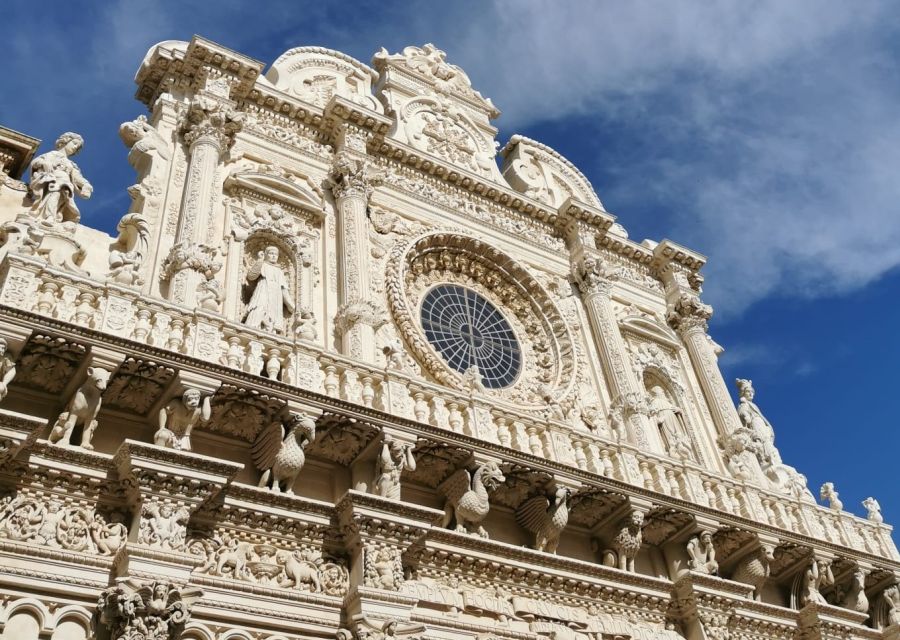
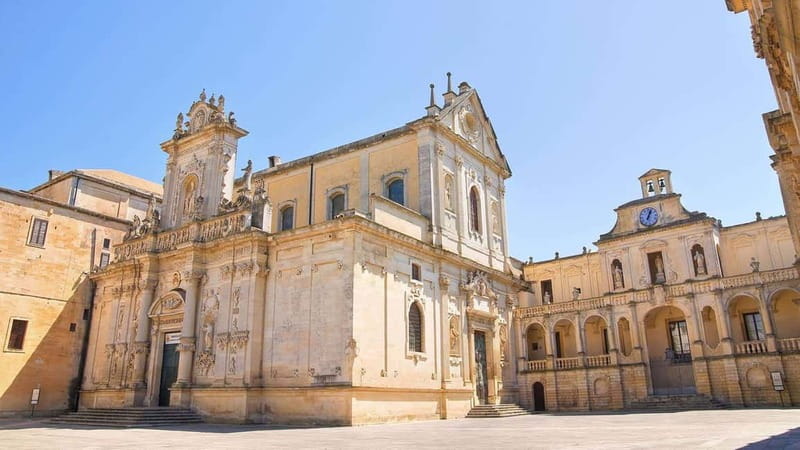
Piazza Duomo is the visual payoff of the above-ground route. Unlike a square that simply happens to contain several buildings, this one feels planned as a single architectural composition.
From the square, you see the Cathedral, the tall bell tower, the Archbishop’s Residence, and the Seminary. The enclosed layout creates a strong sense of theater. A guide can help you read the relationship between the buildings instead of treating each one as an isolated sight.
This is one of the places where the tour’s short format works well. You get enough explanation to understand why the square matters, then you can return later if you want photographs or a closer look. The bell tower and church interiors may require separate admission, depending on what you choose to visit afterward.
Several people use the walking tour as preparation for a church and tower ticket purchased separately. That can be a smart pairing. First learn the architectural language, then go inside with a better idea of what you are seeing.
If you have only one afternoon in Lecce, give Piazza Duomo extra time after the tour. The guide’s explanation will help, but the square also rewards quiet observation. Look at the way the buildings frame one another and notice how different the space feels from the open, Roman-centered Piazza Sant’Oronzo.
Below street level at the Jewish Museum
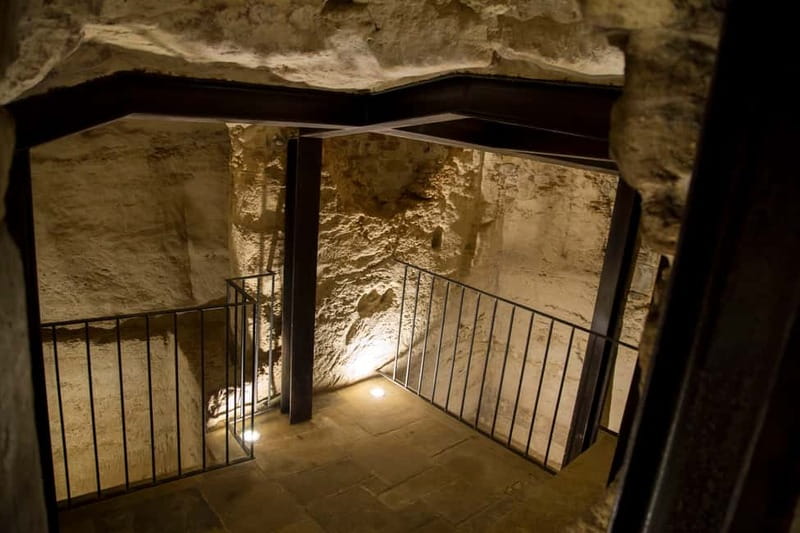
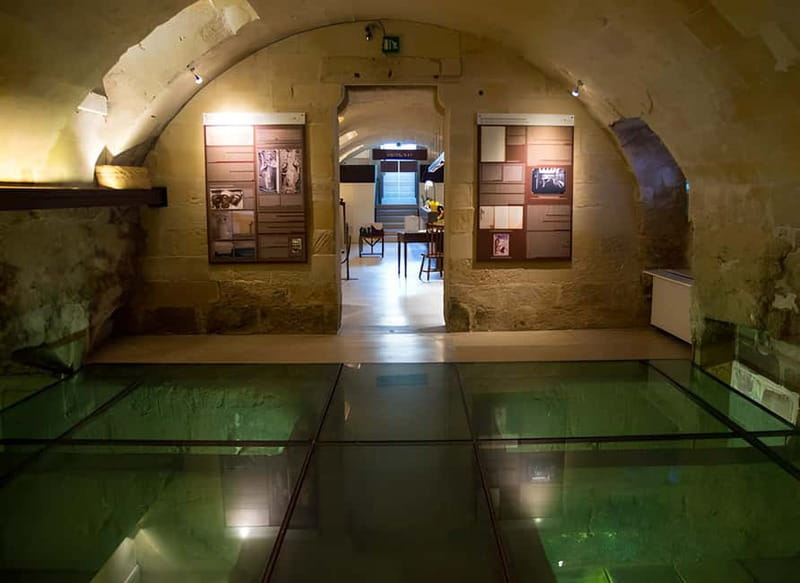
The underground Jewish Museum adds a less obvious chapter to Lecce’s story. The visit takes place below the modern city and explores the presence and history of Lecce’s Jewish community.
The museum is not presented as a large collection of objects. Its value comes from the setting and from the chance to consider a part of Lecce that can be missed when you focus only on Baroque churches and Roman ruins. One visitor worried that the visit would be narrowly religious, but found it broader than expected, with attention to the town’s past and the people who lived there.
The order can vary by departure. The published route describes the museum at the end, while some tour departures have begun underground before moving through the center. Do not be surprised if your group starts there. The meeting instructions and guide will establish the exact sequence.
This is also the part of the tour that divides opinion most clearly. If you expect a large underground complex, you may find it brief. If you want a concise introduction to Jewish Lecce tied to the city above, it adds real value.
The museum ticket is included in the $29 price. That makes the tour more attractive than a simple free orientation walk, especially if you appreciate having a guide explain why the underground space matters.
What the guides add to the experience
The strongest feature here is the human explanation. The route itself is easy to follow, but Lecce’s architecture is much more rewarding when someone points out the details and connects them to Roman and Jewish history.
Max receives repeated praise for his humor, clear English, pacing, and ability to keep the group interested. Massimiliano is described as articulate and especially good at making the city’s past feel connected to modern Lecce. Fabrizio, Angela, Antonio, Alex, and other guides have also led well-received departures.
The guide language choices are English, Italian, and French. Several English-speaking guides are praised for strong fluency, and the tour leaves room for questions. That is useful if you want more than memorized dates. You can ask about restorations, local buildings, or what to see next.
The shared group option should suit most people. The private option makes more sense if you want to control the pace or ask many questions. Group size is not given as a fixed number, but one experience described the group as comfortably sized.
At times, the guide may include a small tasting, such as olive oil or wine, though this is not listed as a standard inclusion. Treat that as a possible extra rather than something to book the tour for. Food and drinks are officially not included.
Timing, cost, and practical value
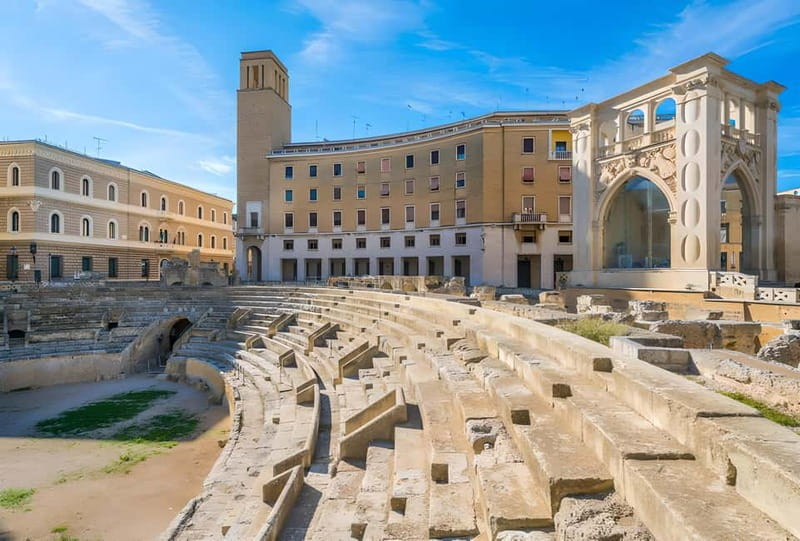
The duration is 1.5 hours, and several departures finish very close to the planned 90 minutes. One person expected two hours, so set your expectations correctly. This is a focused introduction, not a half-day exploration.
At $29, the price sits in the reasonable range for a guided city walk with a museum ticket. You are paying for three things: a local guide, a planned route through the main historic sights, and admission to the underground Jewish Museum.
The value is strongest for first-time visitors who want help getting oriented. It is also useful if you have limited time in Lecce and want to understand the city before choosing which churches or museums to revisit.
The value is weaker if your priority is entering Santa Croce, Sant’Irene, and the cathedral. The regular route focuses on exteriors, and church admission is not included. In that case, add a church pass or set aside time for independent visits after the walk.
You can cancel up to 24 hours before the activity for a full refund, and the reserve now, pay later option keeps your plans flexible. Those terms are helpful in Apulia, where weather and transport plans can shift, but the main practical issue remains the meeting point. Check the booked option rather than assuming all departures begin in the same place.
Who should book this Lecce walk
I would recommend it to you if you want an intelligent first look at Lecce without spending an entire day in formal museums. It suits couples, families with older children, and solo visitors who want local context without arranging a private historian.
It is especially good for anyone interested in architecture. The route gives you several chances to compare the grand Baroque facades, Roman remains, and the more contained underground museum setting.
It also works well for visitors who are unsure how to structure their time in Lecce. After the walk, you can decide if you want to return to Santa Croce, climb or visit the bell tower, enter more churches, or spend time around the amphitheater.
I would hesitate only if you dislike guided walks, need extensive time inside churches, or expect a large archaeological museum below ground. The tour moves at a practical pace and covers several subjects quickly. You will get a strong outline, not every detail.
Should you book it?
Book this tour if you want Lecce to make sense, not just look beautiful. The mix of Baroque architecture, Roman remains, Piazza Duomo, and Jewish history gives you a useful framework for exploring the city on your own.
At $29, it is a good deal for a first visit, particularly because museum entry is included and the guides tend to be clear, warm, and easy to follow. Just remember that the underground museum is compact and that most churches are viewed from outside. If those limits fit your plans, this is a practical and enjoyable way to begin in Lecce.
FAQ
How long does the Lecce walking tour last?
The tour lasts 1.5 hours, or about 90 minutes.
How much does the tour cost?
The listed price is $29 per person.
What languages are available?
Live guiding is available in English, Italian, and French.
Is the Jewish Museum entry included?
Yes. The Jewish Museum admission ticket is included in the tour price.
What sights are visited?
The route includes Santa Croce Church, Piazza Sant’Oronzo, the Roman Column, the Roman amphitheater remains, Corso Vittorio Emanuele, Sant’Irene Church, Piazza Duomo, and the underground Jewish Museum.
Does the tour enter Santa Croce Church?
The stated itinerary includes an exterior visit to Santa Croce. Church entry is not listed as part of the included tour.
Is hotel pickup provided?
No. Hotel pickup and drop-off are not included.
Can I choose a private tour?
Yes. The experience offers a choice between a shared group tour and a private tour.
Can I cancel for a refund?
Yes. You can cancel up to 24 hours in advance for a full refund.
New to the itinerary around Italy
- Vicenza: Palladian Architecture Private Walking Tour★ 3.3 · 3 reviews
- Architectural Milan: Private Tour with a Local Expert★ 4.5 · 2 reviews
- The Architect’s Water★ 4.5 · 11 reviews
- Architectural Florence: Private Tour with a Local Expert★ 5.0 · 3 reviews
- Rione Sanità: tour among street art, architecture, folklore★ 4.5 · 2 reviews
- Palermo Tour: Magnificent Mixture Of Architectural Styles★ 4.2 · 6 reviews
- Discover Coppedè in Rome: Liberty architecture, symbols, and jewels★ 5.0 · 2 reviews
- Bologna: Guided Architecture Walking Tour★ 4.5 · 2 reviews
Baroque Architecture Tours, compared.
Martina Franca: Baroque and Rococo Architecture Walking Tour
Read our review →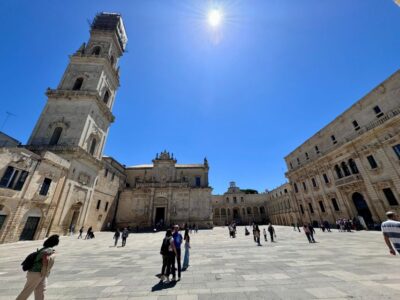
Other lists with this tour