
Review · ITALY
LECCE: AMONG ARCHITECTURAL TREASURES IN THE LECCE BAROQUE
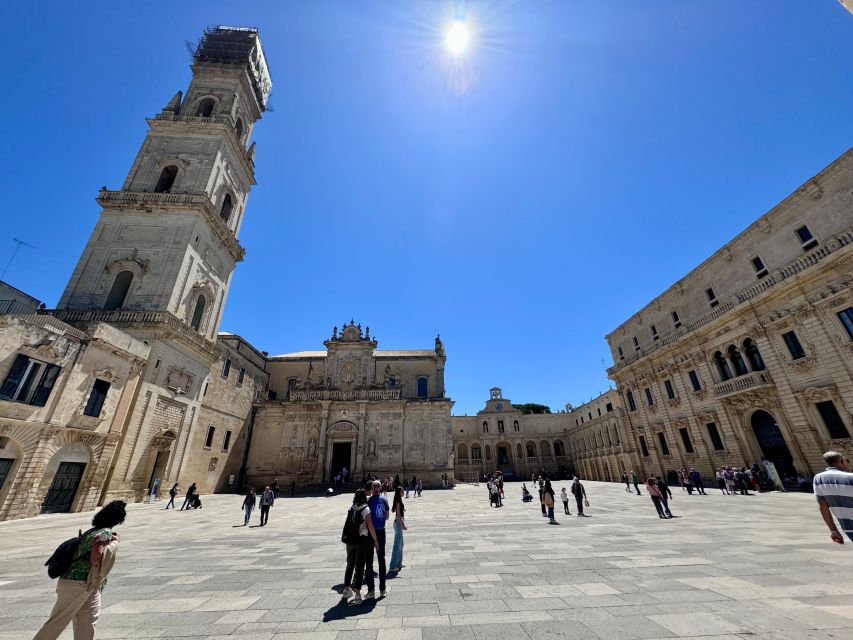
Lecce’s old center is a stage set in honey-colored stone, but the detail is real: carved saints, twisting columns, solemn churches, and Roman remains all share the same streets. This two-hour walk gives you a clear route through the city, beginning at Porta Napoli and moving toward the great Baroque sights.
I like the focus on Piazza del Duomo, one of Italy’s unusual enclosed squares, and the mix of Roman and Baroque landmarks. I also like the flexible small-group price, $147.27 for up to five people, which can be good value when shared. The main consideration is that church admission is not included, and the published route gives both Basilica di Santa Croce and Piazza Sant’Oronzo as important end points, so confirm the exact order when booking.
Key points to know before you book
- Porta Napoli sets the scene: Begin at a 16th-century city gate built in Lecce stone in honor of Charles V of Habsburg.
- Piazza del Duomo is the visual high point: See the cathedral, bishop’s palace, and seminary palace gathered inside a rare closed square.
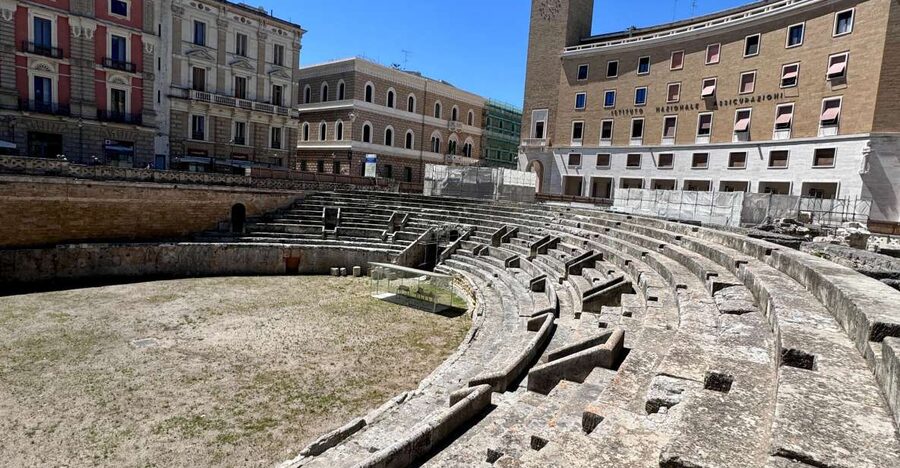
- Roman and Baroque Lecce meet: The walk moves from ancient Roman streets to Piazza Sant’Oronzo and its amphitheater.
- Federica Manzi leads the tour: She guides in Italian or Spanish and is praised for clear explanations, flexibility, and careful answers to questions.
- Church entry costs extra: The tour covers the cultural and historical walk, but admission to churches is not included.
- The route lasts two hours: It is designed as a compact introduction to Lecce’s historic center, with free cancellation up to 24 hours before the start.
Why Lecce is best understood on foot
Lecce can look like a collection of ornate buildings until someone explains how the pieces fit together. This walk helps you read the city in layers. You begin with a defensive gateway, pass through Baroque streets and palaces, encounter the remains of the Roman city, and finish among Lecce’s most famous public monuments.
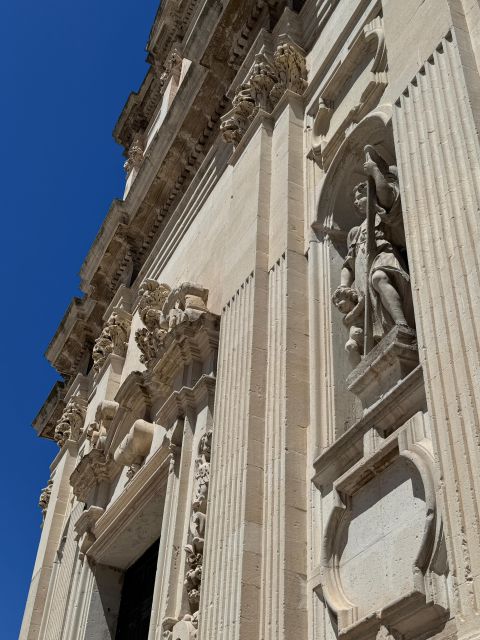
That order matters. Lecce stone is soft and workable, which allowed local builders and sculptors to create the flowing details that define the city. Churches here are not simply large boxes with decoration added later. Their fronts are crowded with figures, foliage, columns, and curved forms. A guide can point out those details while you are looking at them, rather than leaving you with a list of names.
The tour is also practical for a first visit. Two hours is enough to get your bearings without consuming an entire morning or afternoon. You will not see every church in Lecce, but you will come away with a useful framework for exploring on your own.
More Baroque Architecture Tours around Italy:
- Lecce: Baroque Architecture and Underground Walking Tour
★ 4.6 · 1,248 reviews - Noto: Sicilian Baroque Architecture Guided Walking Tour
★ 4.3 · 6 reviews - Martina Franca: Baroque and Rococo Architecture Walking Tour
★ 5.0 · 4 reviews
Starting at Porta Napoli and Via Giuseppe Palmieri
The meeting point is Porta Napoli, a 16th-century gateway at the edge of the historic center. Built from the local stone, the arch commemorates Charles V of Habsburg and gives the tour a strong opening image. Instead of starting with a generic street corner, you begin with a monument that explains Lecce’s position as an important fortified city.
From here, the route continues along Via Giuseppe Palmieri. This street leads you between churches and Baroque palaces, making it a good introduction to the city’s visual style. Look up as you walk. The most interesting work may be around a doorway, balcony, window frame, or upper façade rather than at eye level.
I like this part of the route because it gives you time to adjust to Lecce’s scale. The historic center is explored on foot, and the walk connects one sight to the next rather than treating each building as an isolated stop. You get the pleasure of moving through ordinary city streets while also receiving a cultural explanation of what you are seeing.
The route is described as both historical and gastronomic, though the supplied details focus mainly on architecture, culture, and the historic center. You should not book it expecting a dedicated food tasting. The gastronomic element is better understood as local context woven into a broader city walk, unless the guide confirms otherwise.
Piazza del Duomo, Lecce’s enclosed masterpiece
Piazza del Duomo is one of the major reasons to take this tour. It is a rare example of a closed square, with the surrounding buildings creating a more contained and dramatic space than the usual open European plaza.
The square brings together three major buildings:
- The Baroque cathedral
- The bishop’s palace
- The seminary palace
The arrangement makes the square feel almost like a private courtyard on a grand civic scale. As you enter, the effect is not just about any one façade. It comes from the way the buildings frame one another and control the view.
This is where a guide adds real value. Lecce’s decoration can overwhelm you at first. You may notice the pale stone and elaborate carvings without understanding why the square feels so different from a conventional cathedral plaza. A live explanation helps you slow down and see the relationship between the buildings.
Church entry is not included, so the tour may focus on the exterior unless you pay separately for access. That is worth considering if you want to inspect interiors, altars, or painted decoration. If your main interest is architecture and city planning, the outside view still gives you plenty to study. If interior art matters most, set aside extra time and budget beyond the two-hour walk.
Through the Roman city
After Piazza del Duomo, the route winds through streets associated with the ancient Roman city. This change in period is one of the tour’s strongest features. Lecce is not only a Baroque showcase. Its later buildings sit over and around an older urban foundation.
The walk does not present Roman remains as a separate museum visit. Instead, you encounter the ancient city while moving through the modern historic center. That makes the history easier to place. The roads and public spaces you see today are part of a long sequence of rebuilding and reuse.
For you, the benefit is variety. A tour devoted only to churches can become repetitive, especially in the bright stone of Lecce. Roman traces interrupt that pattern and show how different eras share the same compact center.
The precise Roman features shown can depend on the guide and the day’s route, so it is sensible to ask Federica what will be covered when you meet. The provided route clearly includes the ancient Roman city as part of the walk, but it does not promise a separate archaeological site admission.
More Architecture Tours around Italy:
- Experience Florence’s Art and Architecture on a Walking Tour
★ 5.0 · 318 reviews - Palermo: Art and Architecture Walking Tour
★ 4.7 · 136 reviews - Caprarola: Villa Farnese, masterpiece of Renaissance architecture
★ 4.5 · 28 reviews - Best of Bologna in one day : Food, architecture, art and history
★ 5.0 · 27 reviews
Piazza Sant’Oronzo and the Roman amphitheater
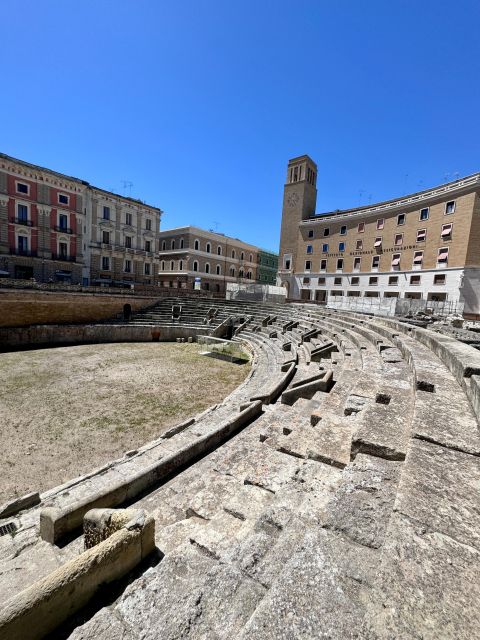
The route continues to Piazza Sant’Oronzo, one of Lecce’s main public squares. Here, the Roman amphitheater provides a striking contrast to the Baroque churches and palaces seen earlier.
The amphitheater is a reminder that Lecce’s past is not merely decorative. Beneath the elegant façades is an ancient entertainment venue tied to the Roman city. Its open stone remains give the square a different mood and help you picture how the area changed over time.
The square also contains a Roman column topped by a statue of Sant’Oronzo, Lecce’s protector. This pairing of Roman monument and Christian symbol captures the city’s layered identity in one view. Ancient material, later religious meaning, and civic life all meet here.
The advertised finish point is Piazza Sant’Oronzo, making it a convenient place to continue exploring independently. At the same time, the tour description also identifies Lecce’s Baroque churches and Basilica di Santa Croce as final highlights. Since the published stop information names Piazza Sant’Oronzo as the finish, ask for clarification about whether Santa Croce is visited before the square or treated as a concluding stop nearby.
Basilica di Santa Croce and Lecce’s Baroque style
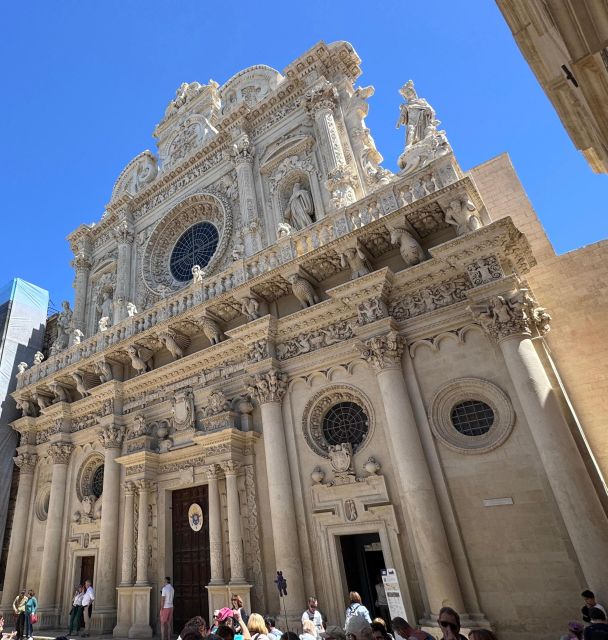
Basilica di Santa Croce is one of the most recognizable symbols of Salento. Its façade is the kind of work that rewards patience. Rather than taking one quick photograph and moving on, look at the layers of figures, plants, columns, and sculpted forms.
The church is especially useful as a final lesson in Lecce Baroque. By this point, you have already seen the city gate, palaces, cathedral square, Roman remains, and other churches. Santa Croce gives those earlier sights a visual reference point. You can compare its façade with the buildings seen along Via Giuseppe Palmieri and understand the shared language of local stone and ornament.
Again, admission is not included. The tour can show you the exterior and explain its place in Lecce’s culture, but you should plan separately if you want to enter. Opening arrangements are not provided, so do not assume that interior access will be possible at your chosen time.
What Federica Manzi adds to the walk
The named guide is Federica Manzi, and the strongest praise for her centers on communication and flexibility. She guides in Italian and Spanish. Her Spanish is described as highly fluent, and she is able to answer questions and adapt the explanations to what the group wants to know.
That matters on a tour with several periods and styles packed into two hours. A fixed speech can leave you lost when the group’s interests change. Federica’s reported approach suggests a more responsive walk, where you can ask about the artwork, the city’s history, or the meaning of a particular building.
I would make use of that flexibility. Ask her to point out the details that are easiest to miss, especially on the church façades and palaces. If you are more interested in Roman Lecce than Baroque sculpture, say so early. The tour covers both, and your questions can help shape the emphasis.
The rating is 4.7 from three reviews, with two five-star accounts praising Federica’s preparation, pleasant manner, Spanish, and ability to handle questions. That is a small sample, so I would treat it as encouraging rather than conclusive. Still, the praise is specific and consistent, which is more useful than a bare star score.
Price, group size, and overall value
The price is $147.27 per group of up to five people. That is not the cheapest way to see Lecce if you are alone, but it can be reasonable for a couple, family, or small private group. Shared among five people, the cost works out to roughly $29.45 each before any separate church admission.
The group pricing also gives the experience a more personal feel than a large public walk, at least when you fill the booking. You can ask questions without waiting through a long line of people, and the guide has more room to adjust the pace.
The value depends on what you want. If you only need a list of buildings, you can walk through Lecce without paying for a guide. If you want the city’s Roman and Baroque layers explained as you go, the price buys structure and context in a short period.
Remember to add possible entry fees for churches. They are not part of the tour price. The walking route itself is the main product, not a package of admissions.
Timing, access, and planning tips
The tour lasts two hours, with starting times available according to the date you choose. Since the exact time is not given in the activity details, check availability before making plans around lunch, dinner, or another booking.
The walk is listed as wheelchair accessible. That is useful, but historic centers can still contain uneven paving or tight approaches around old buildings. If you use a wheelchair, contact the provider before booking to confirm the route for your chosen time and to ask about access to any church interiors. The tour’s listed accessibility applies to the activity, while individual buildings may have separate conditions.
You can cancel up to 24 hours in advance for a full refund. The reserve-now, pay-later option also helps if your Puglia schedule is still shifting. These policies are practical, but they do not change the basic need to check the meeting point and start time carefully.
For the best experience, arrive at Porta Napoli ready to walk and keep the final part of the route flexible. The supplied details identify Piazza Sant’Oronzo as the finish, while Santa Croce is also described as a final highlight. A quick confirmation with Federica can prevent confusion.
Who will enjoy this Lecce tour most
I would recommend this walk to a first-time visitor who wants a strong introduction to the historic center without committing half a day. It suits people who enjoy architecture, urban history, churches, and the contrast between Roman remains and later Baroque design.
It is also a good fit for a small family or group of friends. The per-group price becomes more attractive as the group grows to five, and the ability to ask questions can be especially helpful when different people want different kinds of information.
Spanish-speaking visitors should pay special attention to this option because Federica guides in Spanish as well as Italian. Her ability to explain clearly and respond to questions is one of the experience’s most useful features.
I would be more cautious if you want a food tour with tastings, a long interior visit to several churches, or a detailed archaeological tour. The provided information describes a cultural and historical walking tour, and church admission is separate. It is best treated as an architectural overview with local context, not as an all-inclusive attraction pass.
Should you book it?
Book this tour if you want to understand why Lecce is called a Baroque city, while still seeing the Roman foundation beneath it. The route covers the right essentials: Porta Napoli, Via Giuseppe Palmieri, Piazza del Duomo, the Roman city, Piazza Sant’Oronzo, the amphitheater, Sant’Oronzo’s column, and the churches associated with Lecce’s style.
The strongest reason to choose it is Federica Manzi’s language range and flexible approach. The strongest practical advantage is the two-hour length and group pricing for up to five people. The main drawbacks are separate church entry fees and some uncertainty about the exact position of Santa Croce in relation to the advertised finish at Piazza Sant’Oronzo.
For a compact first look at Lecce, I would book it, especially for a small group that wants explanations rather than a self-guided stroll. Just confirm the route order, ask what church interiors can be entered, and leave extra time afterward if you want to explore inside.
FAQ
Where does the Lecce tour begin?
The tour begins at Porta Napoli, the 16th-century gateway into Lecce’s historic center.
Where does the tour finish?
The stated finish point is Piazza Sant’Oronzo. Basilica di Santa Croce is also described as one of the final highlights, so confirm the exact route order when booking.
How long does the guided tour last?
The guided tour lasts two hours.
Which languages are available?
The live guide offers the tour in Italian and Spanish.
Are church entrance fees included?
No. Entry to the churches is not included in the tour price.
Is the tour wheelchair accessible?
Yes. The activity is listed as wheelchair accessible.
New to the itinerary around Italy
- Vicenza: Palladian Architecture Private Walking Tour★ 3.3 · 3 reviews
- Architectural Milan: Private Tour with a Local Expert★ 4.5 · 2 reviews
- The Architect’s Water★ 4.5 · 11 reviews
- Architectural Florence: Private Tour with a Local Expert★ 5.0 · 3 reviews
- Rione Sanità: tour among street art, architecture, folklore★ 4.5 · 2 reviews
- Palermo Tour: Magnificent Mixture Of Architectural Styles★ 4.2 · 6 reviews
- Discover Coppedè in Rome: Liberty architecture, symbols, and jewels★ 5.0 · 2 reviews
- Bologna: Guided Architecture Walking Tour★ 4.5 · 2 reviews
Baroque Architecture Tours, compared.
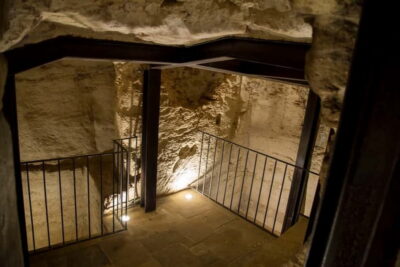
Lecce: Baroque Architecture and Underground Walking Tour
Read our review →
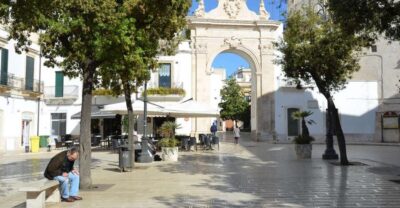
Martina Franca: Baroque and Rococo Architecture Walking Tour
Read our review →Other lists with this tour