
Review · ITALY
Architectural Florence: Private Tour with a Local Expert
Florence’s greatest pleasure is seeing how its churches, civic buildings, bridges, and palaces fit together. This private walk links Brunelleschi’s dome, Florentine Gothic details, Medici power, and the Arno in one compact route led by a local expert.
I like the one-to-one format, which lets you ask about the buildings that catch your eye instead of following a fixed group script. I also like the flexible pace, since the guide can adapt the route to your interests and the weather. The main drawback is the price: $786.04 for up to two people is a serious expense for roughly two hours, and entry tickets are extra.
Key points at a glance
- A private architectural walk for up to two people: You get an exclusive guide rather than a shared group.
- A strong concentration of Florence icons: The route links Santo Spirito, the Duomo, Uffizi, Ponte Vecchio, Pitti Palace, and more.
- Architecture is the main subject: Expect attention to Gothic, Renaissance, religious, and civic design.
- The itinerary can change: Your interests, walking speed, and weather help shape the route.
- Tickets are not included: Museum, monument, and transport costs must be paid separately.
- A demanding price for a short tour: It makes the most sense for visitors who value privacy and tailored commentary.
Why this short Florence walk works
This experience is designed as an architectural orientation to Florence rather than a full museum visit or a long historical walking tour. In about two hours, you move between major buildings that show how the city developed from medieval republic to Renaissance capital and Medici stronghold.
That range is the real attraction. You are not looking at only churches or only art museums. You get religious architecture, public power, private wealth, bridge design, and views over the city. A good local guide can help you connect these pieces instead of leaving them as a string of impressive façades.
The private format matters here. Florence’s center can feel crowded, and architectural details are easy to miss when you are trying to keep up with a large group. With only your party and the guide, you can pause for questions, focus on Renaissance design, or shift attention toward church art and civic history.
The published feedback is especially strong about the guide’s detailed understanding of Florence and its architecture. That is the quality I would care about most on this tour. The buildings are already famous. The value comes from making sense of what you are seeing.
More Private Architecture Tours in Italy
- City Walk with Architect: Private walking tour of Rome
★ 5.0 · 22 reviews - Private Tour: Venice Art and Architecture Walking Tour
★ 4.0 · 22 reviews - Venice Art and Architecture Private Walking Tour
★ 4.5 · 11 reviews
Starting at Santo Spirito in the Oltrarno
The walk begins at Basilica di Santo Spirito in Piazza Santo Spirito. This is a smart starting point because the church offers a clear introduction to Renaissance design through simplicity rather than decoration.
Filippo Brunelleschi designed the church, and its interior is known for an elegant, restrained look. The proportions and repeated architectural forms matter as much as any single ornament. If you are used to judging churches by their painted ceilings and grand façades, Santo Spirito gives you another way to read Renaissance architecture.
The piazza also gives the tour a more local starting point than a first meeting directly beside the Duomo. The guide can set the city’s architecture in context before leading you toward Florence’s better-known sights.
You should confirm how much time is spent inside the church, since admission details are not provided and monument tickets are excluded. Even if the stop is primarily external, the building remains a useful first lesson in Brunelleschi’s approach.
Santa Maria Novella and the city’s polished façade
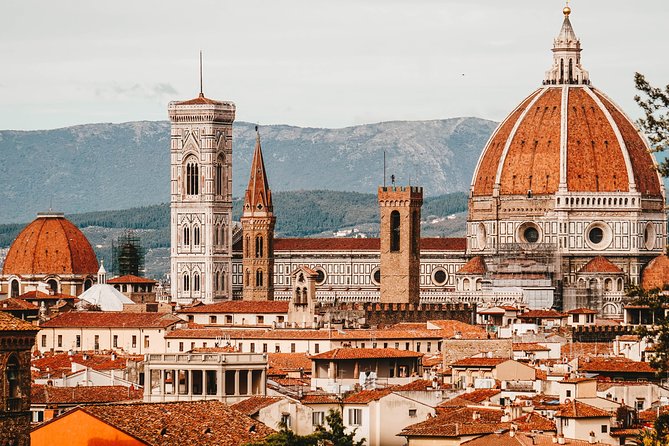
Santa Maria Novella brings a different architectural mood. Its façade combines Gothic structure with Renaissance order, creating one of Florence’s most recognizable church fronts.
The basilica is also important for its art, so this stop can appeal to you if architecture and painting are equally important. Its position at Piazza di Santa Maria Novella makes it easy to connect the church with the wider movement of people and goods through Florence.
This is one point where the short length of the experience matters. Santa Maria Novella deserves more than a quick look if you want to examine its interior works in detail. Since the tour covers many stops and entry fees are not included, you should treat this walk as an introduction unless your guide and schedule allow a longer visit.
That is not a flaw in the route. It simply means you should not expect a complete church tour, museum visit, and city walk in two hours.
The Duomo and Giotto’s Campanile
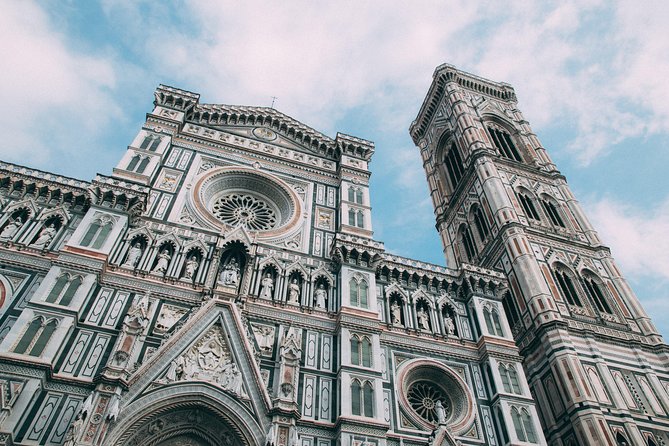
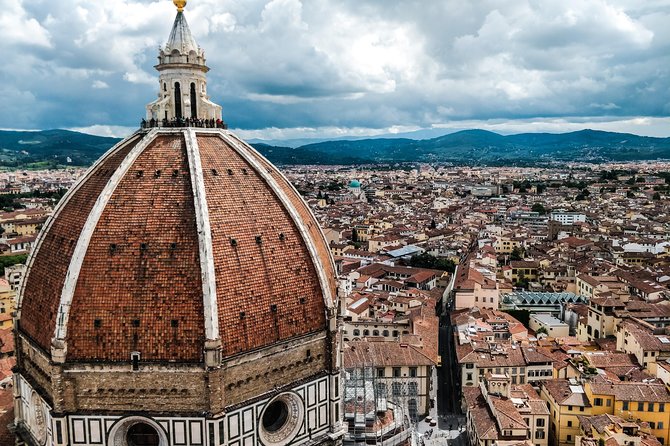
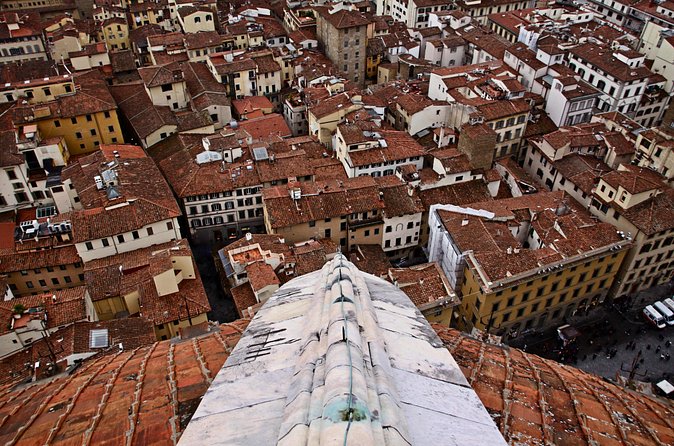
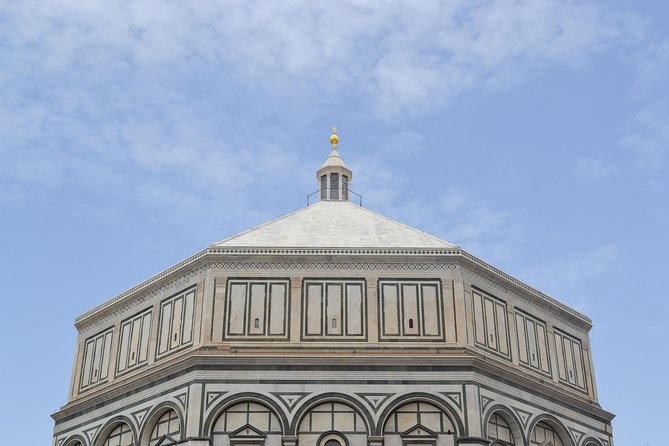
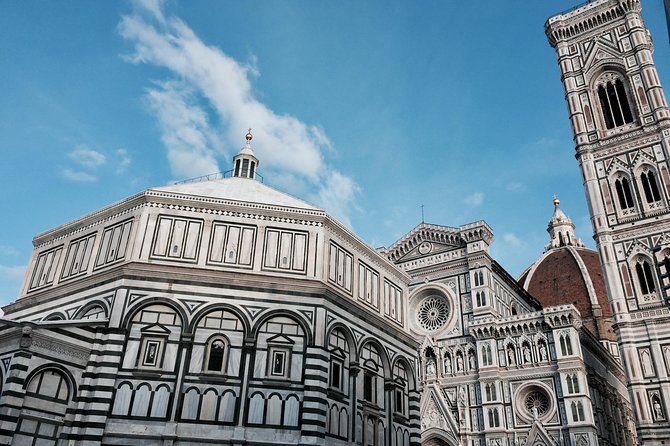
Florence’s cathedral is the visual center of the route. Its enormous dome, designed by Brunelleschi, changed the possibilities of Renaissance building and remains the defining feature of the city skyline.
The guide can help you look beyond the familiar postcard view. Pay attention to the relationship between the cathedral, its dome, and the surrounding Cathedral Square. The complex is not one single style. It brings together medieval and Renaissance ideas, with elaborate exterior decoration set against the bold engineering of the dome.
Next to the cathedral, Giotto’s Campanile offers one of Florence’s finest examples of Florentine Gothic architecture. Its patterned exterior and vertical shape give the Cathedral Square a different character from the dome beside it.
The tower also offers panoramic views, but the tour information does not say that climbing it is included. Monument admission and transport costs are excluded, so do not assume you will go inside or reach the viewing level during this short walk. Your guide can still explain how the tower fits into the cathedral complex and why its design matters.
Same streets, read through a different style:
- Lecce: Baroque Architecture and Underground Walking Tour
★ 4.6 · 1,248 reviews - Naples: San Gaudioso Catacombs Guided Tour
★ 4.7 · 1,105 reviews - Experience Florence’s Art and Architecture on a Walking Tour
★ 5.0 · 318 reviews - Palermo: Art and Architecture Walking Tour
★ 4.7 · 136 reviews
Palazzo Vecchio and the power of the piazza
At Piazza della Signoria, Palazzo Vecchio shifts the subject from religion to government. This medieval palace, with its crenellated tower, was built to project civic authority.
The building is valuable even if you only see it from the square. Its defensive appearance tells you something about Florence’s political life, while the surrounding piazza places public sculpture and state power side by side.
Inside are historic rooms and important artworks, but the tour price does not include monument entry. If Palazzo Vecchio is a priority, ask the guide how much of the stop will be devoted to the exterior and decide if you want to arrange a separate visit.
I like this part of the route because it prevents the tour from becoming a parade of churches. Florence’s architecture is also about government, competition, wealth, and public image. Palazzo Vecchio makes that clear.
Santa Croce and the city’s artistic memory
The Basilica of Santa Croce is the principal Franciscan church in Florence. Its Gothic character differs from the Renaissance restraint of Santo Spirito and the grand scale of the Duomo.
The church is known for its art and the tombs of notable Italians. That gives the stop a strong connection to Florence’s artistic and intellectual identity, not just its architecture. You can look at the church as both a religious building and a place where the city commemorates important figures.
Again, timing is the key consideration. The route includes many major sites, and the advertised duration is only about two hours. If you want to study the interior, chapels, and tombs at length, you will need additional time beyond this experience.
For a first visit, though, the stop helps show how different Florentine churches can feel from one another. The guide’s job is to point out those differences without overwhelming you with dates and names.
Uffizi Gallery, with an important ticket warning
The Uffizi is one of the world’s most famous art museums and one of Florence’s essential Renaissance institutions. Its historic building near Piazza degli Uffizi is part of the story, not just a container for paintings. The structure and its position reflect the political and cultural ambitions of the city.
The tour highlights the chance to explore the Uffizi with ease, but entry tickets are specifically not included. The provided details also do not confirm a reserved admission time. You should therefore ask exactly what the stop involves before booking, especially if you expect to enter the galleries.
If the visit is exterior or introductory, the guide can still explain the building’s role and help you decide if a longer museum visit belongs elsewhere in your schedule. If you already have separate Uffizi admission, this private walk may help you understand the setting before or after that visit.
Do not count on seeing the museum’s full collection during this two-hour experience. The value here is in tying the gallery to Florence’s civic and architectural story.
Crossing the Arno on Ponte Vecchio
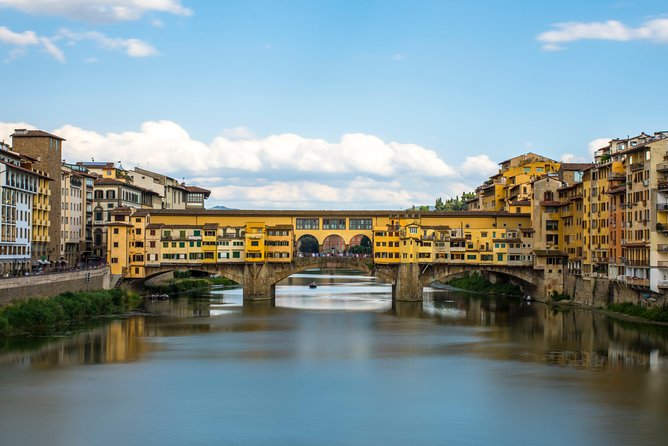
Ponte Vecchio is the route’s most memorable bridge stop. This medieval stone crossing spans the Arno and is famous for the shops built along it.
The bridge is more than a pretty photo point. Its unusual row of shops makes it a piece of urban design, while its long history helps explain the connection between the city center and the Oltrarno. Looking along the bridge, you get a strong sense of Florence as a city built around movement, trade, and the river.
It is also a practical place to notice how crowded the center can become. A private guide can help you stop without losing the group, since there is no larger party to gather and manage.
The route does not promise shopping time, and the schedule is short. Treat Ponte Vecchio as an architectural and city-view stop rather than a chance to browse every shop.
Pitti Palace and the Medici scale of ambition
Across the river, Pitti Palace introduces a grander form of Renaissance architecture. The palace in Piazza de’ Pitti houses several museums and reflects the wealth and ambition associated with the Medici family.
Its broad façade and large square create a very different impression from the narrow lanes and compact medieval streets elsewhere in Florence. This contrast is useful. You can see how private power used architecture to announce status on a city-wide scale.
As with the Uffizi and other monuments, museum admission is not included. The short tour may cover the outside and explain the palace’s place in Florence’s development, but you should not assume that museum access is part of the price.
If you have already spent time around the Duomo and Palazzo Vecchio, Pitti Palace helps complete the story by showing how power shifted across the Arno and how grand residences shaped the Oltrarno.
Ending near Costa San Giorgio and the hilltop villa
The experience ends at Costa San Giorgio, 2, uphill from the river. The final area includes a villa and gardens offering views across Florence. The setting brings together architecture, cultivated outdoor space, and the city spread below.
The information provided does not name the villa, so you should confirm the exact stop with the operator. What is clear is that the ending is designed to give you a broader view of Florence rather than finish in another crowded square.
That final viewpoint can be a satisfying close to a tour focused on buildings. After seeing churches, palaces, and a bridge from street level, you get a chance to understand how the city fits into its surrounding hills.
The uphill finish is also the main physical concern. The tour is not recommended for people with impaired mobility, and the route may involve sustained walking and uneven urban surfaces. Most people can participate, but you should be comfortable walking between multiple sites and handling an uphill ending.
What $786.04 means for the value
At $786.04 per group of up to two, this is not a budget walking tour. For two people, the cost is about $393.02 each before any museum, monument, or transport fees. For one person, the price is harder to justify.
The strongest reason to pay this much is privacy. You are buying a tailored experience with an independent local guide, not simply access to a route. If you want to ask detailed questions about Brunelleschi, compare Gothic and Renaissance design, or adjust the pace around your interests, the format may be worthwhile.
The value is weaker if you mainly want entry to the Uffizi, cathedral complex, or Palazzo Vecchio. Those tickets are not included, and two hours is not enough for thorough visits to all of them. In that case, you may prefer to put the money toward separate admissions and a longer shared walking tour.
Book this experience for the guide’s attention and the architectural connections, not for the number of interiors included.
Timing, pace, and practical details
The tour is offered in English and uses a mobile ticket. Confirmation arrives at booking, and the service is operated by an independent local through LocalBini.
The route is private, so only your party participates. Your itinerary can be adjusted to your interests and walking pace, while weather may change the stops. That flexibility is helpful, but it also means the exact balance between exterior views and interior visits may vary.
Start at Basilica di Santo Spirito, Piazza Santo Spirito, 30. The tour ends at Costa San Giorgio, 2, rather than returning you to the starting point. Plan the rest of your day from the ending location.
Service animals are allowed, and the route is near public transportation. Personal expenses are not included. Free cancellation is available until 24 hours before the start time, but cancellations or changes made inside that window are not accepted.
Who should book this private walk
I would recommend it to a couple who wants a focused introduction to Florence and cares more about architectural explanation than ticking off museum rooms. It also suits repeat visitors who have seen the headline sights but want a local guide to connect them.
It is less suitable for anyone seeking a low-cost overview, a full Uffizi visit, or a slow exploration of each church. The route covers a lot of ground, and the price is high for the duration.
The best way to use it is to tell the guide what matters most before you begin. You might ask for extra attention to Brunelleschi, Florence’s Gothic buildings, Medici architecture, or the relationship between the historic center and the Oltrarno. The more clearly you set that priority, the more useful the private format becomes.
Should you book Architectural Florence?
Book it if you want an exclusive, architecture-led introduction and are comfortable paying for personal attention. The route brings together Florence’s major visual symbols, from Santo Spirito and the Duomo to Ponte Vecchio, Pitti Palace, and the hilltop view near Costa San Giorgio.
Skip it if you need included admissions, a longer museum experience, or a cheaper way to see the center. The price is justified only when the guide’s detailed architectural commentary and flexible private format matter to you. For the right pair, it can turn Florence’s famous buildings into a connected story instead of a series of photographs.
FAQ
How long does the Architectural Florence tour last?
The tour lasts approximately two hours.
How many people can join the private tour?
The price covers a private group of up to two people. Only your group participates.
What language is the tour offered in?
The experience is offered in English.
Where does the tour begin?
The meeting point is Basilica di Santo Spirito, Piazza Santo Spirito, 30, 50125 Firenze FI, Italy.
Where does the tour end?
The tour ends at Costa San Giorgio, 2, 50125 Firenze FI, Italy.
Are museum and monument admission tickets included?
No. Entry tickets for transportation, museums, and monuments are excluded.
Does the route include the Uffizi Gallery?
The Uffizi Gallery is one of the featured stops, but the tour information does not confirm included admission. Museum tickets are excluded.
Can the itinerary change?
Yes. The itinerary adapts to your interests and walking pace, and stops may vary according to weather conditions.
Is the tour suitable for people with impaired mobility?
It is not recommended for guests with impaired mobility. Most travelers can participate, and the route is near public transportation.
New to the itinerary around Italy
- Vicenza: Palladian Architecture Private Walking Tour★ 3.3 · 3 reviews
- Architectural Milan: Private Tour with a Local Expert★ 4.5 · 2 reviews
- The Architect’s Water★ 4.5 · 11 reviews
- Rione Sanità: tour among street art, architecture, folklore★ 4.5 · 2 reviews
- Palermo Tour: Magnificent Mixture Of Architectural Styles★ 4.2 · 6 reviews
- Discover Coppedè in Rome: Liberty architecture, symbols, and jewels★ 5.0 · 2 reviews
- Bologna: Guided Architecture Walking Tour★ 4.5 · 2 reviews
- Borgo Parrini Gaudí-style: a walking tour in a colorful art village★ 4.8 · 9 reviews
Private Architecture Tours, compared.
Sagrada Familia & Gaudi Tour Private or Small Group with Tickets
Read our review →
Barcelona 1.5h Private Old Town, Gothic & Ramblas Walking Tour
Read our review →
Treasures of Barcelona: Private Gaudi Walking Tour
Read our review →
Sagrada Familia & Gaudi Guided Tour Private or Small Groups
Read our review →
Best of Chicago: Architecture & Highlights City Private Tour
Read our review →
Private Harajuku Omotesando Architecture Walking Tour
Read our review →
Private Santa Barbara History and Architecture Walking Tour
Read our review →
Private Barcelona Modernism and Gaudí Walking Tour
Read our review →Other lists with this tour