
Review · CHINA
Beijing Hutong Walking Tour History, Architecture and Local Life
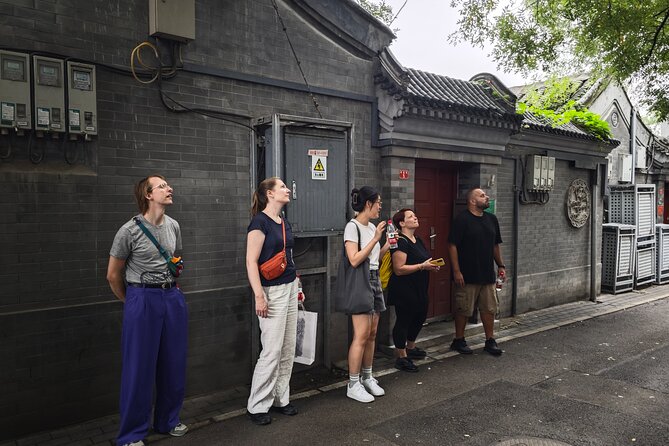
Beijing’s old hutongs make the most sense on foot, and this tour gives you a compact route through lanes, temples, courtyards, and surviving imperial architecture. You’ll see how an old neighborhood sits beside the city’s modern financial district, with the guide explaining details that are easy to miss, from siheyuan courtyard design to the meaning of traditional doors.
I like the variety. In three hours, you visit a Chinese-style church, a Buddhist temple, a Yuan Dynasty brick pagoda, an old hutong, an imperial temple, and the White Stupa area. I also like the practical touch: guides such as Lori and Dee offer restaurant suggestions and Beijing travel advice, not just dates and architectural labels.
The main consideration is pace. The route covers several stops, and the total time includes walking between them. Some places may have limited access, including the Temple of Previous Dynasties, which is visited if open.
Key points to know before you book
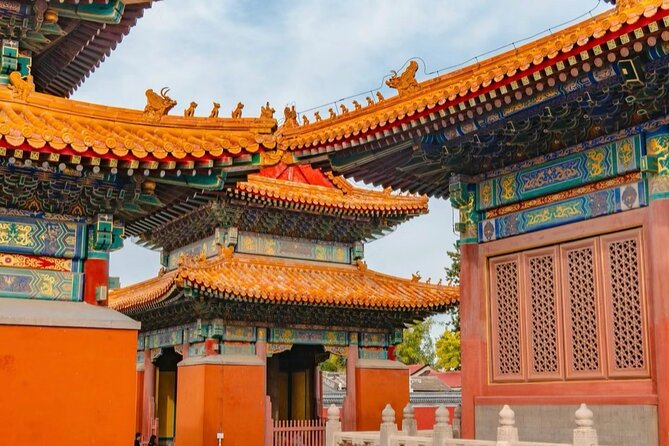
- Six contrasting sights in about three hours: See a church, temple, pagoda, siheyuan, hutong, imperial complex, and stupa area.
- A useful old-Beijing route: Start at Xisi Subway Station and finish near Exit C at Fuchengmen Station on Line 2.
- Small groups make questions easier: The maximum group size is 10 people.
- Local life is part of the route: Zhuanta Lane offers a look at old neighborhood life rather than only grand monuments.
- Practical advice is built in: You receive bottled water, a traditional Beijing drink, and recommendations for food and further sightseeing.
- One access point is conditional: The Temple of Previous Dynasties is included only if it is open.
Why this hutong walk works well for a first look at Beijing
Many Beijing sightseeing routes focus on the Forbidden City, the Great Wall, or the Summer Palace. Those places matter, but they do not show you as much of the ordinary city. This walk takes you through Xicheng, where older lanes and religious buildings sit close to offices and modern commercial streets.
I like that the route is not limited to one theme. You are not spending three hours looking at only temples or only courtyard homes. Instead, the guide connects different parts of Beijing’s past: imperial traditions, Buddhism, Christian history, neighborhood life, and the city’s changing architecture.
The tour begins at Xisi Subway Station and ends at Fuchengmen Station. That makes the route practical if you are using Beijing’s metro. There is no private transportation, so you should be comfortable walking outdoors and moving between stops under your own power.
With a maximum of 10 people, the group is small enough for questions. That matters on a route filled with details, such as the arrangement of a courtyard, the purpose of a doorway, or the story behind a church that does not look entirely European.
More Walking Tours in the world:
- The Official Art Deco Walking Tour by The Miami Design Preservation League
★ 5.0 · 1,580 reviews - Lecce: Baroque Architecture and Underground Walking Tour
★ 4.6 · 1,248 reviews - Chicago in a Day: Food, History & Architecture Walking Tour
★ 5.0 · 1,153 reviews
Xishiku Church and Beijing’s Chinese touch
The first stop is Xishiku Church, described as one of Beijing’s earliest churches. You spend about 10 minutes here, with no separate admission charge.
The appeal is the building’s unusual place in Beijing’s story. It is not simply a European church dropped into the city. The guide explains how the church carries a Chinese touch, giving you a better sense of how foreign religious traditions were adapted within the capital.
Ten minutes is a short visit, so think of this as an introduction rather than a full architectural study. It works well at the start because it immediately shows that Beijing’s old neighborhoods hold more than imperial and Buddhist sites.
If you are interested in architecture, pay attention to the contrast between the church and the traditional buildings that follow. The shift helps you see how many different cultural influences have shaped the city.
Guangji Temple and traditional religious architecture
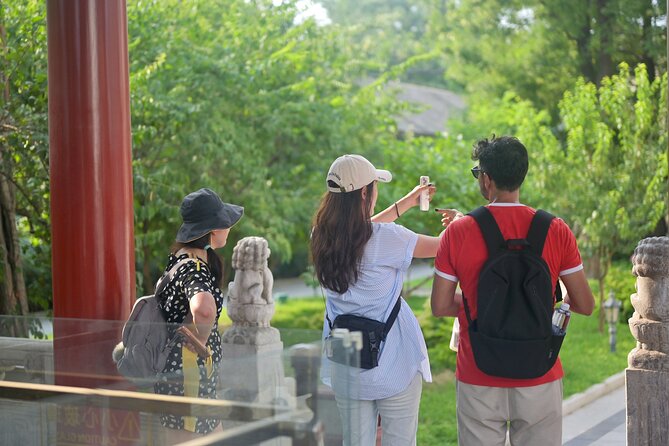
The walk continues to Beijing Guangji Temple, where you spend about 20 minutes. This stop has traditional Chinese temple architecture and ancient finger paintings, giving the visit more substance than a quick look at a gate or roof.
A guide is especially useful here. Temple buildings can appear similar when you first see them, but the arrangement of courtyards, halls, roofs, and decorative details carries meaning. The tour is designed to explain that setting in plain terms.
The stop is free to enter according to the tour details, though access to any religious site can depend on local conditions. You should treat the schedule as a guide rather than a guarantee that every interior will be open at the exact moment you arrive.
I like the balance between looking and listening here. Twenty minutes is enough to notice the setting and ask questions, but it keeps the tour moving toward the hutongs instead of turning into a single-site temple visit.
Wansong Brick Pagoda and a traditional siheyuan
At Zhengyang Shuju, you see the Wansong Brick Pagoda, which dates to the Yuan Dynasty, and explore a collection of old Beijing images in a siheyuan. The planned visit lasts about 20 minutes.
This may be the most useful architectural stop for understanding old Beijing homes. A siheyuan is a courtyard-style residence, traditionally arranged around an open central space. The layout helps explain why the shape and placement of doors matter, a subject the guide can connect to everyday life and social customs.
The pagoda adds another layer. It is a modest brick structure rather than one of Beijing’s grandest monuments, but its age gives the route a direct link to the Yuan period. Seeing an older religious structure beside a courtyard setting makes the city’s past feel less like a single imperial chapter.
The old Beijing images are also helpful. They give you a visual reference for streets and buildings that have changed, and they make the walk through the next hutong easier to understand.
More History Walks around the world:
- Charleston’s Best Highlights: History, Culture & Architecture
★ 5.0 · 422 reviews - Palm Springs Modernism Architecture & History Bike Tour
★ 5.0 · 359 reviews - Charleston: History and Architecture Guided Walking Tour
★ 4.8 · 349 reviews - Historic Georgetown: History, Gossip, & Architecture Walking Tour
★ 5.0 · 321 reviews
Zhuanta Lane, one of the oldest hutongs on the route
Zhuanta Lane is where the tour shifts most clearly from monuments to local life. You spend about 15 minutes walking through one of Beijing’s oldest hutongs, with the guide pointing out the character of the lane and the way people live around it.
This is the part I would value most if you want more than a checklist of famous buildings. Hutongs are not museum corridors. They are neighborhood streets, and their appeal comes from the relationship between narrow lanes, courtyard entrances, old walls, and daily routines.
The visit is brief, so you should not expect a long wandering session through every side street. Still, even a short passage gives you a feel for the old city’s scale. The lane also puts earlier stops into context: the siheyuan is no longer an abstract architectural term, because you have seen how courtyard homes fit into the street pattern.
The guide’s explanation of doors is worth listening for. The placement, size, and decoration of an entrance can reveal something about a home and its former residents. Those small observations are exactly what you might miss walking alone.
The Temple of Previous Dynasties and imperial memory
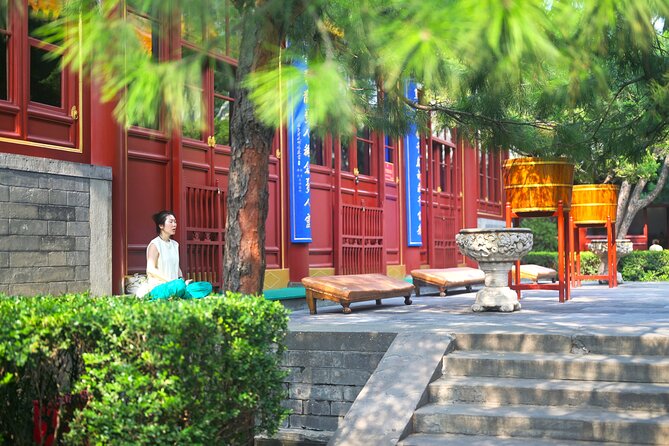
The Temple of Previous Dynasties, also called Lidai Diwang Miao, occupies about 20 minutes of the route if it is open. Its grand palatial structures provide a clear contrast with the small lanes and residential courtyards nearby.
The purpose of the temple is tied to the way Chinese tradition honored earlier rulers and ancestors. That makes it more than a collection of impressive halls. It gives the guide a chance to explain how imperial memory was organized and displayed.
This is also the tour’s main access caveat. The stop is conditional, so you should not book the walk solely to see this site. If it is closed, the route may still be worthwhile because the church, temple, pagoda, hutong, and White Stupa area each offer a different view of Beijing.
The 20-minute timing suggests a focused visit. You will learn what the complex represents and see its architectural character, but you will not have hours to inspect every hall or decorative feature.
Seeing the White Stupa from a nearby cafe
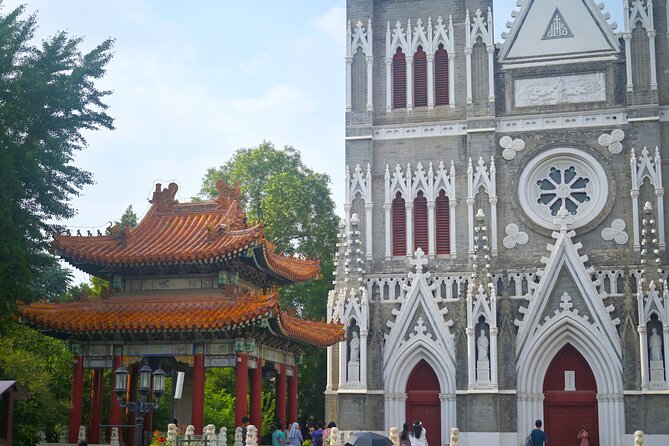
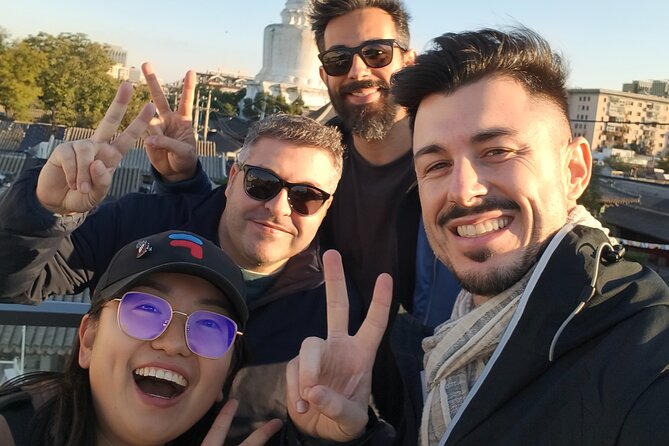
The last major sight is the White Stupa Temple, also known as Miaoying or Baita Si. The tour does not promise a full interior visit. Instead, the guide shows you the exterior design of the White Stupa from a nearby cafe balcony and explains different types of Chinese pagodas.
That viewpoint is a smart practical choice. A stupa can be difficult to understand when you are standing close to its base. A little distance lets you see its outline and proportions more clearly, while the guide supplies the architectural context.
You should know what you are getting here. This is a viewing and explanation stop, not a long temple visit. If you want an extensive look inside Miaoying Temple, this walk may not be enough on its own.
Still, the stop rounds out the route nicely. You have already seen temple buildings, a brick pagoda, and imperial halls. The White Stupa gives you another form to compare, helping you recognize that Chinese religious architecture is not one single style.
What the guide adds beyond the buildings
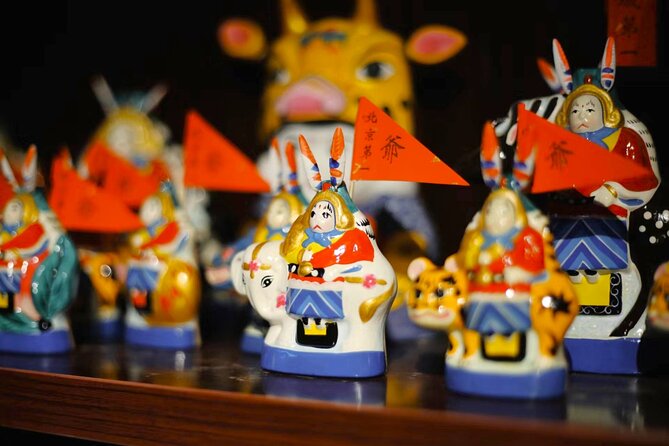
The strongest part of a small walking tour is often the conversation between stops. Guides named Lori and Dee are associated with this experience, and the route is designed around questions, explanations, and practical help.
Lori is noted for explaining how the hutongs are laid out and why doors matter. That is useful because the old lanes can otherwise seem like a series of attractive but disconnected walls and entrances.
Dee is described as personable and ready to answer questions, with interests that include temples, traditional medicine, and other local sights. The food recommendations are a real benefit if you are still finding your way around Beijing. A short conversation about where to eat can save you from choosing a restaurant at random after the walk.
Guide assignments can vary, so you should not assume that a particular person will lead your departure. The important point is that the tour is structured to give you context and practical suggestions, rather than simply leading you from one photo stop to the next.
Price, group size, and what you receive
At $49 per person, this is not the cheapest way to walk through a Beijing neighborhood, but the value is reasonable if you want a guide to connect several smaller sights in one outing. Admission fees and taxes are included, as are bottled water and a traditional Beijing drink.
The price makes the most sense for a first visit. You get orientation, cultural background, and restaurant and sightseeing tips in addition to the walk itself. If you already know Xicheng well and prefer to explore at your own speed, you might find the fixed route less useful.
The maximum group size is 10. That is a good middle ground: more social than a private tour, but small enough for the guide to respond to questions. The three-hour duration also fits neatly into a morning or afternoon without taking over your day.
The mobile ticket is convenient, and confirmation is provided when you book. Since private transportation is not included, plan to reach Xisi Subway Station independently and continue from Fuchengmen Station afterward.
Who should book this three-hour Beijing walk
I would recommend this tour to first-time visitors who want an introduction to Beijing beyond the headline sights. It is also a good fit if you have a short stay and want one organized route through several types of old architecture.
You will get the most from it if you enjoy walking, asking questions, and looking closely at ordinary details. The experience is less suitable if you want long, unhurried visits inside each building or a private vehicle between stops.
Most people can participate, and service animals are allowed. The tour depends on good weather and a minimum number of participants. If poor weather or low enrollment cancels it, you are offered another date or experience, or a full refund.
Free cancellation is available up to 24 hours before the start time. Inside that window, the amount paid is not refunded, and changes are not accepted.
Should you book the hutong walking tour?
Book it if you want a compact, well-rounded introduction to old Beijing, especially if you value explanations about hutong layout, doors, courtyards, and local customs. The mix of Xishiku Church, Guangji Temple, the Yuan Dynasty pagoda, Zhuanta Lane, the imperial temple, and the White Stupa is unusually varied for a three-hour walk.
Skip it if your priority is a single major monument, extensive interior access, or a relaxed pace with plenty of time at each stop. Keep in mind that the Temple of Previous Dynasties is available only if open, and the White Stupa is viewed from a nearby cafe balcony.
For many visitors, the best reason to book is the orientation. You finish near Fuchengmen with a clearer sense of how Beijing’s old neighborhoods fit together, plus a few food and sightseeing ideas to use for the rest of your stay.
FAQ
How long does the Beijing hutong walking tour last?
The tour lasts approximately three hours, including travel time between locations.
Where does the tour begin?
It begins at Xisi Subway Station in Xicheng District, Beijing.
Where does the tour end?
It ends near Exit C of Fuchengmen Station on Subway Line 2, in the Financial Street area.
Is transportation included?
Private transportation is not included. The experience is a walking tour, and the route includes travel time between stops.
How many people can join the tour?
The maximum group size is 10 people.
What is included in the price?
All fees and taxes, bottled water, and a complimentary traditional Beijing drink are included.
Is the tour available with a mobile ticket?
Yes. The experience offers a mobile ticket, and confirmation is provided at the time of booking.
Is the Temple of Previous Dynasties always open during the tour?
No. That stop is visited if it is open.
Can I cancel for a full refund?
Yes, if you cancel at least 24 hours before the experience start time. Cancellations made less than 24 hours in advance are not refunded.
New to the itinerary around the world
- Washington, DC: Georgetown Architecture Walking Tour★ 5.0 · 8 reviews
- Wilmington History and Architecture Tour★ 4.8 · 18 reviews
- Walk & Discover KL’s Architectural and Heritage Gems★ 5.0 · 7 reviews
- Washington DC: Dupont Circle & Embassy Row Architecture Tour★ 5.0 · 6 reviews
- New Orleans : Garden District Architecture Walking tour★ 4.8 · 5 reviews
- Unveiling Brno: History, Culture & Architectural Delights★ 5.0 · 2 reviews
- Vicenza: Palladian Architecture Private Walking Tour★ 3.3 · 3 reviews
- Private Colonial Williamsburg Architectural Tour★ 5.0 · 5 reviews
China Architecture Tours, compared.
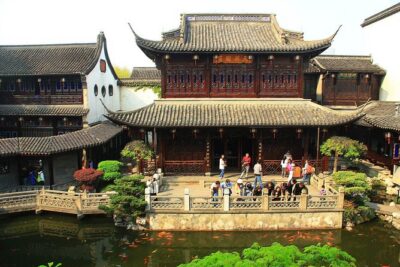
Explore Ancient Chinese Architecture & Meet its People
Read our review →
3-Hour Shanghai Art Deco Walking Tour With City Master
Read our review →Other lists with this tour