
Review · GEORGIA
Brutal Tbilisi — Night Edition: Dark Side of Soviet Architecture
Tbilisi’s Soviet architecture after dark is not polished sightseeing. It is concrete, shadow, unfinished ambition, and real human survival. This private night tour links six striking sites, from an abandoned 17-storey tower to a glowing wedding palace, with a local guide and private transportation between them.
I like the small private format, which lets your guide adjust the pace and stop for better views. I also like the photo focus. You are not simply dropped at a building and given a fact sheet. You get help finding angles, light, and phone-camera settings that suit these unusual subjects.
The main consideration is that this is a serious, sometimes eerie experience. You may encounter uneven ground, long drives between stops, dark stairways, heights, and stories shaped by war and displacement. It is not the right night out if you want bright streets, cafés, and easy walking.
Key points at a glance
- Six powerful night locations: See Arashenda, the Chronicles of Georgia, the Former Archaeology Museum, the former Ministry of Highways, Nutsubidze Skybridge, and the Wedding Palace.
- A private 3 to 4-hour outing: Your own group travels by private vehicle, with the stop order adjusted for traffic, weather, or city events.
- A strong photo angle: Your guide offers photo tips, while a professional photographer helps you frame Tbilisi’s concrete forms and night views.
- A human story behind the ruins: Arashenda is not just an unfinished building. It became shelter for families displaced by war.
- Rare access to Tbilisi after dark: The Chronicles of Georgia and Nutsubidze Skybridge feel quieter and more atmospheric at night.
- Central pickup made simple: Door-to-door service is offered in central Tbilisi, with Liberty Square or Europe Square as fallback meeting points.
Why this night tour feels different
Most city tours in Tbilisi lean toward old churches, sulfur baths, balconies, and wine. Those are worthwhile, but this outing takes you beyond the familiar center and shows you another side of the city: monumental concrete shaped by Soviet ideas, Georgian imagination, political upheaval, and daily life.
The appeal is not simply architectural. Each stop raises a different question. What happens to an ambitious public project when politics changes? How does a monument serve both national identity and state ideology? What does a residential complex become when bold design meets aging infrastructure?
Night changes the answers. Floodlights pick out carved figures. Apartment windows glow inside massive concrete blocks. Unfinished walls become silhouettes. The darkness also hides some of the rough edges, so you should expect atmosphere rather than a formal architectural inspection.
The tour costs $100 per person and lasts about three to four hours. That is a fair price if you value private transportation, a live local guide, photo help, and access to several far-flung places in one evening. It is less compelling if you only want a quick look at one landmark or prefer to explore at your own pace by public transport.
No meals are included, so eat before pickup or plan food afterward. Group discounts are offered, though the amount is not specified. Since this is a private activity, the price may make better sense for a small group that wants a tailored evening rather than for a solo visitor watching every dollar.
More Bauhaus and Brutalist Architecture Tours in the world:
- Brutalist Tbilisi: Urban exploration and untold stories
★ 5.0 · 82 reviews - London: Brutalist Architecture & History Walking Tour
★ 4.8 · 42 reviews - Le Corbusier’s Chandigarh : A Complete Architecture Tour
★ 4.7 · 25 reviews
Arashenda Building, an unfinished tower with a human story
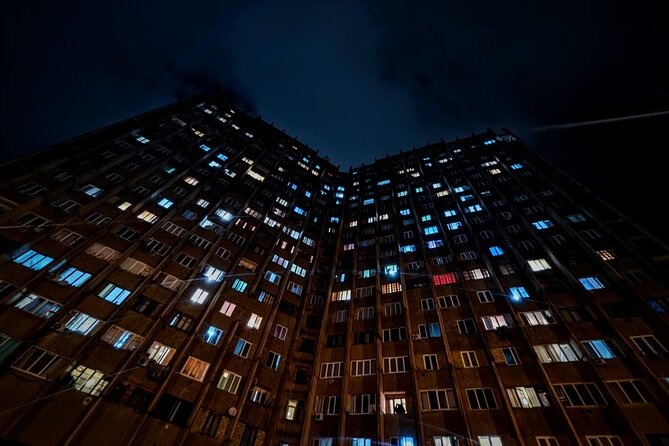
The first stop introduces the tour’s darker mood. Arashenda was begun in the early 1980s as the Hotel Odishi, a grand 17-storey project that was never completed. Political change and civil conflict interrupted the work, leaving behind an enormous frame with two folded wings that look like an open book.
The building later became shelter for families displaced by war. That detail matters. You are not looking at an empty monument frozen in time. You are looking at a place that was adapted for survival, with improvised balconies and signs of long-term human use.
At night, cracked concrete and open stairways take on a stark beauty. Your guide explains why locals call it Arashenda, meaning the one that did not get built, and puts the structure in the context of Tbilisi’s recent past.
The stop lasts about 20 minutes and admission is free. From the open stairways, you can also catch a view toward the Chronicles of Georgia. That contrast is one of the tour’s best visual ideas: an unfinished building of loss and endurance facing a monumental work of national memory.
You should not expect a conventional interior tour or a restored site. The setting is rough, and the experience can feel emotionally heavy. Wear shoes with a firm sole and follow your guide closely.
Chronicles of Georgia, where light turns stone into theater
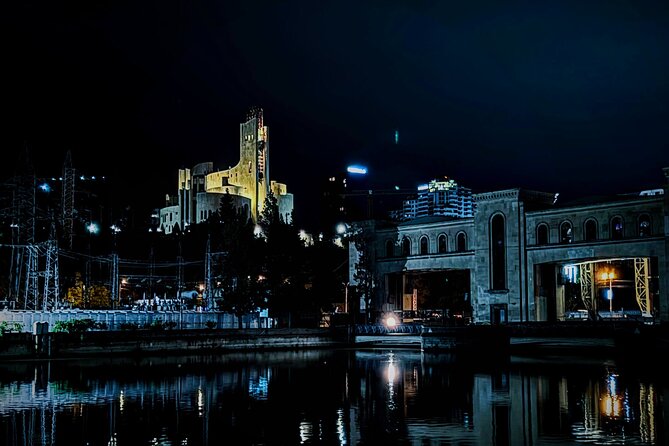
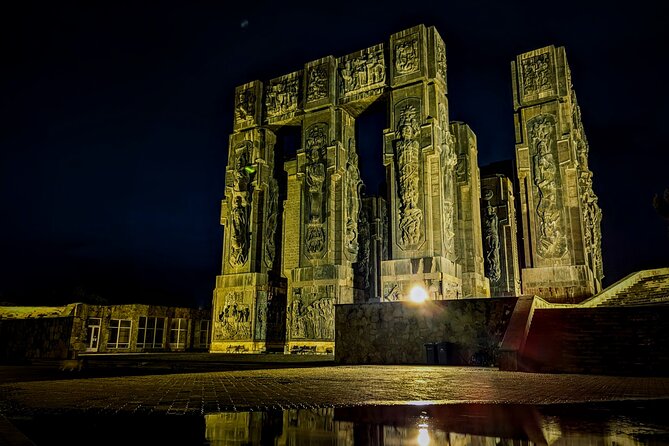
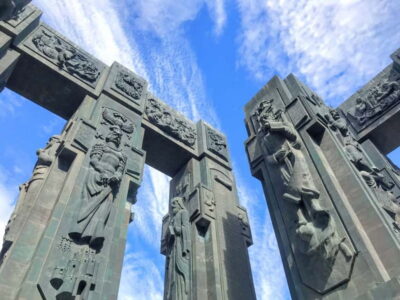
The Chronicles of Georgia is perhaps the most dramatic stop after sunset. Set high above the city, the giant stone columns are lit with a soft golden glow while the spaces between them fall into darkness.
The monument depicts Georgian rulers, saints, and religious stories. Your guide explains the carved figures and the legends connected with them, giving the site more meaning than a simple photo stop. At night, the lighting makes the columns feel larger and more mysterious than they do in ordinary daylight.
The upper platform provides a broad view over Tbilisi and the dark water of the Tbilisi Sea. Bring a phone with a charged battery. This is one of the places where a little help with exposure and night mode can make a real difference.
The stop takes about 45 minutes, making it one of the longer visits. That extra time is useful. You can walk among the columns, listen to the explanations, and wait for a clear angle instead of rushing from one view to the next.
The drawback is the weather. The monument is exposed, and the tour runs in rain or snow. Appropriate clothing matters more here than it might on a short central-city walk.
The Former Archaeology Museum on Digomi Hill
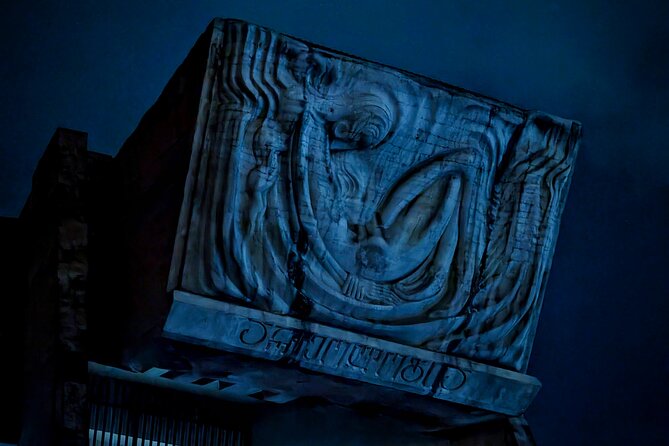
The former Archaeology Museum was built in 1988 to hold Georgia’s ancient treasures, but it never fully opened. Its broad stairway and carved bas-reliefs give it the appearance of an ancient temple, even though its story belongs to the late Soviet period.
At night, the carved figures catch the available light in fragments. The building feels quiet and unfinished, with a sense of purpose that was interrupted before it could be fulfilled. Your guide connects the building to changing politics and the uncertain fate of Georgian archaeology.
This is a short stop of about 20 minutes. It works well after the Chronicles of Georgia because the two sites share a monumental scale, but their moods differ. The Chronicles presents a forceful public story. The museum feels like a project left waiting for its proper moment.
Do not expect a museum visit in the usual sense. The attraction is the exterior, the stairway, the relief work, and the explanation of what the building was meant to become. If you prefer active displays and indoor collections, this will feel spare.
More Evening Tours around the world:
- Chicago River: Guided Sunset Cocktail & Architecture Tour
★ 4.6 · 203 reviews - Night Tapas Walking Tour in Barcelona Modernist Area with Small Group and Dinner
★ 4.5 · 56 reviews - Barcelona: Evening Walking Tour in the Gaudi Area with Tapas
★ 3.9 · 35 reviews - Gaudis Sunset Sagrada Familia and Parc Güell Guided English Tour
★ 5.0 · 29 reviews
Former Ministry of Highways, Soviet engineering in a new role
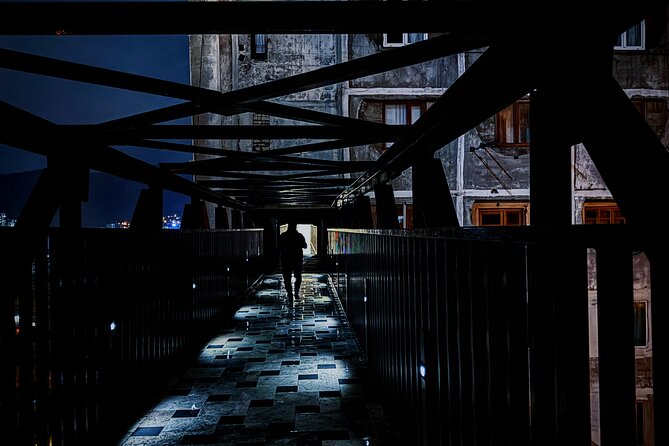
The former Ministry of Highways of the Georgian SSR is one of Tbilisi’s most famous examples of bold Soviet design. Built in the 1970s, it uses massive concrete blocks stacked like bridges across the hillside.
The form was meant to suggest Georgia’s mountain roads and the connection between regions. Today, the building houses the Bank of Georgia headquarters, so the structure has not simply been abandoned. It continues to serve a modern purpose while retaining its original shape.
That mixture is part of the appeal. You see a building created for state administration now functioning as a corporate office. The architecture remains daring: voids cut through the blocks, corridors appear to hang in the air, and the hillside setting gives the whole structure a sculptural quality.
At night, the lit passages and dark recesses create especially strong photographs. Your guide points out the best angles, which is helpful because the building can look flat from the wrong position. Allow about 20 minutes here.
You will be viewing the exterior rather than taking a standard public tour of the headquarters. Keep that distinction in mind. The value is the building’s shape, story, and night presentation, not access to office interiors.
Nutsubidze Skybridge and the old elevator ride
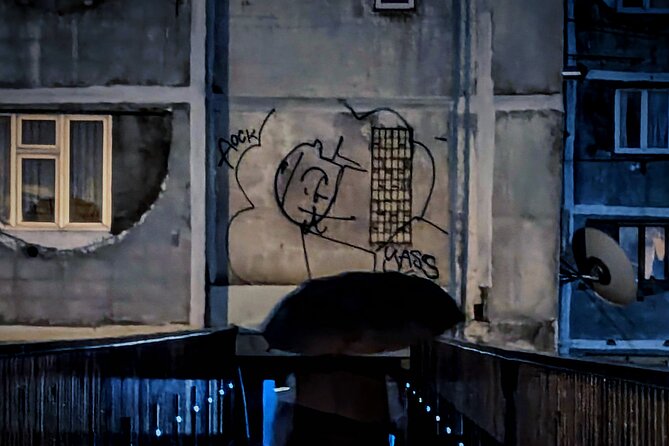
The Nutsubidze Skybridge is one of the tour’s most unusual stops. Three large residential blocks on Nutsubidze Plateau are linked by suspended bridges high above the city. The design is practical and dramatic at the same time, creating a network of walkways between homes on a steep slope.
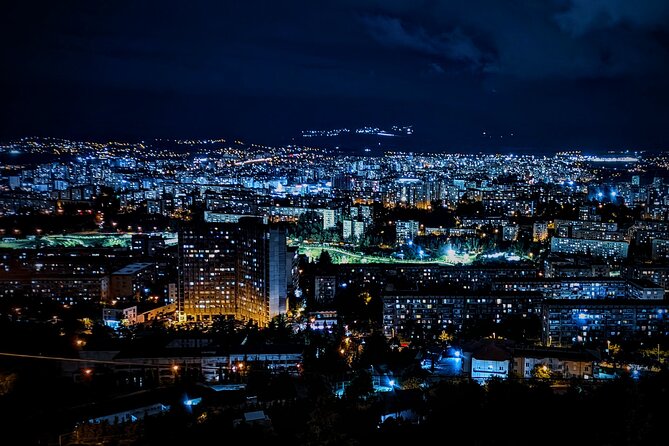
At night, the corridors glow faintly. City lights flicker below, while the upper parts of the concrete towers disappear into darkness. The view reaches across Tbilisi, from newer glass buildings to distant hills.
The elevator ride adds a distinctly local detail. An old lift is still operated by a lift lady, whose presence gives the ascent a human scale. The quiet ride, the machinery, and the faintly lit corridors make this stop feel less like a monument and more like a working part of a neighborhood.
You spend about 45 minutes here. That gives you time to take the elevator, cross the connecting spaces, hear how the complex works, and take photographs from the bridges.
This is also where the tour’s warnings about heights and enclosed spaces matter most. The bridges are suspended above the city, and the elevator is old and confined. If you have a fear of heights or claustrophobia, you should think carefully before booking.
Arcadia Georgia and the Palace of Rituals
The final stop is the Wedding Palace, also known as the Palace of Rituals. Designed by Victor Jorbenadze and built in 1984, it was created for civil marriage ceremonies during the Soviet period.
Its purpose gives the building an unusual tension. Weddings are emotional and personal, while the surrounding system promoted a secular public ritual in place of a church ceremony. The architecture responds with an almost sacred form: spiraling lines, arches, raw concrete, and a vertical profile that recalls a futuristic temple.
At night, light from the windows creates curved shadows across the structure. The effect is romantic but strange, which makes it a fitting final stop. After the unfinished projects, abandoned institutions, and working Soviet housing complex, the Wedding Palace offers a building where ideology and private feeling meet.
The visit lasts about 20 minutes. Your guide explains the building’s design and its place in Soviet Georgia, while the photographer helps you work with the curves and shadows. This is likely to be the most visually playful stop, especially if you enjoy unusual portraits and architectural shapes.
Photo help that is actually useful
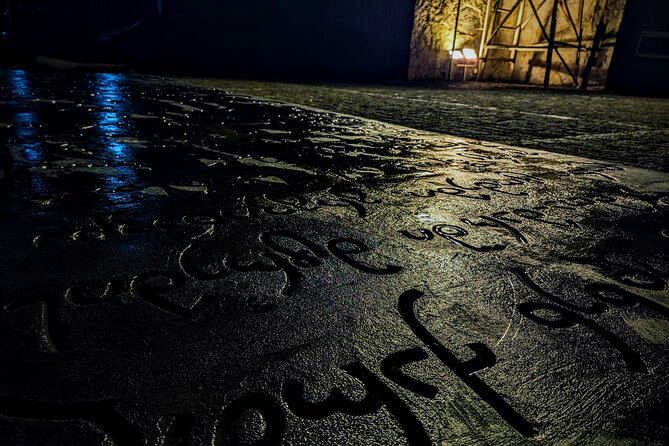
The photo element is more than a promise of scenic stops. The tour includes photo tips and a professional photographer who helps capture strong angles. The supplied details do not promise a fixed number of edited photographs, so you should confirm what final images, if any, are delivered before booking.
You will get the most from this part if you bring a charged phone and leave enough storage space. Night architecture needs patience. A guide who knows where to stand can save you from flat images, blocked views, and excessive glare from lights.
I especially like that the photo work fits the subject. These buildings are not pretty in a conventional way. Their appeal comes from scale, geometry, worn surfaces, and contrast. A useful tip at one location may involve stepping back. At another, it may mean placing a person against a huge concrete form so the scale becomes clear.
The earlier city-tour feedback connected with this provider also highlights guides such as Jonah, Oksana, Aleski, and Alex for clear explanations, flexible routes, and strong photographs. Those comments concern the provider’s broader Tbilisi tours rather than naming the guide for this specific night experience, so you should ask who will lead your booking. The important point is to expect a local guide with both storytelling and photo direction, not a purely technical photographer.
Pickup, timing, and practical comfort
Door-to-door pickup is available within central Tbilisi. After booking, you share your accommodation address, and the guide or driver contacts you through WhatsApp on the day to confirm the exact time and place.
If your hotel or apartment falls outside the pickup zone, the suggested meeting points are usually Liberty Square or Europe Square, near the vintage tram-café. Both are central and easy to find, which removes much of the usual evening transport hassle.
Private transportation is important here. The stops are spread across Tbilisi, and this is not a compact walking route. Traffic, weather, and special events can change the order, but the key locations and viewpoints are intended to remain part of the evening.
The tour operates in all weather. Wear comfortable shoes and clothing suited to rain or snow if needed. You should also be ready for uneven terrain, dark areas, long drives, and outdoor waiting between stops.
Most people can participate, but this is not an effortless sightseeing loop. The company specifically warns that the experience may be emotionally intense and is not suitable for people with fear of heights or claustrophobia.
Who should book this experience?
I would choose this tour if you have already seen Tbilisi’s central sights and want something more unusual. It suits photographers, architecture fans, people interested in Soviet-era Georgia, and anyone who prefers a private evening with a strong sense of place.
It is also a good choice if you want to see distant sites without working out taxis, buses, and directions after dark. The private vehicle and central pickup add real value, especially for a small group.
I would skip it if you want a relaxed dinner outing, easy pavement, or a cheerful introduction to Tbilisi. The material is sometimes disturbing, the sites can feel bleak, and the heights and enclosed spaces are not minor details.
Cancellation is free if you cancel at least 24 hours before the start time. Changes or cancellations made later are not accepted for a refund.
Should you book Brutal Tbilisi, Night Edition?
Book it if you want to understand Tbilisi through concrete, unfinished projects, Soviet civic ideas, and the people who adapted these places to real life. The combination of private transport, a local guide, six distinctive stops, and photo help makes the $100 price reasonable for the right audience.
The strongest reasons to go are the Chronicles of Georgia at night, the Nutsubidze elevator and skybridges, and Arashenda’s difficult human story. Just arrive prepared for darkness, rough ground, exposed viewpoints, and serious subject matter. This is not a standard city tour, and that is exactly why it can be one of the more memorable evenings in Tbilisi.
FAQ
How long does Brutal Tbilisi, Night Edition last?
The experience lasts approximately three to four hours, including travel between the sites.
What locations are included?
The tour visits the Arashenda Building, Chronicles of Georgia, Former Archaeology Museum, former Ministry of Highways of the Georgian SSR, Nutsubidze Skybridge, and Arcadia Georgia, also known as the Wedding Palace or Palace of Rituals.
Is transportation included?
Yes. Private transportation is included, and door-to-door pickup is offered within central Tbilisi.
Where is pickup arranged?
You provide your accommodation address after booking. If you are outside the central pickup area, the usual meeting points are Liberty Square or Europe Square near the vintage tram-café.
Is the tour private?
Yes. Only your group participates in the activity.
Does the tour include food?
No. Meals are not included.
Can I cancel for a full refund?
Yes, if you cancel at least 24 hours before the experience start time. Cancellations or changes made less than 24 hours before the start time are not accepted for a refund.
New to the itinerary around the world
- Washington, DC: Georgetown Architecture Walking Tour★ 5.0 · 8 reviews
- Wilmington History and Architecture Tour★ 4.8 · 18 reviews
- Walk & Discover KL’s Architectural and Heritage Gems★ 5.0 · 7 reviews
- Washington DC: Dupont Circle & Embassy Row Architecture Tour★ 5.0 · 6 reviews
- New Orleans : Garden District Architecture Walking tour★ 4.8 · 5 reviews
- Unveiling Brno: History, Culture & Architectural Delights★ 5.0 · 2 reviews
- Vicenza: Palladian Architecture Private Walking Tour★ 3.3 · 3 reviews
- Private Colonial Williamsburg Architectural Tour★ 5.0 · 5 reviews
Bauhaus and Brutalist Architecture Tours, compared.
Brutalist Tbilisi: Urban exploration and untold stories
Read our review →
Le Corbusier’s Chandigarh : A Complete Architecture Tour
Read our review →
Architecture of New Belgrade – Brutalism Decoded
Read our review →
Secret Split: Socialist Architecture & brutalism – Urban Utopia
Read our review →
Tashkent Soviet Architecture (Modernism) and Subway station tour.
Read our review →
Belgrade: Space architecture tour – brutalist architecture
Read our review →
USSR History, Soviet Architects ,Statues & Mosaics
Read our review →Other lists with this tour