
Review · AMSTERDAM
Walking Tour about Golden Age Architecture, private local guide
Amsterdam’s Golden Age is easiest to understand from the street, where grand merchant houses, narrow canal homes, warehouses, and crooked façades tell the story together. This private walk connects those details from Dam Square to Westerkerk, giving you more than a quick look at pretty buildings.
I like the private format, since you can ask questions, pause for photos, and steer the conversation toward architecture, history, or daily life. I also like the attention to overlooked details, such as hoisting beams, facade stones, and the engineering needed to build the Royal Palace on soft ground.
The main drawback is the pace. Ninety minutes includes several stops, but most are short, and the tour involves standing and walking for the full period. If your legs need frequent breaks, or you use a walker, this may not be the right outing.
Key points to know before you book
- A private walk with Anna: The local guide is praised for clear English, friendly answers, and a strong grasp of Amsterdam’s architecture, history, and social policies.
- A useful route through central Amsterdam: You begin at the Royal Palace and finish by Westerkerk, close to the Anne Frank House.
- More than a façade tour: Expect explanations of building materials, canal commerce, marshy ground, religious design, and the people who lived in these houses.
- Small details make the difference: Look for crooked houses, roof hoists, decorative facade stones, and the dolphin symbol on De Dolphijn.
- Good value for architecture fans: At $73.59 per person, the price makes the most sense for a small group that wants a focused private lesson rather than a general city walk.
- Plan for continuous walking: The route lasts about 1 hour 30 minutes, with no bottled water included and no mobility aids available.
Starting at Dam Square and the Royal Palace
The walk begins at the Royal Palace Amsterdam, at Nieuwezijds Voorburgwal 147, though the first discussion centers on nearby Dam Square. This is a smart place to begin because Amsterdam’s Golden Age story starts with the city’s rise as a global trading power in the 17th century.
You’ll get the basic framework before the architecture arrives: Amsterdam expanded its trade, wealth, and influence, and its buildings began to reflect that success. Dam Square gives your guide a natural place to explain the political and commercial forces behind the city you see today.
The Royal Palace receives about 10 minutes of attention. It was first built as Amsterdam’s town hall, not as a royal residence. That change in purpose helps you understand the building as a symbol of civic power before it became part of the Dutch monarchy.
The architectural discussion includes Dutch Neoclassical style, building materials, and construction methods. The most useful point is the ground beneath the city. Amsterdam was built on soft, marshy soil, so the palace required clever engineering to support its heavy structure. You are not just looking at a grand façade. You are learning why putting that building there was such a demanding task.
You will not tour the palace interior on this experience. The listed stop is a short exterior discussion, and admission is not included because there is no admission charge for the stop itself. If you want to visit inside, treat that as a separate plan.
More Private Architecture Tours in Netherlands:
- Gouda Private Walking Tour: History, Architecture & Cheese
★ 4.5 · 8 reviews - Private Rotterdam Walking Tour – guided by Architects
★ 5.0 · 2 reviews - Amsterdam, Eastern Docklands Architecture: Private Tour
★ 5.0 · 2 reviews
Huis Bartolotti and the language of wealth
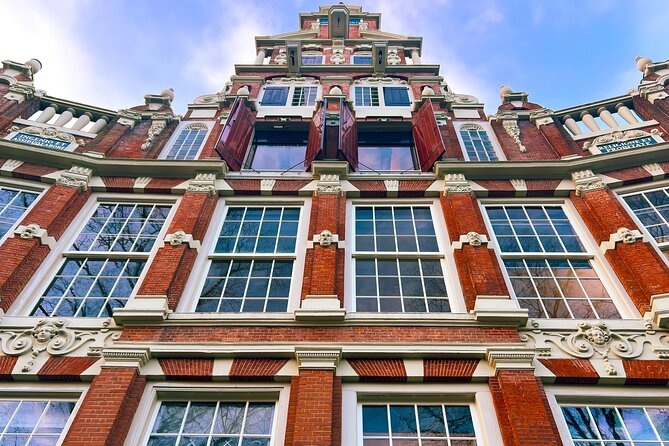
The next stop is Huis Bartolotti, a canal house with a red-brick façade, large windows, and sandstone decoration. It offers a compact lesson in 17th-century Dutch Baroque design.
The house was built for a wealthy owner with strong trading links to Italy. That background matters because the decorative style was not created in isolation. Amsterdam’s merchants had international connections, and those connections shaped the buildings they commissioned.
Here, I would pay attention to the contrast between brick and sandstone. The brick gives the house its strong color and practical structure, while the carved stone adds status and visual drama. Your guide can point out how the façade communicated wealth without needing a modern sign or advertisement.
The stop lasts about five minutes, so you should expect a focused explanation rather than a long architectural lecture. Have your camera ready, but listen for the social clues in the design. The house tells you who could afford such a property and how trade influenced the city’s appearance.
Torensluis and Amsterdam’s crooked houses
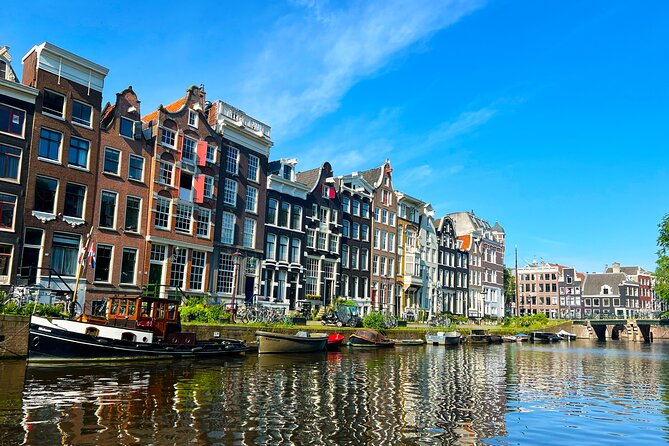
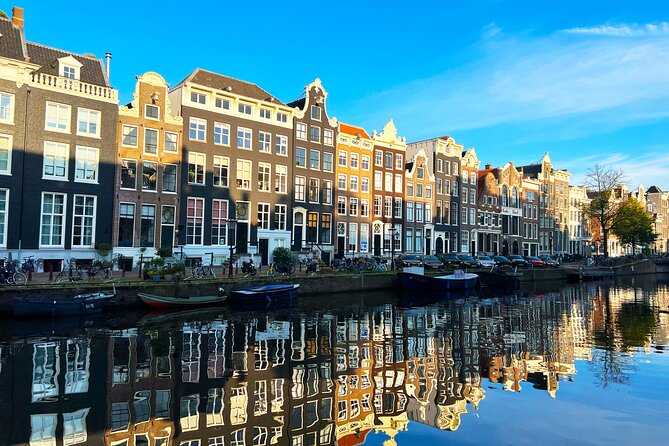
Torensluis is one of the more useful viewing points on the route because the wide bridge lets you compare several façade types at once. The tour focuses on four designs popular with Amsterdam’s merchant class during the Golden Age.
You’ll see how Baroque ideas were adapted to local needs. Dutch buildings often had to fit tight plots along canals, so grand design took a narrow, vertical form. The result is a row of houses that may look similar at first glance but reveal different gables, details, and proportions when you take a closer look.
This is also a good place to notice Amsterdam’s crooked houses. Buildings lean for several reasons connected to age, construction, and the city’s soft ground. Some appear charmingly askew, while others show how difficult it was to maintain tall, narrow structures on unstable soil.
The bridge is an ideal place to pause because you can read the façades as a group. On your own, you might photograph the canal and move on. With a guide, you get a visual checklist: compare the rooflines, ornament, windows, and angle of each building.
De Dolphijn and the people behind the façades
De Dolphijn adds a personal story to the architectural route. Its name refers to a dolphin, a symbol linked with wealth and Amsterdam’s maritime trade. The house was once owned by Frans Banning Cocq, the captain associated with Rembrandt’s famous painting The Night Watch.
That connection gives the building extra meaning. You are not simply studying an attractive canal house. You are standing near a home tied to a prominent figure from Amsterdam’s commercial and civic world.
The stop is brief, about five minutes, but it helps connect architecture with biography. Merchant houses were shaped by the fortunes, ambitions, and public roles of their owners. A façade could signal prosperity, professional success, and a place in the city’s social order.
If you know The Night Watch, this stop may be especially appealing. If you do not, the guide can still use De Dolphijn to explain how Amsterdam’s wealthy residents lived and how their homes reflected their position.
More Walking Tours in Netherlands:
- Rotterdam: Architectural Highlights Guided Walking Tour
★ 4.8 · 215 reviews - Rotterdam: Highlights, Gems, Architecture & History Walk
★ 5.0 · 191 reviews - Rotterdam Walk: Hilights, Gems, Architecture & WWII | 2 or 3hrs
★ 5.0 · 149 reviews - Rotterdam Architecture Highlights Walking Tour
★ 5.0 · 66 reviews
The Ronde Lutherse Kerk dome
The Ronde Lutherse Kerk provides a change of shape and purpose. Instead of a narrow private house, you will consider a religious building and the importance of domes as a major architectural achievement during the Renaissance period.
The stop is short, around five minutes. It is best understood as a quick comparison with the canal houses around it. Private buildings emphasized narrow lots and merchant identity, while a church required a larger public presence and a form that could be seen across the city.
The tour does not list an interior visit here, so expect an exterior explanation. This is one of the shorter stops, but it breaks up the run of residential façades and shows that Golden Age architecture was not limited to merchant homes and warehouses.
Prinsengracht warehouses and the mechanics of trade
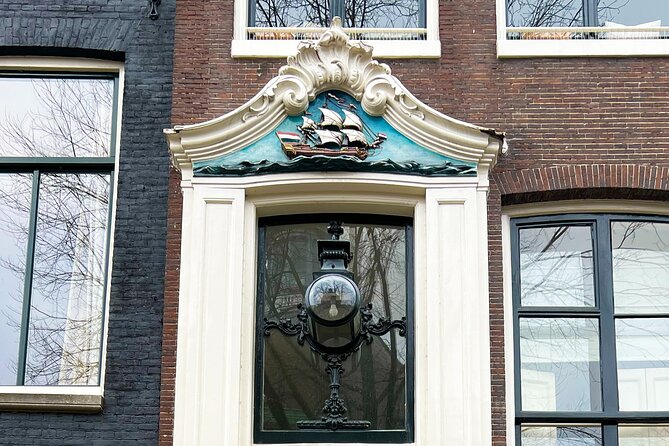
At Prinsengracht, the focus shifts from ornament to function. The warehouses along the canal were built for Amsterdam’s trading economy, and their design shows exactly how goods moved through the city.
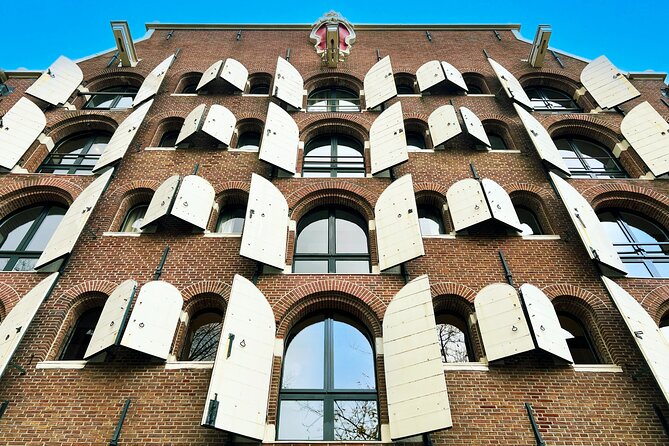
Look up at the steep gables and roof-level wooden hoisting beams. Those beams allowed merchants and workers to lift cargo from boats and bring it into storage areas above. The architecture was shaped by a practical problem: canal houses were narrow, streets were tight, and heavy goods had to move vertically.
The large windows helped with light, while the simple façades reflected the working purpose of the buildings. These were not designed mainly as showpieces. Their scale still hints at the money handled by the merchants who used them.
This stop is valuable because it explains a feature many people photograph without understanding. Once you know what the roof beams were for, the canal district becomes easier to read. Amsterdam’s architecture is not just decorative. It records how trade worked.
Jordaan and the stories told by facade stones
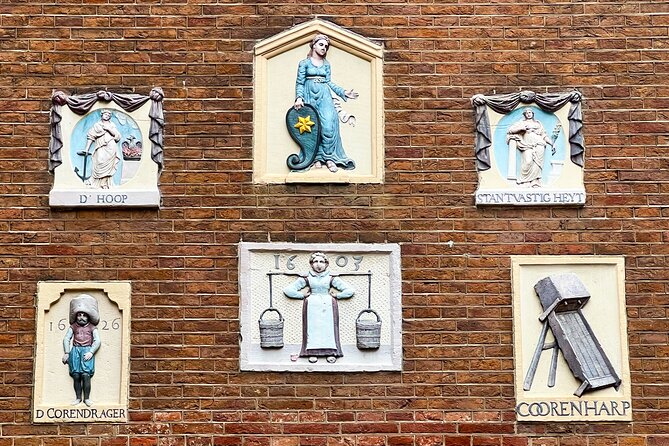
The Jordaan receives about 20 minutes, making it the longest stop on the route. That extra time is useful because the neighborhood supports a closer look at everyday architecture and the small signs built into its façades.
In the 17th century, Jordaan was a district of craftspeople, laborers, shops, and homes. Buildings often combined living quarters with workspaces, so the neighborhood offers a different view from the grander merchant houses.
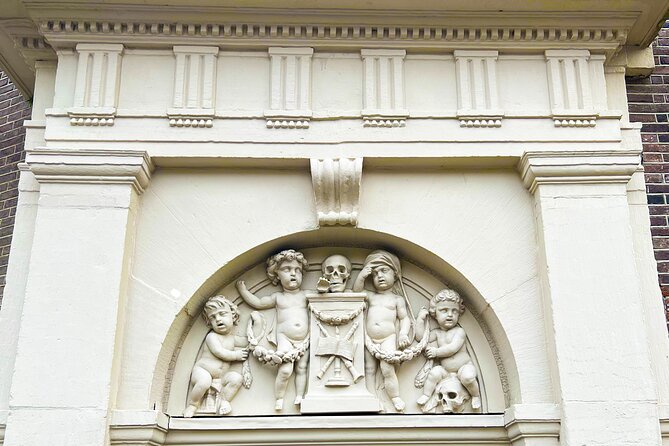
The main subject here is the gevelsteen, or facade stone. These small carved plaques were set into building fronts and could show a profession, a trade, a household, or another important fact about the people connected with the building.
I like this part of the tour because it gives you something practical to keep using after the walk. Once your guide points out facade stones, you can begin spotting them on your own. They turn a plain street into a collection of small clues.
The stones also show how people communicated before modern street signs and business branding. A carving might identify the work done inside, the building’s former use, or the identity of its owner. You can think of them as compact pieces of public storytelling.
Jordaan is also where the tour’s social history becomes clearer. Amsterdam’s wealth did not belong to one group. The canal belt included merchants, workers, craftspeople, and families with different levels of income. The buildings reveal those differences through size, decoration, and location.
Westerkerk and the route’s final view
The tour ends at Westerkerk, at Prinsengracht 279, near the Anne Frank House. The church is one of Amsterdam’s best-known landmarks and gives the walk a strong finish.
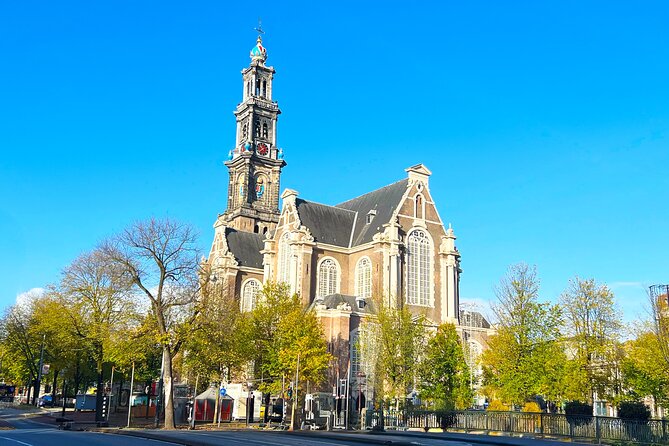
Westerkerk was built as a Calvinist church for the city’s growing population. Its interior design is known for being large, airy, and relatively restrained, reflecting Calvinist preferences in worship spaces. The tour focuses on its historical and architectural importance, but the listed plan does not include an interior visit.
The tower rises 85 meters, or about 280 feet, above Jordaan. It was completed in 1638 and is topped with the imperial crown, a symbol connected with Amsterdam’s status. The clock and its chimes have marked the hours for centuries, and Anne Frank wrote about the sound in her diary.
Rembrandt is also associated with Westerkerk as his final resting place. The church therefore brings together several themes from the walk: religion, city identity, art, public life, and the people who shaped Amsterdam’s culture.
Finishing near the Anne Frank House is convenient if that is part of your sightseeing plan. Keep in mind that the walk itself does not include entry to the church or Anne Frank House, so arrange those separately.
What the private format is worth
The price is $73.59 per person. That is not the cheapest way to see Amsterdam’s canals, but the comparison is not really with a free stroll. You are paying for a private guide, a focused subject, and the chance to ask questions throughout the route.
The value improves for a small group. Three people, for example, can share one guide while keeping the conversation personal. You are not waiting for a large group to gather or trying to hear a guide across a busy street.
Anna is the named local guide connected with this experience. Her strengths include explaining architecture in plain language, answering many questions, adjusting for photo stops, and connecting buildings with Amsterdam’s history and social policies. Her local connection also helps make the route feel less like a list of famous addresses.
This is a good choice if you want to understand what you are seeing. It is less useful if your main goal is to enter historic buildings, climb towers, or spend a long time at each site.
Timing, walking, and practical details
The walk lasts about 1 hour 30 minutes. The stop lengths range from five to 20 minutes, so you will keep moving and standing. Wear comfortable shoes and plan for outdoor conditions.
The tour is offered in English and includes a mobile ticket. It is near public transportation, and most people can take part. Service animals are allowed. Bottled water is not included, so bring your own.
The experience is not recommended for people who use a walker or have trouble walking and standing for 90 minutes. Mobility aids are not available. Because this is a private activity, your group will not be combined with other participants.
You receive confirmation when booking, and free cancellation is available up to 24 hours before the start time. Changes or cancellations made within 24 hours are not accepted for a refund.
Who should book this Amsterdam architecture walk?
I would choose this tour for a first or second visit to Amsterdam if you want the city’s buildings to make more sense. It suits architecture fans, history students, photographers, and anyone who enjoys asking detailed questions.
It is also a good fit for couples, families with older children, or a small group of friends who prefer a private conversation. The route covers many central sights without trying to turn each one into a long museum lecture.
I would skip it if you need a seated experience, want substantial time inside buildings, or prefer a general tour covering food, art, and nightlife. The subject is specific: Golden Age architecture and the forces behind it.
Should you book it?
Book this walk if you often look at Amsterdam’s canal houses and wonder why they lean, why their roofs have beams, or what those tiny carved plaques mean. The route answers those questions while showing how trade, faith, engineering, and social class shaped the city.
At $73.59 per person, it earns its price through the private format and the guide’s personal attention. Go prepared to walk and stand for 90 minutes, and you will get the most from Anna’s explanations. For a compact, architecture-focused introduction to central Amsterdam, this is a strong choice.
FAQ
How long does the Golden Age architecture tour last?
The tour lasts approximately 1 hour and 30 minutes.
Where does the tour begin?
It begins at the Royal Palace Amsterdam, at Nieuwezijds Voorburgwal 147, 1012 RJ Amsterdam.
Where does the tour end?
The tour ends at Westerkerk, Prinsengracht 279, 1016 DL Amsterdam, near the Anne Frank House.
Is this a private tour?
Yes. Only your group participates in the activity.
Is the tour offered in English?
Yes. The experience is offered in English.
What is included in the price?
A private guide is included.
Is bottled water included?
No. Bottled water is not included.
Can people with mobility limitations join?
Most people can participate, but the tour is not recommended for people who use a walker or have trouble walking and standing for 1.5 hours. Mobility aids are not available.
Are service animals allowed?
Yes. Service animals are allowed.
Can I cancel for a full refund?
Yes, if you cancel at least 24 hours before the experience’s start time. Cancellations made less than 24 hours before the start time are not refunded.
New to the itinerary around Netherlands
- Escape Room – l’Architecte★ 4.5 · 13 reviews
- Private Rotterdam Walking Tour – guided by Architects★ 5.0 · 2 reviews
- Rotterdam Must Do Tour: Highlights, History, WW2 and Architecture★ 5.0 · 20 reviews
- Rotterdam Architecture and Highlights Walking Tour (TOP RATED)★ 4.5 · 14 reviews
- Maastricht Highlights, Architecture & Heritage Tour★ 5.0 · 7 reviews
- Gouda Private Walking Tour: History, Architecture & Cheese★ 4.5 · 8 reviews
- Amsterdam Walking Tour. All about History, Architecture, Traditions & Anecdotes.★ 5.0 · 2 reviews
- Rotterdam Architecture: Centre and South Bank with watertaxi★ 5.0 · 4 reviews
Private Architecture Tours, compared.

Sagrada Familia & Gaudi Tour Private or Small Group with Tickets
Read our review →
Barcelona 1.5h Private Old Town, Gothic & Ramblas Walking Tour
Read our review →
Treasures of Barcelona: Private Gaudi Walking Tour
Read our review →
Sagrada Familia & Gaudi Guided Tour Private or Small Groups
Read our review →
Best of Chicago: Architecture & Highlights City Private Tour
Read our review →
Private Harajuku Omotesando Architecture Walking Tour
Read our review →
Private Santa Barbara History and Architecture Walking Tour
Read our review →
Private Barcelona Modernism and Gaudí Walking Tour
Read our review →Other lists with this tour