
Review · ROTTERDAM
Rotterdam: Wilhelminapier, High-rise & floating architecture
Rotterdam’s Wilhelminapier is where the city’s port past meets its boldest new architecture. This one-hour private tour takes you from the red Het Nieuwe Luxor Theater to the former Holland America Line area, into Pakhuismeesteren, and up to a rooftop view of the skyline. You also get a close look at De Rotterdam and several floating projects along Rijnhaven.
I like the mix of history and design, and I like that the rooftop entrance is included rather than left as a vague promise. The tour is also wheelchair accessible and available in five languages. The main catch is time: one hour is enough for an introduction, but not for a slow architectural study or a long stop at Foodhallen.
Key points to know before booking
- The Wilhelminapier changed from ocean-liner port to high-rise district, and the guide explains that shift as you walk.
- Pakhuismeesteren’s rooftop is the visual payoff, with a broad view of Rotterdam’s modern skyline.
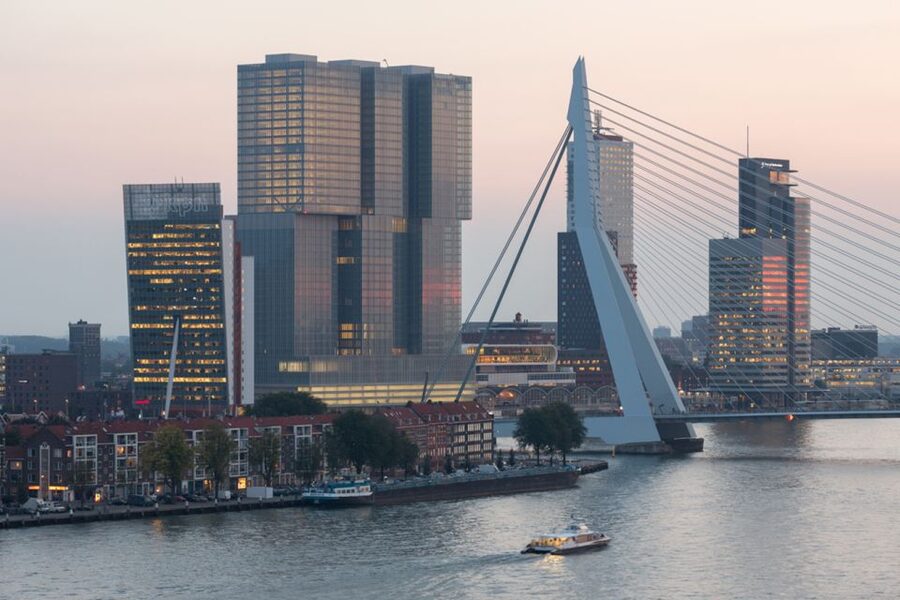
- De Rotterdam gets proper attention, including its concept, design, and place in the city.
- Foodhallen occupies a former harbor warehouse, giving the stop both architectural and food interest.
- Rijnhaven’s floating hotel, park, and office show Rotterdam testing new ways to use water.
- The $286 price covers a private group of up to six, making the value much better for a full group than for one or two people.
Why the Wilhelminapier makes a good one-hour tour
I find the Wilhelminapier especially useful for understanding Rotterdam because the area tells a clear before-and-after story. This was tied to the Holland America Line, with ships carrying people between Europe and North America. Today, it is known for tall buildings, new public spaces, and eye-catching architecture.
That contrast gives the tour a strong backbone. You are not simply looking at impressive buildings one by one. You are learning how a working port district became one of Rotterdam’s main architectural showcases.
The setting also keeps the walk compact. The meeting point is outside Het Nieuwe Luxor Theater, the large red building near the pier. From there, the route connects the theater area, Pakhuismeesteren, the high-rise buildings, and the edge of Rijnhaven. Since the activity lasts only an hour, the guide needs to keep the pace moving.
I would not book this expecting a long museum visit, a full meal, or a detailed tour of every building. Think of it as a focused introduction that helps you know what you are seeing when you later explore the district on your own.
More Skyscraper Tours in Netherlands:
- Chicago Premium Driving Tour with River Boat Cruise and Sky Deck
★ 4.5 · 165 reviews - Chicago Walking Tour: Art Deco Skyscrapers Loop
★ 5.0 · 138 reviews - Chicago Walking Tour: Art Deco Skyscrapers Riverfront
★ 5.0 · 53 reviews
Starting at Het Nieuwe Luxor Theater
Your guide meets you outside Het Nieuwe Luxor Theater. The red building is a practical landmark, so you do not need to search for a hidden doorway or reception desk. Arrive ready to walk, since the experience moves through an open urban area rather than staying inside one building.
The guide can lead the tour in Dutch, English, German, Spanish, or French. That range is helpful for mixed-language groups, especially since this is a private booking. You are not joining a large crowd with one fixed pace or one language.
The supplied information does not name the guide in advance. One earlier booking was led by Willem, and the experience was described as a pleasant walk with humor and useful facts. That gives you a sense of the intended tone: informative, but not stiff or overly academic.
The guide’s role matters here. Rotterdam’s high-rises can look like a collection of unrelated towers if you walk through the area alone. A guide can point out how the buildings fit into the redevelopment of the pier and explain why architects used such a large scale.
From Holland America Line history to modern Rotterdam
The first major theme is the transformation of the Wilhelminapier. The area’s connection to the Holland America Line gives the modern buildings a human story. This was once a place associated with long-distance departures, arrivals, and ocean travel. The new towers now frame a very different kind of city life.
I like this historical layer because it prevents the tour from becoming a simple parade of glass and concrete. You get a reason for the district’s importance before examining its newer design.
The former Holland America Line connection also helps explain why the Wilhelminapier feels different from an ordinary office district. The architecture is not placed on an empty plot without context. It sits on a pier with a strong link to movement, migration, trade, and the river.
The tour ends near Fenix Migration Museum, Rotterdam’s newest icon according to the supplied description. The museum itself is not listed as an included interior visit, so you should treat it as a useful endpoint and a possible next stop, not part of the tour admission.
De Rotterdam and the scale of high-rise design
A central part of the walk focuses on De Rotterdam. The guide explains its history, concept, and design, helping you read the building as more than a giant block on the waterfront.
De Rotterdam is one of the key structures that gives the Wilhelminapier its identity. From street level, its height and mass can be difficult to take in. A guide can make the building easier to understand by discussing how its different sections and functions relate to the larger plan for the district.
I would pay attention here if you enjoy architecture but do not have technical training. The tour is designed to explain the ideas behind the buildings, not just name the architects. You can expect a general explanation of what makes the structures important rather than a specialist lecture on engineering drawings or materials.
The short duration shapes this part of the experience. You will hear the main design story, then continue. If you want to photograph details, compare facades, or sketch the buildings, you will need to return later. The tour gives you context and a strong first look, not hours of inspection.
More Architecture Tours around Netherlands:
- Rotterdam: Architectural Highlights Guided Walking Tour
★ 4.8 · 215 reviews - Rotterdam: Highlights, Gems, Architecture & History Walk
★ 5.0 · 191 reviews - Rotterdam Walk: Hilights, Gems, Architecture & WWII | 2 or 3hrs
★ 5.0 · 149 reviews - Rotterdam Architecture Highlights Walking Tour
★ 5.0 · 66 reviews
Pakhuismeesteren: warehouse, hotel, and rooftop view
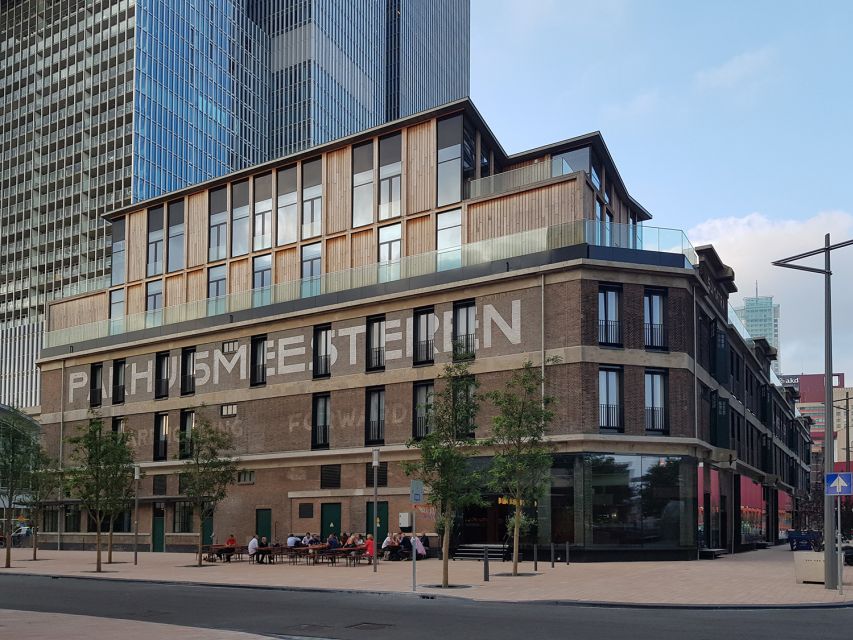
Pakhuismeesteren is the most varied stop on the route. The building began as a harbor warehouse and now contains a hotel and Foodhallen. That change captures Rotterdam’s habit of giving old port buildings new work instead of treating them as untouchable relics.
You visit the building from inside and go up to the rooftop. This is a real advantage, since the view gives you a better sense of how the Wilhelminapier fits into the city. From above, you can take in Rotterdam’s skyline and its collection of modern buildings from one clear vantage point.
The rooftop entrance is included in the tour price. That makes the visit feel more complete than a street-only architecture walk. You are not just hearing about the district. You get a chance to see its shape from above.
The view is also likely to be the tour’s best photo opportunity. The supplied details promise a scenic, panoramic look at Rotterdam and its architecture, but they do not give a guarantee about weather or visibility. On a rainy or cloudy day, the experience remains useful for the building history, though the rooftop may not have the same impact.
A Dutch treat is included as well. It is a small extra rather than a meal, so do not arrive expecting the tasting portion to replace lunch. I see it as a pleasant local touch during a tightly timed walk.
Foodhallen inside a former harbor warehouse
Foodhallen gives Pakhuismeesteren a more everyday side. Instead of seeing the former warehouse only as a preserved industrial shell, you see how it now works as a public food destination.
The stop is particularly useful if you like architecture with a practical purpose. Foodhallen is described as a must-see for food lovers, but the tour does not include a full food tour or meal. You will see the setting and hear about its role in the building, while the included Dutch treat gives you a small taste along the way.
If you want to eat properly, plan another visit or allow time before or after the tour. The one-hour schedule leaves little room to browse stalls, wait for food, and sit down without cutting into the walking route.
I like this stop because it keeps the tour from feeling too formal. The route moves between major buildings and a place where people actually gather, eat, and spend time. That contrast makes the redevelopment easier to understand.
Rijnhaven’s floating park, hotel, and office
The final major theme is floating innovation along Rijnhaven. You stop to look at three kinds of projects: a floating hotel, a floating park, and a floating office.
These projects show Rotterdam using its water in an active way. Instead of treating the harbor only as scenery, the city is testing how buildings and public spaces can sit on the water. For you, this adds a forward-looking chapter to the tour after the historical story of ships and port warehouses.
The floating projects are viewed from the route. The information does not say that you enter the hotel or office, so expect an exterior look and an explanation from the guide. That is still worthwhile, especially if you want to understand how the city is experimenting with limited urban space.
This section may appeal most to people interested in planning, sustainability, and unusual buildings. It also gives children and teenagers something concrete to look at, since floating structures are easier to discuss than an abstract planning policy.
What the private format adds
The tour costs $286 for a private group of up to six people. For a full group, that works out to about $47.67 per person. At that rate, the private format can make good sense, especially if you want your own language, your own pace, and a guide focused on your group.
For one person or a couple, the price is much harder to justify. The tour lasts one hour, and the route covers a compact area. You are paying for private guiding, the rooftop entrance, and the convenience of a dedicated explanation, not for a long full-day activity.
I would compare this with the cost of booking separate attractions and hiring a guide elsewhere. The value improves if you care about architecture and want a structured explanation rather than a casual walk. It is weaker if you mainly want a rooftop view, since the history and design discussion make up much of the experience.
The private format also helps if your group includes people with different interests. One person can ask about the Holland America Line, another can ask about De Rotterdam, and a third can focus on floating design. That flexibility is difficult in a large public group.
Accessibility, languages, and practical timing
The tour is wheelchair accessible, which is important for a route involving modern public buildings and a rooftop visit. The provided details do not explain the exact lift or route arrangements, so if your group has specific mobility needs, confirm the practical details when booking.
You can choose Dutch, English, German, Spanish, or French. The guide is live rather than prerecorded, so you can ask questions as you go.
The activity lasts one hour. I would schedule it near the start of your time in Rotterdam if you want orientation for the rest of your visit. The Wilhelminapier and Rijnhaven area can then feel easier to read when you return independently.
The price includes free cancellation up to 24 hours before the start time, and you can reserve without paying immediately. Those terms are useful if your day in Rotterdam depends on weather or a changing train schedule. Availability and start times need to be checked for your chosen date.
Who will get the most from this tour
I would choose this experience for a small group that wants a quick but meaningful introduction to Rotterdam’s modern side. It suits architecture fans, first-time visitors, and anyone curious about how a port district can change without losing its connection to the water.
It also works well for people who prefer explanation to self-guided wandering. The buildings are striking, but their purpose and history are not always obvious from the sidewalk.
Families may appreciate the short length, the rooftop, the floating structures, and the Dutch treat. The tour is less suitable if you want a relaxed meal at Foodhallen, a long photography session, or a full history of Rotterdam.
The three available ratings were all four out of five. That fits the experience as described: the walk offers an interesting setting, a pleasant guide-led explanation, and a useful rooftop stop, but the compact schedule limits how much detail you can cover.
Should you book the Wilhelminapier architecture tour?
Book it if you have up to six people, care about Rotterdam’s buildings, and want a private guide to connect the Holland America Line past with De Rotterdam, Pakhuismeesteren, and the floating projects at Rijnhaven. The rooftop view and included Dutch treat add value to the short route.
Skip it if you want a full food experience, a long architectural lecture, or the cheapest possible way to see the skyline. At $286, it is best treated as a private orientation tour. For the right group, it gives you the story behind one of Rotterdam’s most unusual districts and leaves you near Fenix Migration Museum for your next stop.
FAQ
Where does the tour meet?
The meeting point is outside Het Nieuwe Luxor Theater, which is the red building.
How long does the experience last?
The tour lasts one hour.
How much does the private tour cost?
The price is $286 for a private group of up to six people.
Which languages are available?
The live guide can conduct the tour in Dutch, English, German, Spanish, or French.
Is the tour wheelchair accessible?
Yes, the activity is listed as wheelchair accessible.
Is the rooftop entrance included?
Yes, entrance to the Pakhuismeesteren rooftop is included.
Is food included?
A tasty Dutch treat is included. A full meal or Foodhallen food tour is not listed as included.
What floating projects will you see?
The route takes you past a floating hotel, floating park, and floating office along Rijnhaven.
Can you cancel for a full refund?
Yes, you can cancel up to 24 hours in advance for a full refund.
New to the itinerary around Netherlands
- Escape Room – l’Architecte★ 4.5 · 13 reviews
- Private Rotterdam Walking Tour – guided by Architects★ 5.0 · 2 reviews
- Rotterdam Must Do Tour: Highlights, History, WW2 and Architecture★ 5.0 · 20 reviews
- Rotterdam Architecture and Highlights Walking Tour (TOP RATED)★ 4.5 · 14 reviews
- Maastricht Highlights, Architecture & Heritage Tour★ 5.0 · 7 reviews
- Gouda Private Walking Tour: History, Architecture & Cheese★ 4.5 · 8 reviews
- Amsterdam Walking Tour. All about History, Architecture, Traditions & Anecdotes.★ 5.0 · 2 reviews
- Rotterdam Architecture: Centre and South Bank with watertaxi★ 5.0 · 4 reviews
Skyscraper Tours, compared.
Chicago Premium Driving Tour with River Boat Cruise and Sky Deck
Read our review →
Chicago Walking Tour: Art Deco Skyscrapers Loop
Read our review →
The Story Behind NY’s Evolving Skyline An Architectural Journey Through History
Read our review →Other lists with this tour