
Review · ROTTERDAM
Rotterdam: Architecture Highlights Tour including the Depot
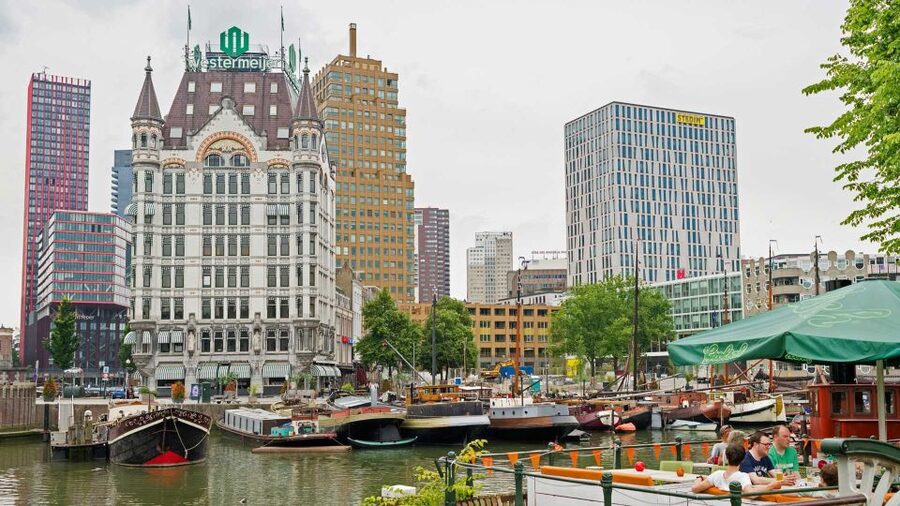
Rotterdam’s architecture is the main event here, and this tour gets you inside the story rather than leaving you to admire buildings from the pavement. You’ll move from the old port-era Het Witte Huis to the mirrored Depot, with sharp lessons in why this city keeps rebuilding itself.
I like the rooftop access and the private format for up to six people. I also like the mix of famous sights and less obvious buildings, especially the Timmerhuis and the post-war structures around Central Station. The main consideration is pace: two and a half hours on foot covers a lot, and people with mobility limits may find the route difficult despite the tour being listed as wheelchair accessible.
Key points at a glance
- Depot’s curved mirror facade: Learn how the double-curved panels and large entrance doors were engineered.
- Two different rooftop options: Weekday tours include a Timmerhuis rooftop visit, while weekend tours visit Het Witte Huis.
- A smart route through central Rotterdam: See Markthal, Grotekerkplein, Central Station, Museumpark, and many major buildings in one walk.
- Private groups up to six: You can ask questions and set the conversation around architecture, city planning, or construction.
- Useful extras: Receive three postcards by Rotterdam architectural photographer Ossip van Duivenbode and a 50 percent discount for the Cube Houses.
- Guides with a clear teaching style: Dutch, English, and German are available, and Frank Schipper has led the tour with a warm, well-informed approach.
Why Rotterdam works so well for an architecture walk
Rotterdam is a city where the buildings explain the city itself. War damage, post-war rebuilding, port wealth, bold planning, and a taste for new ideas all show up in a short walk through the center.
That makes this more useful than a simple list of pretty facades. Your guide explains why a building looks the way it does, what problem its designers were trying to solve, and how it fits into Rotterdam’s ongoing push for new construction.
You’ll see historic survivors beside post-war blocks and recent experiments. The contrast is the point. Rotterdam does not hide its odd corners or smooth over its architectural arguments.
The private format helps here. With a maximum of six people, you can stop to ask why a structure uses glass, steel, mirrors, or unusual angles. Reviews of the tour praise the clear explanations of building history, structural systems, and the engineering behind tall buildings. That is useful if you want more than a quick photo stop.
Frank Schipper is one guide associated with the experience. His style has been described as cheerful, friendly, and highly informed, with a talent for making city building history approachable. The tour is also offered in Dutch and German, so you can choose the language that lets you follow technical details most comfortably.
More Architecture Tours around Netherlands:
- Rotterdam: Architectural Highlights Guided Walking Tour
★ 4.8 · 215 reviews - Rotterdam: Highlights, Gems, Architecture & History Walk
★ 5.0 · 191 reviews - Rotterdam Walk: Hilights, Gems, Architecture & WWII | 2 or 3hrs
★ 5.0 · 149 reviews
Starting at Het Witte Huis
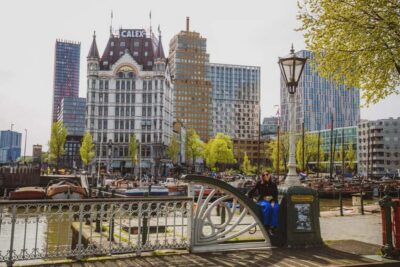
The meeting point is outside the entrance of Het Witte Huis, an important place to begin. Built as an early skyscraper, it gives you an immediate link to Rotterdam’s older commercial and port identity.
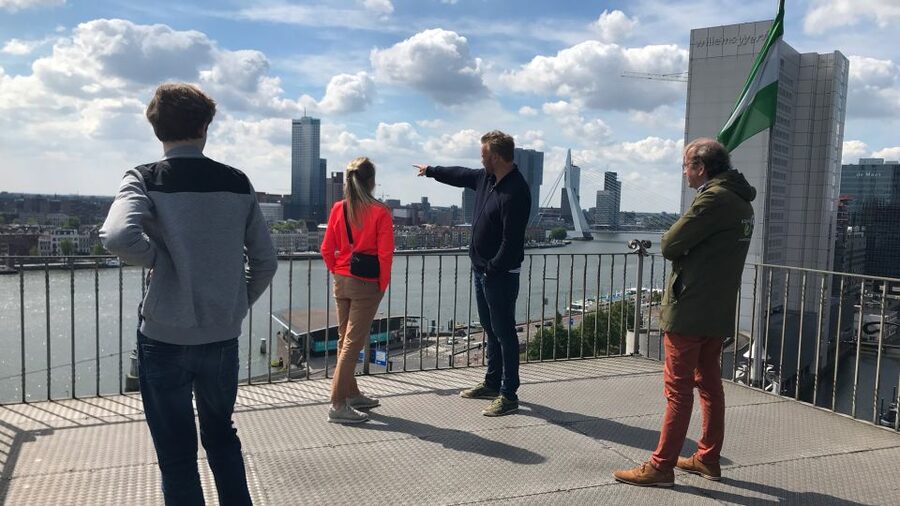
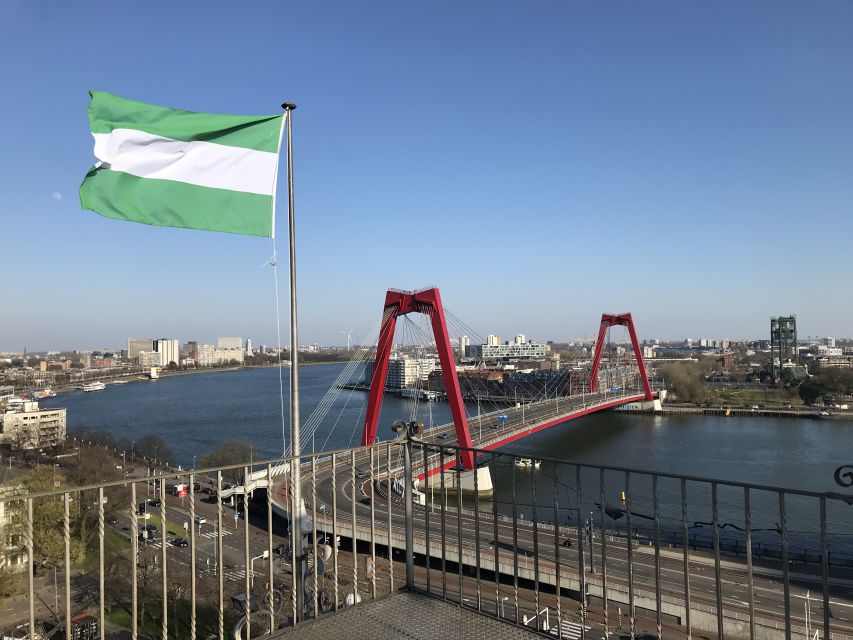
On weekend tours, you also visit the roof of Het Witte Huis. From there, you can look across to Markthal, the Cube Houses, the Erasmus Bridge, the Willems Bridge, De Rotterdam, and the surrounding center.
That view helps you read the city as a collection of different building eras. The bridges connect the visual story to the river, while the Cube Houses and Markthal show Rotterdam’s willingness to turn ordinary city functions into large design statements.
The weekend rooftop visit is a strong reason to choose a Saturday or Sunday if your schedule allows. It provides a broad view before the walking route begins. The tradeoff is that weekday tours use a different rooftop option, so you should not assume you will get the Het Witte Huis roof on every departure.
The meeting point is easy to understand, but you should arrive ready for a walking tour. The route moves through central Rotterdam and ends near Museumpark and Depot Boijmans van Beuningen rather than returning you to the starting point.
Markthal and the Cube Houses
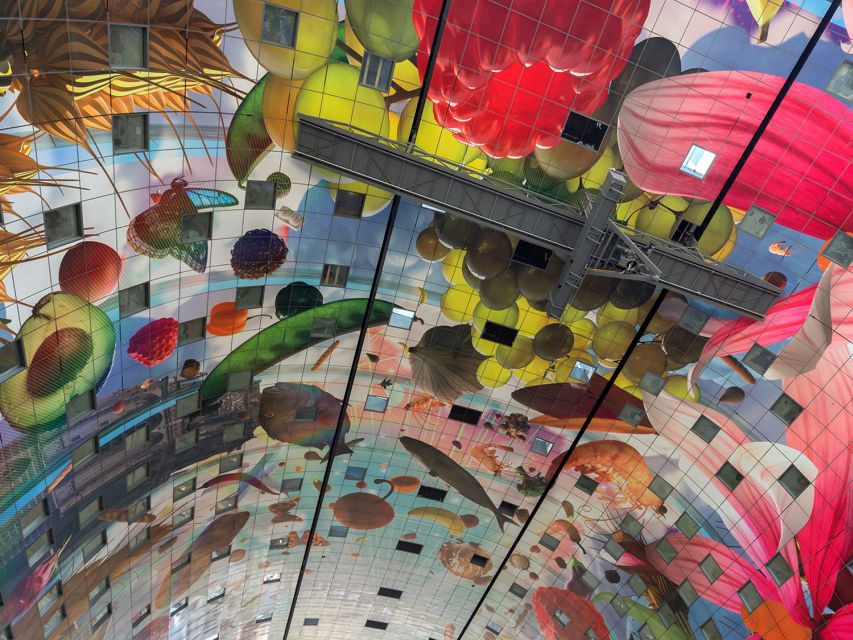
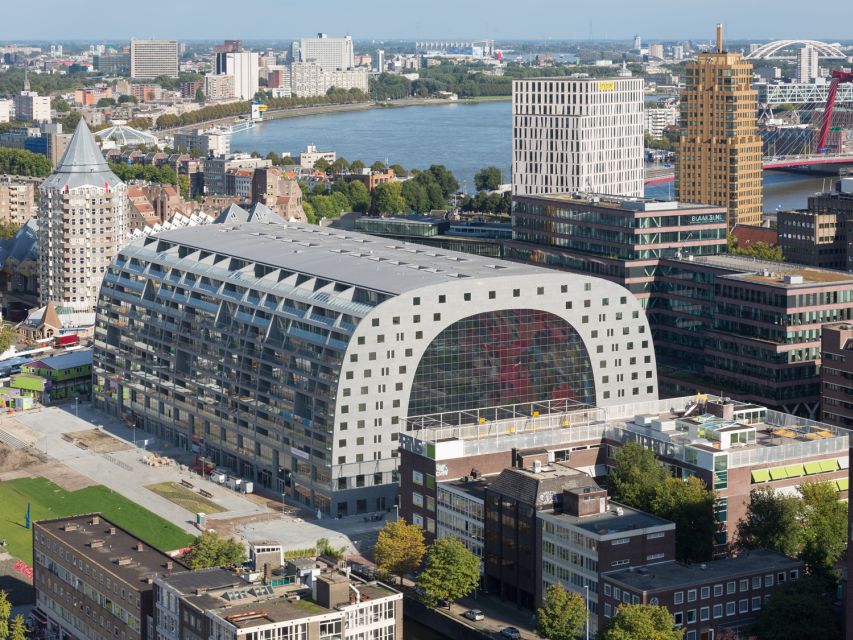
The route continues through Markthal, one of Rotterdam’s most recognizable modern buildings. Its design combines housing with a large indoor food setting, making the structure work as both a residential block and a public market.
Your guide can help you look beyond the colorful interior and focus on the basic idea: people live in the arching outer structure, while the central space functions as a public food hall. It is a good example of Rotterdam trying to use land efficiently while creating a place with social energy.
Markthal is also a useful stop for visitors who want a break from technical architecture talk. The building is easy to appreciate at a glance, but the design concept becomes more interesting when you understand how housing and public use share the same volume.
You receive a 50 percent discount on entry to the Cube Houses. The tour does not make the Cube Houses the central stop, so plan to use the discount separately if you want to go inside one. From the rooftop at Het Witte Huis, you can see how their tilted forms create a sharp contrast with more conventional city blocks.
This part of the route can feel busy, especially around the market and central streets. That is not necessarily a drawback, but it means the guide’s explanation matters. You will get more from the stop by listening for the urban planning choices rather than treating Markthal as only a photo backdrop.
Grotekerkplein and the weekday rooftop
At Grotekerkplein, you’ll see a newer public-space project with a city park and a public stage for music and dance. This stop shows that Rotterdam’s design story is not only about towers and landmark buildings. It is also about how streets and squares are adapted for daily life.
On weekday tours, the rooftop visit takes place at the Timmerhuis or a nearby terrace described as having a view over the city center and Markthal. This is a practical difference between tour days. If rooftop views are high on your list, check the departure details before booking.
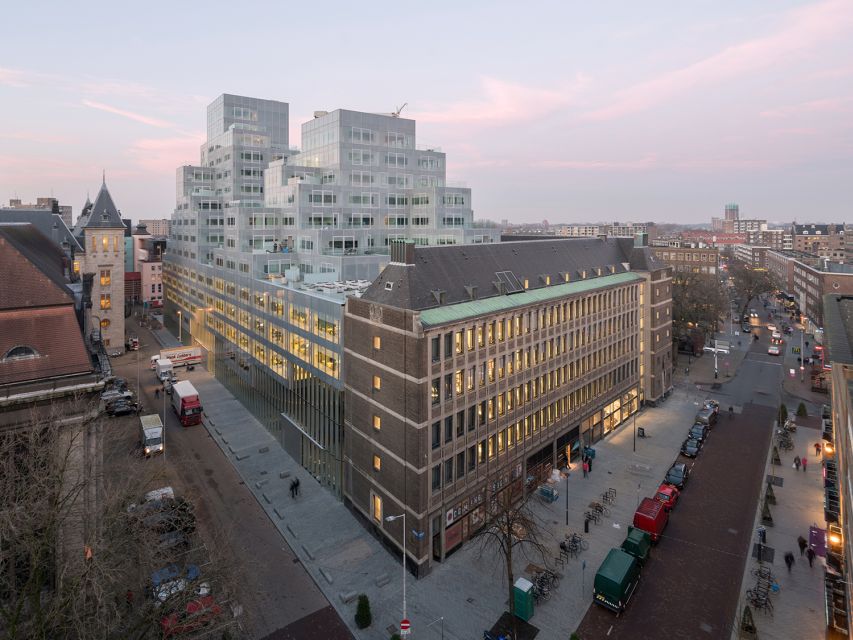
The Timmerhuis is one of the more rewarding stops for people who like the mechanics of architecture. Rotterdam-based firm OMA joined a municipal office block from the 1950s with a newer steel-and-glass structure made from pixel-like sections.
The result is not a clean replacement of the old building. It is a conversation between an earlier office block and a new structure. Your guide can explain how the two parts meet and why the redevelopment matters for a dense city center.
I like this stop because it asks a better question than Is the building beautiful? It asks how a city can reuse an existing structure while adding space, light, and a new public identity.
Same streets, read through a different style:
- Rotterdam Architecture Highlights Walking Tour
★ 5.0 · 66 reviews - The rise of Haarlem: Culture, History, Art and Architecture Walking Tour
★ 5.0 · 59 reviews - Rotterdam Must Do Tour: Highlights, History, WW2 and Architecture
★ 5.0 · 20 reviews - Walking Tour about Golden Age Architecture, private local guide
★ 5.0 · 15 reviews
From Dudok to Schouwburgplein
The walk passes Dudok’s Dudok, then continues toward several central buildings that tell the story of Rotterdam’s rebuilding after wartime destruction. You’ll see the post office and the de Bijenkorf warehouse, followed by Forum on the way to Schouwburgplein.
These buildings help connect the modern showpieces to the city’s commercial and civic functions. The route is not only a parade of new architecture. It includes older buildings, post-war monuments, and projects that reflect changing ideas about retail, offices, public space, and city movement.
Schouwburgplein provides another change of scale. The square is part of Rotterdam’s effort to create large civic spaces in the modern center. Depending on the day and activity, it may feel open and spare rather than cozy. That is worth knowing if you prefer old-town streets and small squares.
You will also pass Kruiskadeplein, where several important sights come into view. The Groothandelsgebouw, Rotterdam Central Station, and de Delftse Poort show different responses to transport, trade, and the city’s post-war renewal.
Central Station and the city’s rebuilding story
Rotterdam Central Station is one of the route’s most striking modern stops. Its architecture has a strong directional quality, drawing your eye toward the entrance and the flow of passengers.
A guide gives the station more meaning than a quick arrival photo. You can consider how a major transport hub has to handle movement, scale, public access, and a city’s image all at once.
Nearby, de Delftse Poort adds another layer to the story. The route also includes Calypso, Pauluskerk, and de Unie, giving you a sequence of buildings with different purposes and visual languages.
This is where the tour can feel dense. You cover many buildings in a short time, and not every stop receives the same amount of attention. That is a fair trade for seeing such a broad range in 2.5 hours, but you should choose this tour for variety and context rather than a slow study of two or three sites.
People with a serious interest in architecture may appreciate the pace because it creates comparisons. You can see how Rotterdam handles housing, transport, religion, offices, retail, and public gathering spaces in a compact route.
Museumpark and the road to Depot
The final stretch leads through Museumpark, with stops at Sonneveld House and Het Nieuwe Instituut. Both help broaden the tour beyond large commercial buildings.
Sonneveld House brings the focus to domestic design and modern living. It gives you a chance to consider architecture at the scale of a home, not only at the scale of a station or office tower.
Het Nieuwe Instituut adds a design and cultural angle. Together, these stops prepare you for Depot Boijmans van Beuningen, where the tour reaches its most recent architectural highlight.
You might notice that the route becomes more visually polished as it approaches Museumpark. That contrast with the city center is part of the appeal. Rotterdam’s architecture does not follow one neat style, and the tour makes that variety easy to see.
Because the tour lasts only 2.5 hours, the exact amount of time at each building can vary. If Sonneveld House or Het Nieuwe Instituut is your main interest, ask your guide how much attention the group can give them. The tour’s strongest focus is the city as a whole, ending with Depot.
Understanding the mirrored Depot
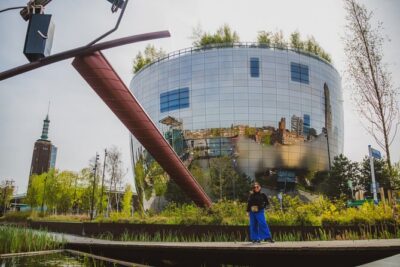
Depot Boijmans van Beuningen is the tour’s final eye-catcher. Its curved mirror facade reflects the surrounding park and city, making the building look different from each angle.
Your guide explains the idea behind the reflecting panels and the construction of the double-curved exterior. This is where the tour’s emphasis on engineering becomes especially useful. A mirrored surface may look simple from a distance, but the curved form creates demanding design and construction problems.
You’ll also hear about the aviation engineering techniques used to operate the huge entrance doors. That detail gives the building a practical edge. Depot is not only a dramatic shell. It has to function as the world’s first publicly accessible art depot.
That public role matters. A traditional museum displays selected works in galleries, while an art depot is concerned with storing and managing a much larger collection. The building therefore needs to support access, storage, and public interest at the same time.
You should not expect this walking tour to function as a full museum visit. Its focus is the architecture and the idea behind the building. If you want to explore the Depot’s contents in depth, you’ll need to arrange that separately.
Price, group size, and what you receive
The price is $494 per private group of up to six people. That works out to about $82 per person for six people, before considering the included extras. For two people, the effective price is much higher, so the value depends heavily on how full your group is.
For a family, a small architecture-minded group, or a professional design visit, the private format can make sense. You avoid being placed with a large crowd, and the guide can adjust explanations to your interests. For solo visitors or a couple on a tight budget, it is a significant spend for a 2.5-hour walk.
The package includes:
- An expert local guide
- A weekday rooftop entrance at Timmerhuis or a weekend rooftop visit at Het Witte Huis
- Three postcards by Rotterdam architectural photographer Ossip van Duivenbode
- A 50 percent discount for the Cube Houses
The postcards are a pleasant extra rather than a reason to book. The real value is the guide, private group, rooftop access, and range of buildings. The tour also allows free cancellation up to 24 hours before the start and offers reserve-now, pay-later booking, which can help if your schedule is still changing.
The tour is offered in Dutch, English, and German. Pets are not allowed, except for assistance dogs.
Who should book this Rotterdam tour?
I’d choose this tour if you want a strong first look at Rotterdam’s architecture and prefer explanations to a self-guided route. It suits people who enjoy city planning, structural design, modern buildings, and the way old and new construction share the same streets.
It is also a good choice for a small professional or student architecture group. The direct access to a guide and the private format make it easier to ask detailed questions about construction, materials, and redevelopment.
Families can enjoy it too, especially if the group likes unusual buildings. The Cube Houses discount gives you an extra option after the walk.
I would be more cautious if you want a relaxed stroll, an art museum visit, or a tour focused mainly on historic Rotterdam. The route is packed, and its interest comes from comparison across many buildings. Mobility is another concern. The experience is listed as wheelchair accessible, but it is also marked as unsuitable for people with mobility impairments, so confirm the current route and rooftop access before paying.
Should you book it?
Book it if you want a private, architecture-first introduction to Rotterdam and can fill several places in the group. The rooftop options, Markthal, Central Station, Timmerhuis, Museumpark, and Depot create a strong sample of the city’s design story.
Choose a weekend if the Het Witte Huis rooftop view appeals most. Choose a weekday if you prefer the Timmerhuis rooftop option and want to focus on the city’s newer redevelopment projects.
Skip it if $494 feels too high for a short walk, if you need a slow pace, or if your main goal is to spend time inside museums. For the right small group, though, this is a thoughtful way to understand why Rotterdam looks so different from other Dutch cities.
FAQ
How long does the Rotterdam architecture tour last?
The tour lasts 2.5 hours.
What is the price of the tour?
The price is $494 for a private group of up to six people.
Where does the tour begin?
Meet your guide outside the entrance of Het Witte Huis.
Which languages are available?
The tour is offered in Dutch, English, and German.
Is the tour private?
Yes. It is organized as a private group experience for up to six people.
Which rooftop will I visit?
Weekend tours visit the roof of Het Witte Huis. Weekday tours include rooftop access at the Timmerhuis, with a terrace offering views toward the city center and Markthal.
Is the tour wheelchair accessible?
The activity is listed as wheelchair accessible, but it is also marked as unsuitable for people with mobility impairments. Confirm the route and rooftop access before booking if mobility is a concern.
Does the tour include Cube Houses admission?
The tour includes a 50 percent discount on an entrance ticket to the Cube Houses. It does not state that full admission is included.
New to the itinerary around Netherlands
- Escape Room – l’Architecte★ 4.5 · 13 reviews
- Private Rotterdam Walking Tour – guided by Architects★ 5.0 · 2 reviews
- Rotterdam Must Do Tour: Highlights, History, WW2 and Architecture★ 5.0 · 20 reviews
- Rotterdam Architecture and Highlights Walking Tour (TOP RATED)★ 4.5 · 14 reviews
- Maastricht Highlights, Architecture & Heritage Tour★ 5.0 · 7 reviews
- Gouda Private Walking Tour: History, Architecture & Cheese★ 4.5 · 8 reviews
- Amsterdam Walking Tour. All about History, Architecture, Traditions & Anecdotes.★ 5.0 · 2 reviews
- Rotterdam Architecture: Centre and South Bank with watertaxi★ 5.0 · 4 reviews
Netherlands Architecture Tours, compared.
Rotterdam Walk: Hilights, Gems, Architecture & WWII | 2 or 3hrs
Read our review →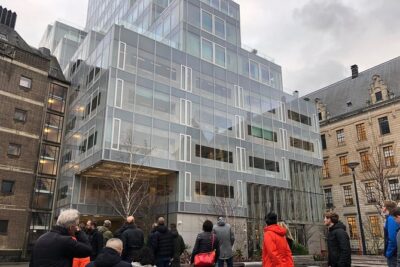
The rise of Haarlem: Culture, History, Art and Architecture Walking Tour
Read our review →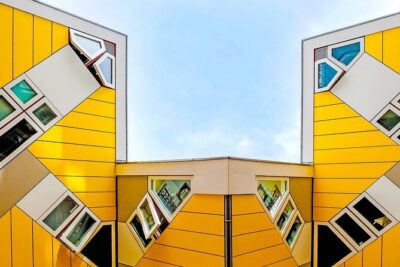
Rotterdam Must Do Tour: Highlights, History, WW2 and Architecture
Read our review →
Walking Tour about Golden Age Architecture, private local guide
Read our review →
Rotterdam Architecture and Highlights Walking Tour (TOP RATED)
Read our review →Other lists with this tour