
Review · COPENHAGEN
Copenhagen Architecture and Sustainability Tour with local Guide
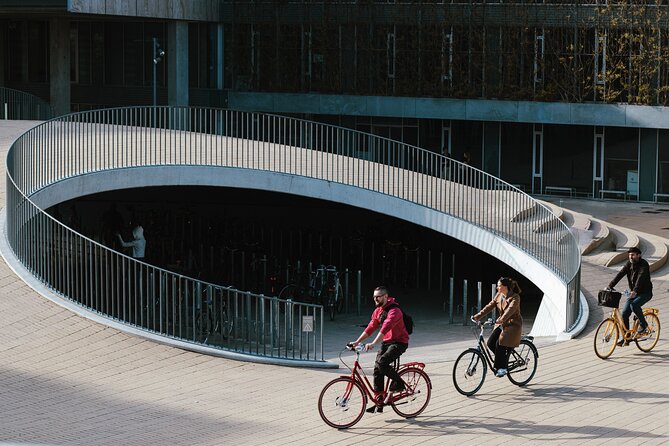
Copenhagen’s best story is not found in one grand palace. It is spread across bike bridges, shared housing, restored parks, and a once-polluted harbor. This three-hour ride takes you to those places, showing how the city handles daily life as much as it handles postcard views.
I like the way the route gets beyond the usual center, and I like the small group, capped at 15 people. Guides such as Jörn and Julia bring a clear focus to recent city development, not just old dates and royal names. The main drawback is physical: you will ride about 11 kilometers between stops, and busy harbor areas can feel crowded in summer.
Key points to know before you book
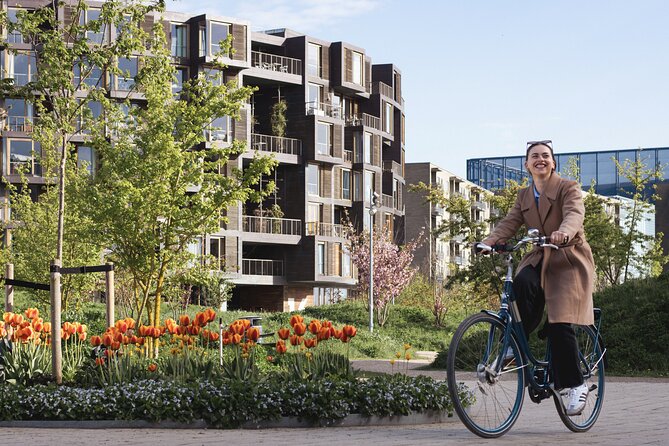
- About 11 kilometers of cycling: The ride covers much more ground than a walking tour, but you need a moderate level of fitness.
- A look at modern Copenhagen: Blox, Tietgen Residence Hall, Cykelslangen, and Enghave Park show how design meets social and environmental goals.
- Small-group format: The group is limited to 15 people, giving you a better chance to hear the guide and ask questions.
- Bikes are included: Children’s bikes are available in different sizes, and helmets are free upon request.
- Useful route for first-time visitors: The ride links the harbor, Amager, Vesterbro, Nørrebro, and central parks in one outing.
- Price and timing: At $72.57 per person for about three hours, this is good value if you want context and coverage, not just a bike rental.
A bike tour about how Copenhagen works
This is not mainly a sightseeing ride in the traditional sense. You will not spend the morning ticking off royal residences or stopping for long museum visits. Instead, the route uses buildings, bridges, parks, and public spaces to explain how Copenhagen has changed.
That makes the tour useful early in your stay. You get a broad sense of the city’s layout, including the harbor crossings, Amager, Vesterbro, and central Copenhagen. You also see how cycling fits into ordinary city movement rather than treating bikes as a special activity for visitors.
The three-hour schedule includes roughly 11 kilometers of cycling between stops. Most visits last around five to 15 minutes, so expect short talks followed by another ride. This keeps the outing moving, but it also means you should not expect a detailed architectural tour inside every building.
A group limit of 15 is a real advantage. The guide can usually speak to the whole group without shouting, and you have a reasonable chance to ask about a building or neighborhood that catches your eye. The pace remains social rather than private.
More Guided Tours around the world:
- Chicago River: 1.5-Hour Guided Architecture Cruise
★ 4.8 · 8,046 reviews - Park Güell: Guided Tour with Optional Gaudí Experience Entry
★ 4.1 · 832 reviews - Barcelona: Gaudi’s Casa Vicens Guided Tour
★ 4.8 · 401 reviews
Starting at Blox and crossing Lille Langebro
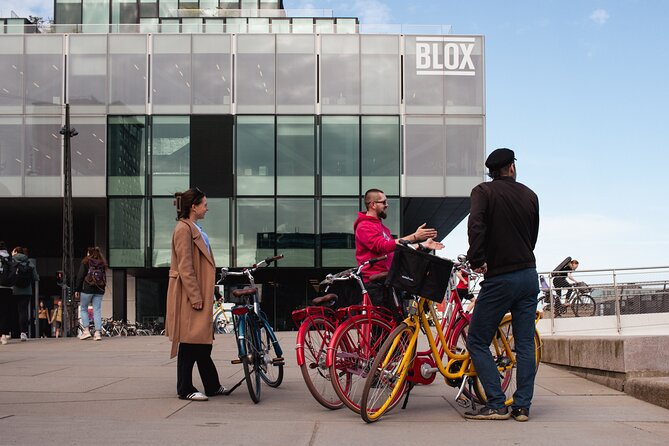
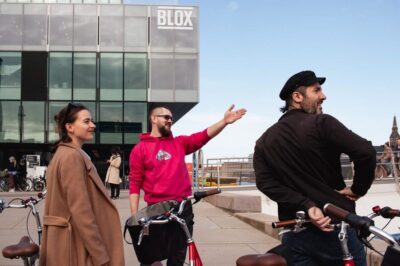
The ride begins at Vester Voldgade 2, close to public transportation. Blox is the first stop, and it sets the tone for the entire outing.
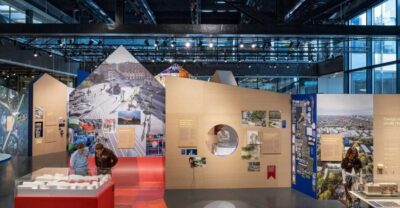
Blox is a mixed-use building developed with technical and social sustainability in mind. The Danish Architecture Center is its best-known occupant, with exhibitions about Copenhagen architecture. The tour does not include admission to an exhibition, so think of this stop as an introduction to the city’s current design thinking rather than a museum visit.
You may want to check what the Danish Architecture Center is showing before your tour. The exhibitions change, and a separate visit could add more value if architecture is a major interest. On the ride itself, the guide gives you about 10 minutes here, enough to understand the building’s purpose and place in the city.
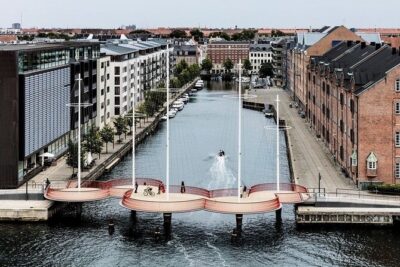
From Blox, the route reaches Lille Langebro. This bridge is designed for pedestrians and cyclists, making it part of Copenhagen’s effort to reclaim the historic harbor for daily public life. The harbor was once shaped mainly by trade and naval use. New crossings help connect neighborhoods while also making the waterfront a place to walk, ride, and spend free time.
This is a quick five-minute stop, so do not expect a long bridge design lecture. Its value comes from seeing the connection in use. You are not just hearing that Copenhagen supports cycling. You are riding on infrastructure built to make cycling and walking practical.
Islands Brygge and the city’s changing relationship with water
The next stop is Havnebadet at Islands Brygge. When this harbor bath opened in 2003, it marked a major change in how Copenhagen related to its water.
The stop lasts about 10 minutes. You will see a public swimming facility rather than a formal monument, but that is exactly why it matters. The harbor is presented as part of city life, not simply as a working edge or scenic backdrop.
This stop also gives you a useful sense of Copenhagen’s public-space priorities. A harbor bath asks a basic question: can a former commercial waterfront become a clean, accessible place for ordinary recreation? The tour uses that question to connect water quality, urban planning, and public use.
The practical issue is crowding. The harbor area can be very busy in summer, especially around the first waterfront stops. One rider specifically found the crowded area near the canal overwhelming, while still praising the off-the-beaten-path routing and friendly guide. If you prefer quiet streets and empty viewpoints, this portion may feel less relaxed than the later sections.
Tietgen Residence Hall and DR Koncerthuset
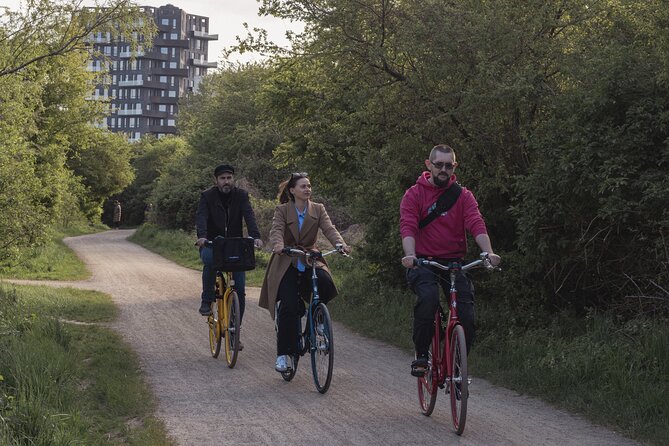
Tietgen Residence Hall gives the tour a more human angle. Its design supports both private life and community life for about 400 residents. Individual rooms are small and include a washroom, while kitchens, living rooms, and other facilities are shared by some or all inhabitants.
You spend about 10 minutes here. The point is not simply the circular or distinctive form of the building. The guide explains how architecture can encourage contact between residents while still giving each person a private room.
This is one of the route’s strongest stops if you want to understand the social side of sustainability. Energy systems and materials often get all the attention in green design. Shared facilities and social connection matter too, especially in a residence built for a large student population.
Next comes DR Koncerthuset, home to an 1,800-seat concert hall, the Royal Symphony Orchestra, smaller stages, and recording studios. The stop lasts around 10 minutes.
The building gives you a different version of modern Copenhagen. Tietgen Residence Hall focuses on everyday community life. DR Koncerthuset focuses on music, broadcasting, and large-scale cultural production. Together, the two stops show that contemporary architecture does not serve only one purpose. It can house people, support shared resources, and create spaces for public culture.
The route does not include a concert or interior performance. You are seeing the building as part of the city’s modern architectural story.
More Architecture Tours around the world:
- Chicago Architecture River Cruise
★ 5.0 · 15,756 reviews - Chicago River 90-Minute Architecture Tour
★ 4.5 · 9,629 reviews - Barcelona: Park Güell and Gaudí House Museum Entry Ticket
★ 4.5 · 6,326 reviews - Chicago Architecture Center River Cruise aboard First Lady
★ 5.0 · 5,536 reviews
Amager Fælled, from military ground to open nature
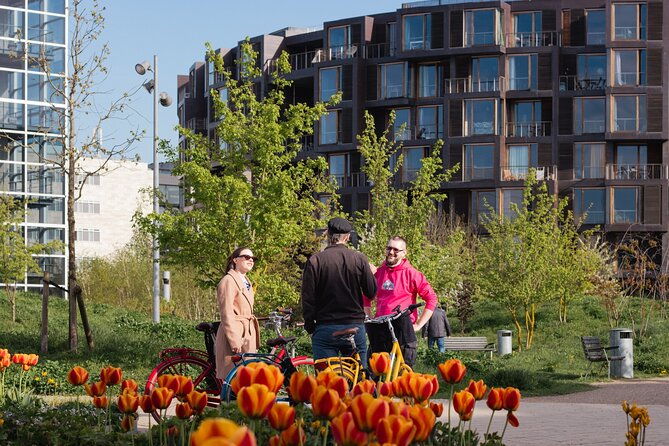
Amager Fælled is one of the more surprising stops. The area served as military training grounds and a shooting range from the 1700s through the 1950s. It later became a garbage dump, a history reflected in Amager’s joking nickname, Lorteøen, or shit island.
Today, Amager Fælled offers a rare patch of relatively untouched nature within Copenhagen. Much of the surrounding land is artificially reclaimed, which makes the area’s natural character even more striking.
The visit lasts about 15 minutes, the longest stop on the route. That gives the guide time to explain how land use can change over centuries. Military ground, waste site, and open natural area are not separate stories here. They are stages in the city’s growth and attempts to manage its limits.
This section is also a welcome change of pace after bridges and dense buildings. You get a more open setting and a chance to see that sustainability in Copenhagen is not only about polished new construction. It can also mean preserving or restoring space that already has ecological value.
Do not expect a wilderness excursion. This is still a city tour, and the stop is short. Its strength is the contrast with the built-up areas you have just left.
Cykelslangen and the logic of cycling
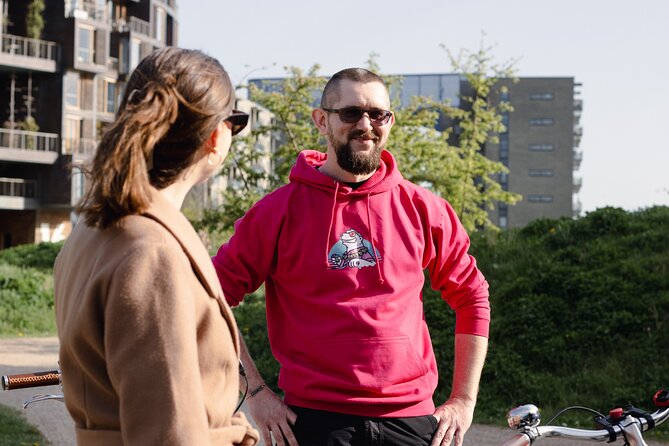
Cykelslangen, or the Cycle Snake, is one of the clearest demonstrations of Copenhagen’s cycling network. Together with Bryggebroen, it formed the first of the new harbor crossings built exclusively for cyclists.
You stop for about 10 minutes. The bridge is useful to see from a rider’s point of view because its design responds to the movement of bikes rather than treating cyclists as an afterthought. You experience the route instead of only photographing it.
This is where the tour’s subject becomes personal. The guide can explain cycling policy, but you also feel what it means to connect neighborhoods without stepping down from your bike or competing directly with car traffic.
The ride is not a race. You need to stay with the group and manage your bike confidently on city roads and shared routes. The tour description calls for moderate physical fitness, and that is the right way to read it. You do not need to be an athlete, but you should be comfortable riding for several hours with repeated stops and starts.
Enghave Park and rain control in Vesterbro
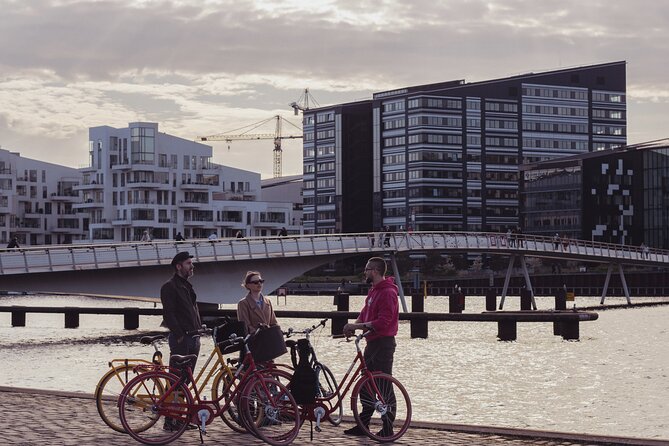
Enghave Park was created in the late 1920s on the site of former allotment gardens. Its original design followed a neoclassical plan, with a bandstand, playground, and sports fields.
Between 2017 and 2019, the park underwent a full redesign. The new work gives it a role in managing torrential rain in Copenhagen. This makes the park more than a pleasant green space. It is also part of the city’s response to heavier downpours and stormwater.
You spend about 10 minutes here. The guide can connect the formal older layout with the newer practical function, showing how a familiar neighborhood park can be adapted instead of replaced.
I find this one of the most useful stops for understanding sustainability as a daily concern. You do not need a technical background to see the point. A park can offer sports and recreation in normal weather while helping protect the city during extreme rain.
The short stop means you will not study every drainage feature in detail. Still, the location makes a difficult infrastructure issue easy to grasp.
Absalon and the Meatpacking District
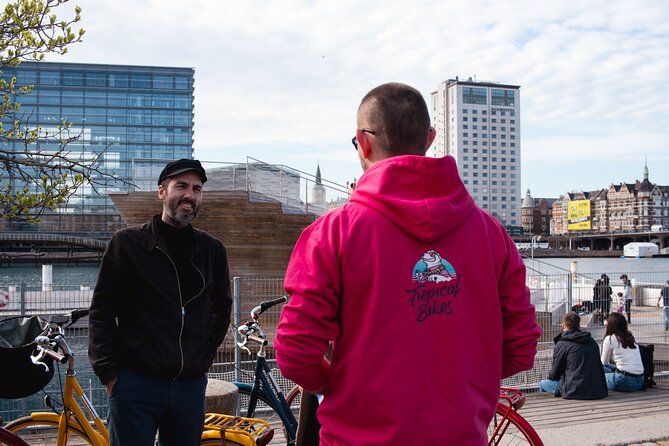
Folkehuset Absalon occupies a former church that has been converted into a privately run community center. The stop is only about five minutes, but the building adds another social dimension to the tour.
The important idea is reuse. A religious building can take on a new public role without disappearing from the neighborhood. This fits the wider focus on using existing spaces in practical ways.
After Absalon, the ride continues to Copenhagen’s Meatpacking District, known locally as Kødbyen. The city planned this district to create cleaner and healthier conditions for the meat trade as Copenhagen grew. It expanded through several building campaigns, leaving an urban area that shows how industrial architecture changed during the 19th and 20th centuries.
You have about 10 minutes here. It is a good place to connect public health, business, and architecture. The district was not planned as a trendy entertainment quarter first. Its original purpose was practical: organize food production under better sanitary conditions.
The area’s layered design also helps you read Copenhagen as a working city. You see how old industrial needs can shape streets and buildings long after the original businesses change.
Israel’s Square and Ørstedsparken
Israel’s Square and nearby Torvehallerne bring the route back toward food and public gathering. The square is now a meeting place for Copenhagen food lovers, but its past is just as revealing.
A farmers’ market occupied the area from the 1890s until the 1950s, after the old walled city’s strict building limits ended. Later, the whole area became a large parking lot. Its current public role marks another shift in how Copenhagen uses central land.
The stop lasts about 10 minutes. You get a compact lesson in urban priorities: market space, car storage, and public meeting place have all occupied the same ground.
The final listed stop is Ørstedsparken, an early example of reuse. It was once part of the city’s defensive system outside the walls. After the walls were demolished, the area became a park, retaining parts of the old moat as a lake, along with steep hills and winding paths.
This is a fitting ending because the park combines old infrastructure with new public use. It also gives you a calmer setting after the busier central streets. The stop lasts around 10 minutes, and the remaining time is spent cycling back to the starting point.
What the $72.57 price really covers
At $72.57 per person, this costs more than hiring a bike for three hours. The difference is the route and the guide. You receive a bicycle, local guidance, and a carefully linked look at architecture, public space, cycling, water, and social design.
The value is strongest if you want to cover a lot of ground and understand what you are seeing. A self-guided ride could reach some of the same places, but you would need to plan the route, research the buildings, and manage navigation. This tour handles that work for you.
The price is less attractive if you mainly want casual cycling or a short introduction to old-town sights. The focus is modern city development, and several stops are brief exterior visits. You are paying for interpretation and coverage, not admission to a series of interiors.
Bikes are included, and children’s sizes are available, though you should contact the provider about availability. Helmets are free upon request. Phone holders and baskets cost 49 DKK each. Upgrades cost extra: 249 DKK for an e-bike, 449 DKK for a cargo or tandem bike, 649 DKK for an e-cargo bike, and 119 DKK for a child seat.
Who will get the most from this ride
I would choose this tour if you enjoy architecture, city planning, cycling, or practical environmental projects. It also works well for someone with only a few days in Copenhagen, since it reaches parts of the city that are spread too far apart for an easy walking tour.
It suits confident casual cyclists who can handle about three hours on a bike. You should be ready for roughly 11 kilometers between stops, short talks, city traffic, and changing surfaces.
Families may find the ride useful, since children’s bikes and child seats are available as options. Check availability before booking, and remember that the standard tour calls for moderate fitness.
This is not the best match if you want long museum visits, a slow food tour, or a private experience. The group can include up to 15 people, and the schedule keeps moving.
The guides appear to be a key part of the experience. Jörn is described as friendly and competent, with a strong grasp of recent city development. Julia is also praised for making the tour lively and academically interesting. Guide quality can vary by date, but these names give you a useful sense of the tone to expect: clear, approachable, and focused on how Copenhagen has developed.
Practical details that affect your day
The tour begins and ends at Vester Voldgade 2, 1552 København. Toilets are available at the bike store before departure, which is useful because the route itself does not promise regular facilities at every stop.
The activity is offered in English and uses a mobile ticket. Confirmation arrives when you book. Free cancellation is available until 24 hours before the start time. If poor weather cancels the ride, you can receive another date or a full refund. The same applies if the minimum number of participants is not reached.
Weather matters here more than it would on a museum tour. Bring clothing suited to cycling and be prepared for a ride that may feel different in sunshine, wind, or rain. The tour operates only when conditions allow.
Should you book the Copenhagen sustainability ride?
Book it if you want to see Copenhagen as a working experiment in urban design. The best parts are the connections: the harbor bath with waterfront renewal, Tietgen Residence Hall with social life, Cykelslangen with everyday cycling, and Enghave Park with stormwater control.
Skip it if your priority is classic sightseeing or a gentle pedal with few kilometers. Busy summer sections may test your patience, and the short stops leave little time for extended exploration.
For the right rider, $72.57 is a fair price for three hours of guided coverage, a bike, and a useful explanation of how Copenhagen functions. You finish with more than a list of buildings. You understand why the bridges, parks, housing, and public spaces look and work the way they do.
FAQ
How long is the Copenhagen Architecture and Sustainability Tour?
The tour lasts approximately three hours, including the cycling time between stops.
How far do I ride?
There are roughly 11 kilometers of biking between the stops. The tour requires a moderate level of physical fitness.
Where does the tour start and finish?
It starts at Vester Voldgade 2, 1552 København, Denmark, and finishes back at the same meeting point.
Is bicycle use included?
Yes. Bicycle use is included in the tour price. Children’s bikes in different sizes are available, but you should contact the provider to check availability.
Are helmets included?
Free bike helmets are available upon request.
How large is the group?
The tour has a maximum of 15 participants.
Is the tour offered in English?
Yes. The experience is offered in English and uses a mobile ticket.
What happens if the weather is poor?
The tour requires good weather. If it is canceled because of poor weather, you can receive a different date or a full refund.
New to the itinerary around the world
- Washington, DC: Georgetown Architecture Walking Tour★ 5.0 · 8 reviews
- Wilmington History and Architecture Tour★ 4.8 · 18 reviews
- Washington DC: Dupont Circle & Embassy Row Architecture Tour★ 5.0 · 6 reviews
- New Orleans : Garden District Architecture Walking tour★ 4.8 · 5 reviews
- Walk & Discover KL’s Architectural and Heritage Gems★ 5.0 · 7 reviews
- Unveiling Brno: History, Culture & Architectural Delights★ 5.0 · 2 reviews
- Vicenza: Palladian Architecture Private Walking Tour★ 3.3 · 3 reviews
- Private Colonial Williamsburg Architectural Tour★ 5.0 · 5 reviews
Copenhagen Architecture Tours, compared.
Copenhagen City, Old Town, Nyhavn, Architecture Walking Tour
Read our review →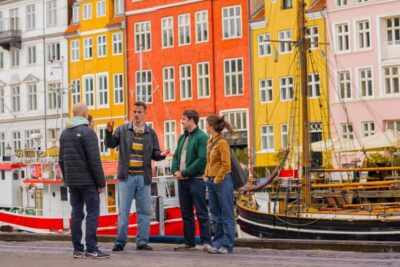
Other lists with this tour