
Review · BOSTON
Downtown Freedom Trail Walking Tour – History & Architecture
Boston’s Freedom Trail is easy to follow on your own, but the stones and red-brick buildings do not explain themselves. This walking tour gives the route a human voice, linking the Boston Massacre Site, Faneuil Hall, and the State House with the people and arguments that shaped the American Revolution.
I like two things here. First, the 70-minute route is a useful first look at central Boston without eating half your day. Second, the tour adds architecture to the political story, from French Second Empire design at Old City Hall to the 23-karat gold dome of the State House. The price is also fair for a small group capped at 20 people.
The main caution is guide variation. Alan and Andrew receive especially warm praise for humor and clear storytelling, but one person found a guide difficult to hear, and another wanted more history and less architectural discussion. Ask questions, stay near the guide, and consider the weather carefully.
Key details that shape the experience
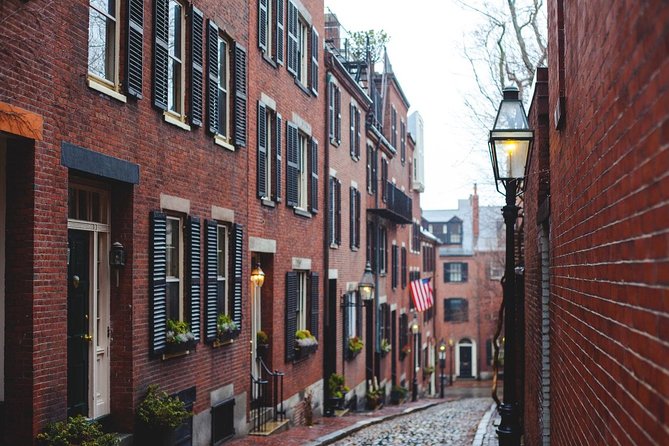
- The route covers the central Freedom Trail: You walk from Faneuil Hall and Quincy Market to Boston Common, passing some of Boston’s best-known colonial and civic landmarks.
- The tour connects buildings with events: You hear about the Boston Massacre, the American Revolution, abolition, immigration, education, religion, and Boston’s changing architecture.
- The tour lasts about 70 minutes: It is short enough for families and first-time visitors, but full enough to give you useful bearings downtown.
- Guides can make the difference: Alan and Andrew are singled out for humor, warmth, and strong explanations, while some people found it hard to hear quieter guides.
- You finish near Brewer Fountain: The endpoint at Boston Common is convenient for continuing toward Beacon Hill, the Public Garden, or another downtown sight.
- Weather matters: The walk operates in all weather conditions, but poor weather can affect comfort and may lead to cancellation with a choice of another date or a full refund.
Starting at Faneuil Hall, Boston’s old debating room
Meet at State Street and Congress Street at 10:00 a.m. The start is central and near public transportation, though downtown Boston streets can be confusing if you are rushing. Give yourself time to locate the guide and group.
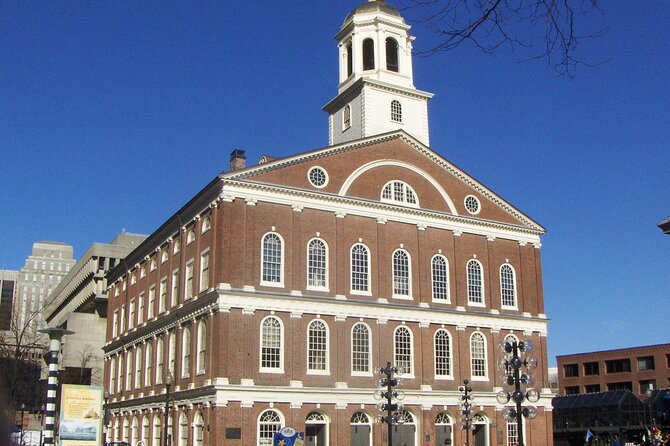
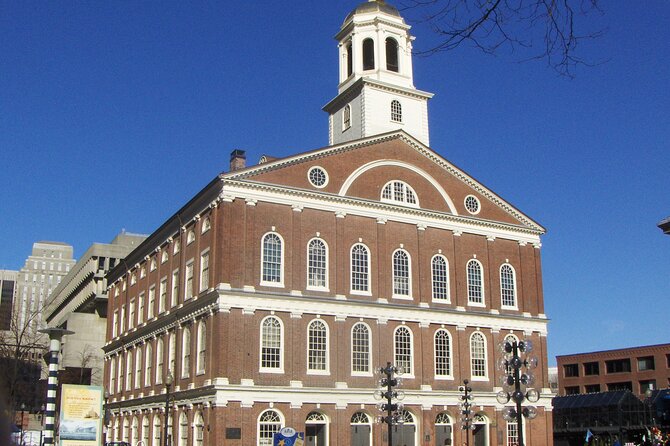
The route begins around Faneuil Hall and Quincy Market. Faneuil Hall is often called the Cradle of Liberty because public meetings and fiery speeches here helped build opposition to British rule. Look up for the grasshopper weathervane, one of the building’s most recognizable details.
The value of beginning here is context. You are not just seeing an old meeting hall. You are seeing a place where public opinion was shaped in person, before newspapers, radio, or social media could spread a message in seconds. A good guide can make that shift feel real.
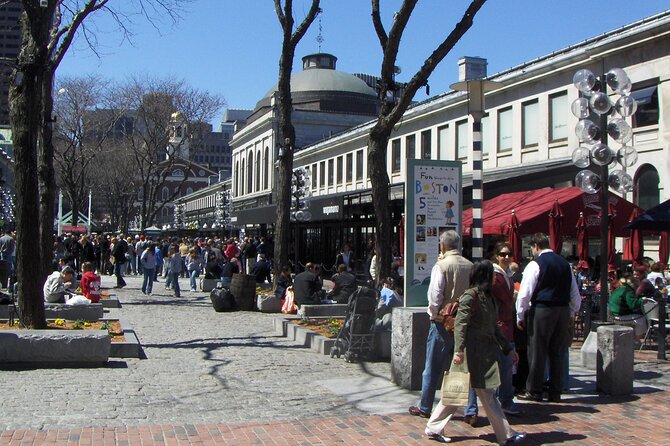
Quincy Market adds a more modern commercial note. The area can be busy, and the tour does not appear to include a food stop, so save your appetite for later. You pass through one of Boston’s most popular areas rather than settling in to explore every shop and stall.
More Walking Tours in the USA
- The Official Art Deco Walking Tour by The Miami Design Preservation League
★ 5.0 · 1,580 reviews - Chicago in a Day: Food, History & Architecture Walking Tour
★ 5.0 · 1,153 reviews - Miami South Beach Art Deco Walking Tour
★ 5.0 · 1,039 reviews
The Boston Massacre Site and the Old State House
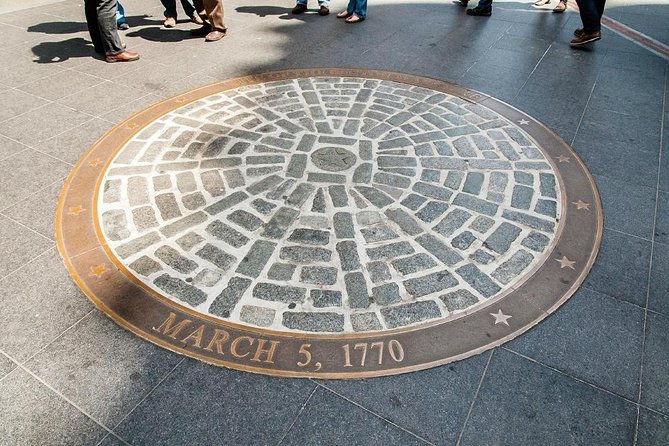
A short walk brings you to the Boston Massacre Site, marked by a cobblestone ring in the pavement. On March 5, 1770, British soldiers fired into a crowd, killing five colonists. The event became powerful political material for colonial leaders, even though the circumstances were more complicated than the simple name suggests.
This is one of the best places to listen closely. The physical marker is easy to miss when people are moving around you, yet the spot had an outsized effect on the road to rebellion. A guide adds the political setting and helps you understand why the incident mattered far beyond the few feet where it occurred.
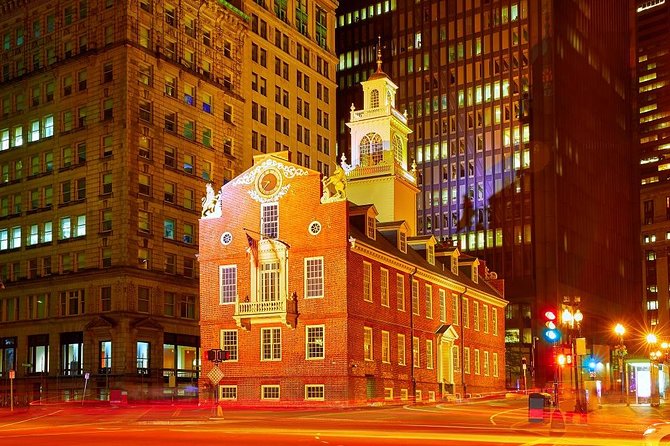
The Old State House follows. Built in 1713, it was the seat of British colonial government and later a symbol of American independence. The Declaration of Independence was first read to Boston residents from its balcony.
The building itself is compact and surrounded by modern downtown streets. That contrast is part of the charm. You see colonial government framed by office buildings and traffic, a reminder that Boston’s old center is still part of a working city rather than a sealed historic park.
The walking tour passes these sites rather than functioning as a full indoor museum tour. If you want to explore the interiors, you may need to return on your own and allow extra time.
Old South Meeting House and the voices of protest
The Old South Meeting House is tied to the Boston Tea Party. In 1773, it was the setting for large gatherings where colonists argued over the tea tax and British control. The church’s size mattered because it could hold crowds too large for many other meeting spaces.
The tour also points out the church associated with signals for the Boston Tea Party. The key idea is not only the famous tea dumped into Boston Harbor, but the network of meetings, protests, and rapid communication that made the action possible.
I like this part of the walk because it moves beyond a list of dates. You begin to see the Revolution as a local dispute that grew through public meetings, commercial pressure, street conflict, and political messaging.
The Old Corner Bookstore is another small but worthwhile stop. Built in 1718 as a home and apothecary shop, it became a bookstore in 1828. Ralph Waldo Emerson, Charles Dickens, and other writers gathered there, giving the building a literary connection alongside its older commercial role.
Do not expect a dramatic interior visit here. The interest is in the building’s survival and in the way one address can carry several chapters of Boston life.
School Street, Old City Hall, and Boston’s first public school
School Street packs several contrasting sights into a short stretch. Old City Hall, at 45 School Street, served as Boston’s city government from 1865 to 1969. Its French Second Empire design is a sharp change from the earlier colonial buildings nearby.
This is where the architecture focus becomes especially clear. You are looking not only at what happened inside buildings, but also at what their design says about the era that built them. Old City Hall reflects a later, more formal civic Boston, not the small colonial town seen in the earliest stops.
The original site of Boston Latin School is marked by a statue of Benjamin Franklin and a sidewalk mosaic. Founded in 1635, it is recognized as the first public school in America. The school offered free classical education to boys under Puritan leadership.
That last detail matters. The site represents an important early experiment in public education, but it also reminds you that colonial opportunity was limited by gender, race, religion, and social position. A strong explanation should give you both sides rather than treating the school’s founding as a complete picture of equality.
Nearby, the Boston Irish Famine Memorial presents two groups of statues. One shows an Irish family suffering during the famine of 1845 to 1852. The other shows a prosperous family that immigrated to America. It is a compact memorial to hardship, migration, and the very different outcomes that newcomers could experience.
The memorial adds a later chapter to the route. Boston’s story does not end with the Revolution. It continues through immigration, labor, religion, education, and the growth of a modern American city.
Same streets, read through a different style:
- Chicago Architecture River Cruise
★ 5.0 · 15,756 reviews - Chicago River 90-Minute Architecture Tour
★ 4.5 · 9,629 reviews - Chicago River: 1.5-Hour Guided Architecture Cruise
★ 4.8 · 8,046 reviews - Chicago Architecture Center River Cruise aboard First Lady
★ 5.0 · 5,536 reviews
King’s Chapel and the Omni Parker House
King’s Chapel has more than 330 years of history, beginning with its founding in 1686. Its story runs through British rule, the American Revolution, the early United States, and later changes in Boston’s religious and civic life.
The church is one of the route’s strongest reminders that the Freedom Trail is not only about battles and famous speeches. Religious buildings often reveal who held power, who was permitted to worship, and how institutions adapted when the political order changed.
Across the historic center, the Omni Parker House brings a different kind of history. Founded by Harvey D. Parker in 1855, it is described as the oldest continuously operating hotel in the United States. It is associated with the Boston Cream Pie, Parker House Rolls, and the word scrod, and it has hosted every U.S. president since Ulysses S. Grant.
These details are fun, but they also show how Boston’s identity shifted from colonial port to major hotel, business, literary, and political center. The tour’s best moments often come when small facts like these are tied to the larger city story.
Tremont Temple and Old Granary Cemetery
Tremont Temple has an important place in American religious and social history. It began in 1839 as the Free Baptist Church and became known for open attendance without charge. That policy made it the first integrated church in America, according to the historical information presented for the site.
The building also hosted public events, including speeches against slavery by Frederick Douglass and Sam Houston, along with unusual displays such as an Egyptian mummy in 1850. You get a glimpse of a church serving as a meeting hall, lecture room, and public forum, not only a place for Sunday worship.
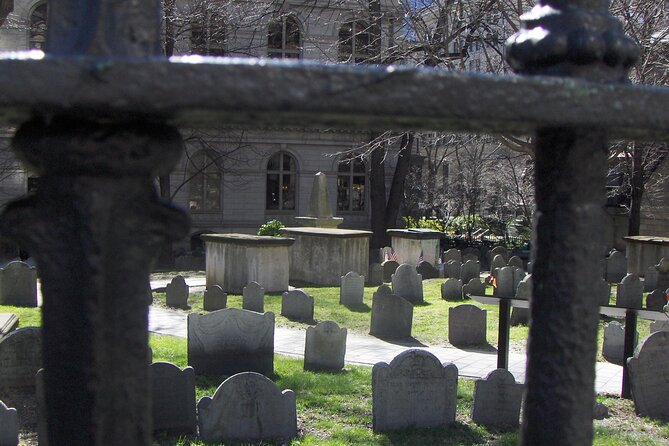
The next major stop is Old Granary Cemetery, one of Boston’s most visited burial grounds. Paul Revere, Samuel Adams, and John Hancock are buried here, along with other figures from the colonial and revolutionary era.
Cemeteries can be easy to rush through. I recommend slowing down long enough to read a few stones and notice how close the graves are to busy modern streets. This setting makes the past feel physical, but the narrow paths and crowds may make it difficult to linger during the group stop.
Park Street Church and Boston Common
Park Street Church marks the final part of the walk toward Boston Common. The large brick church is linked with the signals that helped launch the Boston Tea Party in 1773. It also gives you another chance to compare Boston’s religious architecture with the commercial and civic buildings seen earlier.
You finish at Boston Common, near Brewer Fountain. At 50 acres, Boston Common is the oldest city park in the United States. It is bounded by Tremont Street, Park Street, Beacon Street, Charles Street, and Boylston Street.
This is a useful ending because you leave the dense historic core and arrive at open space. From here, you can continue through the Common, head toward the Public Garden, walk up Beacon Hill, or simply take a break.
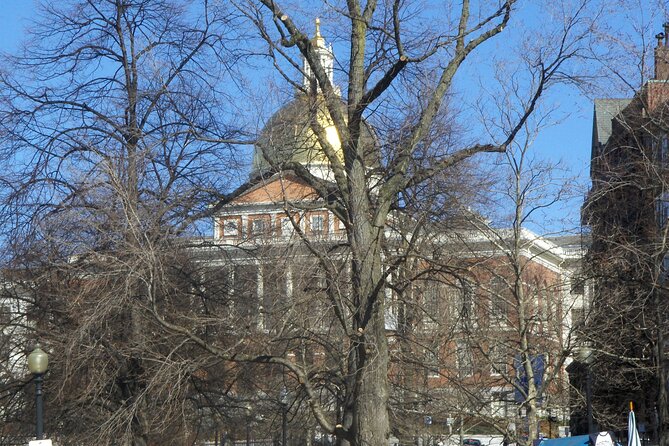
The New State House overlooks the Common. Built in 1798, it has an iconic 23-karat gold dome and remains the seat of Massachusetts government. Calling it new is a reminder of how old Boston’s Old State House really is.
The tour’s advertised journey runs from the old State House to the new State House. It is a neat visual line through changing ideas of government, from a colonial seat of British authority to the state government of an independent American republic.
What the $45 price buys you
At $45 per person, this is not the cheapest way to walk downtown Boston. You can follow the Freedom Trail independently for free, using the painted line and public markers.
The value comes from interpretation. In 70 minutes, you get a guided route through Faneuil Hall, the Old State House, the Boston Massacre Site, Old South Meeting House, Old Corner Bookstore, Old City Hall, Boston Latin School, King’s Chapel, Tremont Temple, Old Granary Cemetery, Park Street Church, the New State House, and Boston Common.
That is a lot of ground. I would treat the tour as an orientation rather than a complete study of every building. If you want indoor visits, long cemetery stops, or detailed architectural analysis at each address, you will need more time afterward.
A few people have continued from Boston Common toward Beacon Hill and Back Bay for an additional $15. Be clear about the 70-minute tour you booked, since that longer continuation is separate.
Group size, guide style, and hearing clearly
The maximum group size is 20, which is a sensible limit for a city walk. Smaller groups make it easier to ask questions and keep up, and one especially positive experience came from a group so small that the tour felt personalized.
Alan is praised for connecting history with modern Boston and for using humor without losing the thread of the story. Andrew is also singled out for making the walk educational and funny. If either guide leads your departure, you can expect an energetic presentation based on the comments provided about their style.
Still, do not assume every departure will feel the same. One person found a guide too quiet and felt the explanations were thin. Another preferred more history of the people and buildings and less emphasis on architecture. The operator does not appear to provide a microphone, so stay close if you have trouble hearing.
The tour is suitable for children, and guides have involved young participants with questions. Children must be accompanied by an adult. The walk is also a good fit for families because it is brief, outdoors, and broken into many recognizable stops.
Weather, timing, and practical advice
The tour starts at 10:00 a.m. and lasts about 70 minutes. Wear comfortable shoes, since the route uses city streets and includes historic areas with uneven paving. Dress for the forecast, not for an ideal postcard day.
The walk operates in all weather conditions, but rain can change the experience. A guide may look for shelter when possible, yet you will still be outside. Poor weather can also lead to cancellation, with a different date or full refund offered.
Protests, demonstrations, and public events can affect Boston Common. These are outside the guide’s control and may make the final stop noisier or less open than expected.
You receive confirmation at booking, and free cancellation is available up to 24 hours before the start time. Inside that 24-hour window, changes and refunds are not accepted unless the operator cancels the activity.
Who should book this Freedom Trail walk?
I would choose this tour for a first morning in Boston, especially if you want the basic layout before exploring independently. It suits history fans, families, solo visitors, and anyone who prefers a short introduction over a half-day commitment.
It is also a good match if you want architecture included in the story. You will see colonial buildings, churches, a cemetery, civic architecture, memorials, and public spaces in one compact route.
I would hesitate if you want an intensely theatrical performance, a costumed guide, or long interior visits. I would also think twice if you dislike walking in uncertain weather or need every word amplified.
For the best experience, arrive early, stay near the guide, ask for clarification when a stop feels brief, and keep time afterward for the Old State House, King’s Chapel, or Boston Common if you want to explore further.
FAQ
How long does the Downtown Freedom Trail Walking Tour last?
The tour lasts approximately 1 hour and 10 minutes, or 70 minutes.
Where does the tour begin?
The meeting point is at State Street and Congress Street in Boston, Massachusetts.
What time does the tour start?
The listed start time is 10:00 a.m.
Where does the tour end?
The tour ends at Brewer Fountain on the Freedom Trail near Boston Common.
How much does the tour cost?
The price is $45 per person.
What landmarks are included?
The route includes Faneuil Hall, Quincy Market, the Old State House, the Boston Massacre Site, Old South Meeting House, Old Corner Bookstore, Old City Hall, the Boston Latin School site, King’s Chapel, Tremont Temple, Old Granary Cemetery, Park Street Church, the New State House, and Boston Common.
Is admission to the attractions included?
The walking tour includes a professional guide and passage by the listed attractions and landmarks. The itinerary identifies the Freedom Trail portion as free admission, but it does not state that indoor admission fees are included.
Is the tour offered in English?
Yes. The experience is offered in English and uses a mobile ticket.
Can children join the tour?
Yes. Most people can participate, and children are welcome when accompanied by an adult.
What happens if the weather is poor?
The tour operates in all weather conditions, so you should dress appropriately. If the experience is canceled because of poor weather, you can receive a different date or a full refund.
Can I cancel for a full refund?
Yes. You can cancel at least 24 hours before the start time for a full refund. Cancellations and changes made less than 24 hours before the tour are not accepted, unless the operator cancels the experience.
Should you book it?
Book this walk if you want a compact, guided introduction to central Boston and care about both history and architecture. The route covers an impressive number of landmarks for $45, and guides such as Alan and Andrew can make the stories lively and easy to follow.
Choose another format if you want a highly theatrical guide, guaranteed amplification, or detailed indoor access. For most first-time visitors, though, this is a practical way to get oriented, learn why the Freedom Trail matters, and finish in a useful spot for the rest of your Boston day.
More History Walks around the USA
- Charleston’s Best Highlights: History, Culture & Architecture
★ 5.0 · 422 reviews - Palm Springs Modernism Architecture & History Bike Tour
★ 5.0 · 359 reviews - Charleston: History and Architecture Guided Walking Tour
★ 4.8 · 349 reviews - Historic Georgetown: History, Gossip, & Architecture Walking Tour
★ 5.0 · 321 reviews
New to the itinerary around the USA
- Washington, DC: Georgetown Architecture Walking Tour★ 5.0 · 8 reviews
- Wilmington History and Architecture Tour★ 4.8 · 18 reviews
- New Orleans : Garden District Architecture Walking tour★ 4.8 · 5 reviews
- Washington DC: Dupont Circle & Embassy Row Architecture Tour★ 5.0 · 6 reviews
- Private Colonial Williamsburg Architectural Tour★ 5.0 · 5 reviews
- Tulsa: Art Deco Walking Tour of Tulsa★ 5.0 · 8 reviews
- Castle to Capitol: Museums of the National Mall Architecture Tour★ 4.5 · 9 reviews
- Monuments and Memorials Architectural Walking Tour★ 5.0 · 17 reviews
Boston Architecture Tours, compared.
Boston’s Architecture, History + Photo Walking Tour (SMALL Group)
Read our review →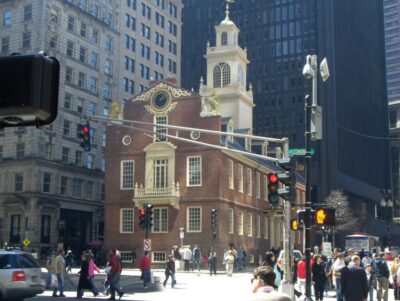
Boston: Freedom Trail History and Architecture Walking Tour
Read our review →
Boston: Harbor and Charles River Architecture Boat Tour
Read our review →Other lists with this tour