
Review · USA
Downtown Austin Historical Architecture Walk
Austin’s story is written in stone, brick, iron, and surprisingly bold decoration. This walking tour moves from grand government buildings to Victorian houses and downtown theaters, showing how the city changed as its needs and tastes changed. The best stop is the Driskill, the only building on the route you enter.
I like the clear progression from public buildings to private homes and then commercial Austin. I also like the small-group limit of 25, which gives you a better chance to hear the guide and ask questions. The main drawback is time: 1 hour 45 minutes goes quickly, so most stops are viewed from outside and the pace may feel brisk in warm weather.
The guide Emily has been singled out for answering detailed questions and adding extra places when the group’s interests called for it. That suggests this is a tour that can work for both casual sightseers and serious architecture fans, though you should have a moderate level of fitness for the walking.
What makes this Austin walk worth your time
- The Driskill is the one interior visit: Spend about 20 minutes inside Austin’s famous hotel and hear how its design and unusual past shaped its place in the city.
- The Bremond Block gives you a residential contrast: See a preserved group of Victorian homes built after the Civil War, not just official buildings and downtown facades.
- Eight stops cover several eras: The route includes Victorian, Art Deco, Gothic-influenced religious design, government architecture, and ornate theater decoration.
- The Capitol gets useful context: You view the Texas State Capitol from the south lawn and hear stories about its scale and design without spending the tour inside.
- The group stays manageable: A maximum of 25 people is small enough for questions, though the experience is still a guided group walk rather than a private tour.
- The timing helps you plan your day: Meeting at 9:45 am and finishing back at the starting point leaves the rest of your day open for museums, food, or more downtown exploring.
Start at 103 E 5th Street and get ready to walk
The tour begins at 103 E 5th St. in central Austin at 9:45 am. From there, you spend about 1 hour and 45 minutes on foot before returning to the same meeting point.
That round-trip setup is handy. You do not need to arrange a pickup at the far end, and you can leave luggage or later plans centered around downtown. The meeting point is near public transportation, which makes it practical if you are staying outside the central district.
You should come ready for a city walk, not a hop-on, hop-off outing. The stated fitness level is moderate, and the stops are spread among government blocks, residential streets, and commercial streets. Good walking shoes and water make sense, especially since the tour requires favorable weather.
The group can include up to 25 people. That is not an intimate private walk, but it is still a reasonable size for an urban history tour. If you enjoy asking questions, staying near the guide will help.
More Walking Tours in the USA
- The Official Art Deco Walking Tour by The Miami Design Preservation League
★ 5.0 · 1,580 reviews - Chicago in a Day: Food, History & Architecture Walking Tour
★ 5.0 · 1,153 reviews - Miami South Beach Art Deco Walking Tour
★ 5.0 · 1,039 reviews
Inside the Driskill, Austin’s grand opening chapter
The Driskill receives the longest single stop, about 20 minutes, and for good reason. It is the only place on the route where you go inside rather than simply viewing a building from the street.
The focus is not just on pretty decoration. You learn what influenced the hotel’s architecture and how its design changed through the years. That gives the tour a useful opening lesson: buildings are not frozen objects. They reflect the ambitions, money, fashion, and practical needs of the people who built and altered them.
The Driskill also has a wild past, so this is where architecture and local storytelling meet most directly. You can expect the guide to connect the building’s appearance with the stories attached to it, rather than treating it as a simple photo stop.
I would pay close attention here. The interior visit gives you a chance to study details at close range, while many later stops are viewed from the sidewalk or across the street. If you care about design, this is the part where you get the best look at materials and decorative choices.
The Bremond Block and Austin’s Victorian homes
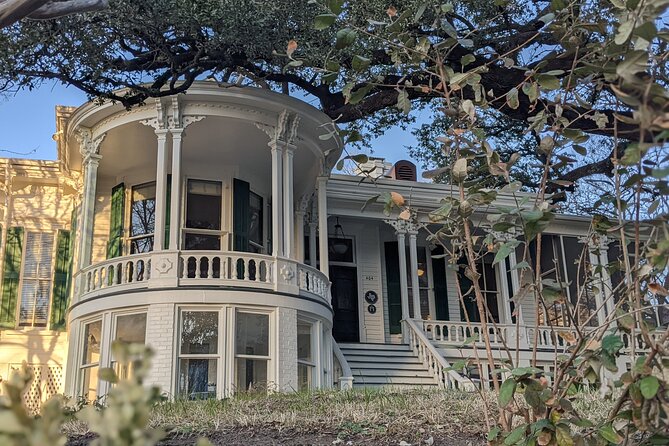
The Bremond Block takes about 20 minutes and provides the clearest change of mood on the walk. Here, you stroll around a well-preserved block of Victorian homes and learn how their design developed.
These houses were built after the Civil War, and their presence helps correct a common idea about downtown Austin. The center was not always made up of offices, government buildings, hotels, and shops. A century ago, many of these blocks held homes, including houses larger than the current Governor’s Mansion.
That comparison makes the Governor’s Mansion stop easier to understand later. It also shows why the Bremond Block matters beyond its appearance. You are looking at a surviving piece of a residential Austin that has largely been replaced by commercial and civic buildings.
The guide’s explanation of architectural evolution should be especially useful here. Rather than seeing Victorian style as one fixed look, you get a chance to consider how homes changed over time and how different owners expressed status and taste.
Architecture fans may want more time than 20 minutes allows. Still, the stop is long enough to slow the pace and look closely at several homes as a group. That matters because one house alone can seem decorative, while a whole block shows the pattern more clearly.
Art Deco at the Heman Marion Sweatt courthouse
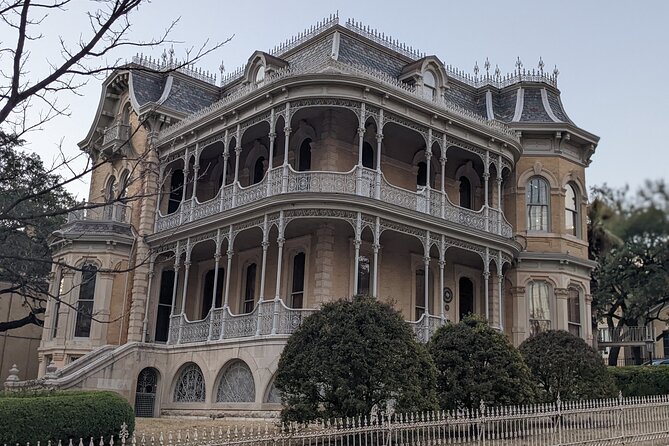
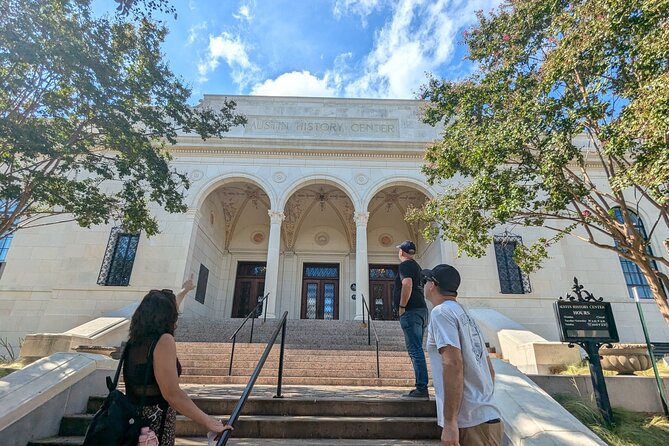
The Heman Marion Sweatt Travis County Courthouse is a 10-minute exterior stop. The building represents pre-Depression Art Deco, giving the walk another sharp shift in style.
You will not go inside. Instead, the guide helps you read the building from the outside and place its design in the period before the Great Depression changed construction, public spending, and civic life.
This stop works best as part of the larger sequence. After the layered decoration of Victorian houses, the courthouse offers a more structured civic expression. It reminds you that architecture can signal public authority in different ways, from the grand and ornamental to the controlled and geometric.
Ten minutes is enough for an explanation and a look at the exterior, but not for a long study session. If Art Deco is your main interest, take mental notes and consider returning on your own after the tour.
Same streets, read through a different style:
- Chicago Architecture River Cruise
★ 5.0 · 15,756 reviews - Chicago River 90-Minute Architecture Tour
★ 4.5 · 9,629 reviews - Chicago River: 1.5-Hour Guided Architecture Cruise
★ 4.8 · 8,046 reviews - Chicago Architecture Center River Cruise aboard First Lady
★ 5.0 · 5,536 reviews
The Governor’s Mansion in a former residential quarter
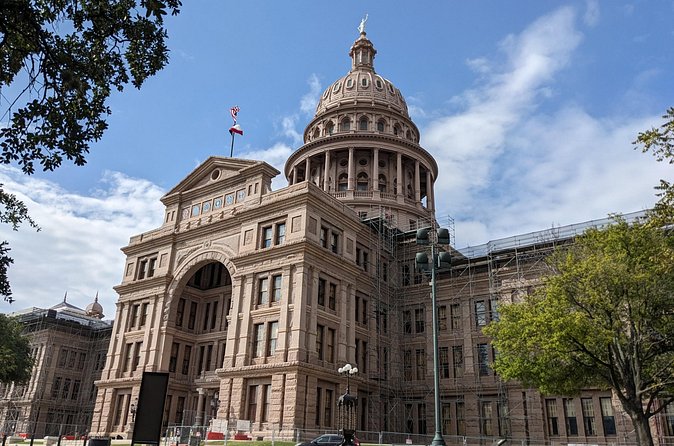
The Texas Governor’s Mansion may seem oddly placed among government offices and commercial buildings. The guide explains why: about 100 years ago, the surrounding blocks were filled with houses, and some were even larger than the mansion.
That simple piece of context changes how you see the building. It is not an isolated residence dropped into an office district. It is a surviving reminder of when this part of Austin had a far more residential character.
The stop lasts about 10 minutes and is viewed from outside. You should not expect a mansion tour or an interior visit. The value comes from understanding the surrounding blocks and how the city grew around older buildings.
I like this kind of stop because it asks you to picture what is no longer there. Austin’s architecture is not only about famous buildings. It is also about the buildings that disappeared and the new uses that took their place.
The State Capitol, seen from the south lawn
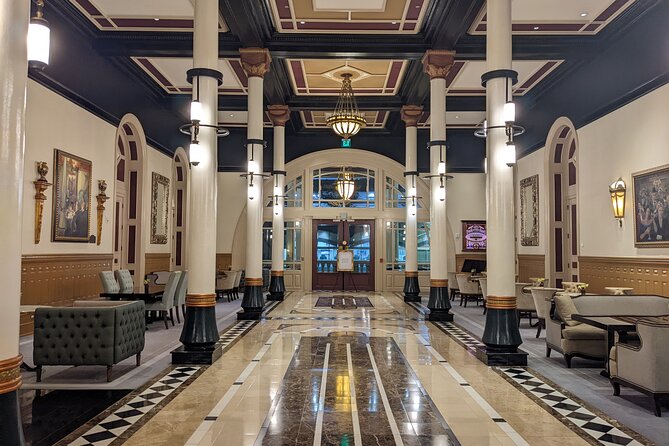
The Texas State Capitol gets another 10-minute stop, viewed from the south lawn. The guide covers selected stories about the building’s architecture and the many ideas packed into its design.
There is far too much to explain about the Capitol in a short visit, and the tour does not pretend otherwise. You get a focused introduction rather than a full building tour. That is a sensible trade-off when the goal is to cover several parts of central Austin.
The Capitol is described as the largest state capitol building in the country, so scale is part of the experience. From the south lawn, you can take in the building as a civic statement and hear a few of the stranger or more surprising stories tied to its construction and design.
Because this is an exterior stop, weather matters. Bright sun, heat, or rain can affect how comfortable you feel while listening. The tour requires good weather, and this open lawn is one reason why.
Saint Mary Cathedral and its unusual construction
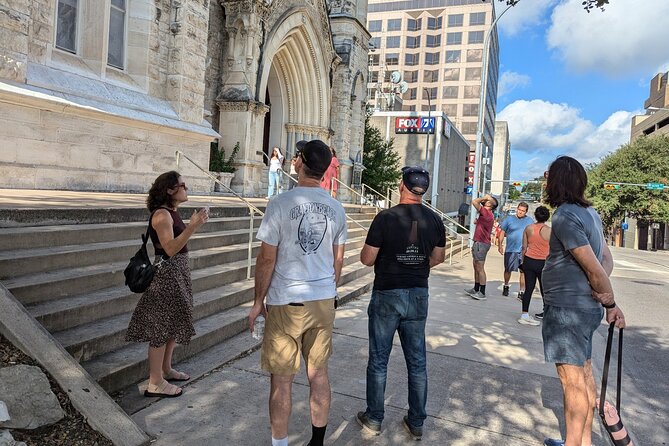
Saint Mary Cathedral is another 10-minute exterior stop. Here, the guide explains the cathedral’s history and its distinctive construction.
The building adds a religious landmark to a route otherwise dominated by government, residential, and commercial structures. That variety is one of the walk’s strongest features. You are not studying one architectural style for the entire morning. You are watching different institutions express themselves through buildings.
Since the stop is outside, details may be easier to appreciate from a short distance than from within the church. Listen for the explanation of how the building was put together and why its form differs from the nearby civic architecture.
As with the Capitol, this is a short introduction. If you want an interior visit, this tour does not promise one, so plan around that limitation.
The old Capitol Complex Visitors Center
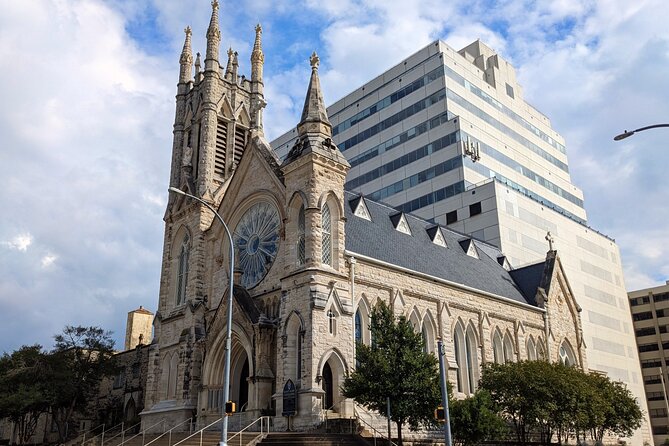
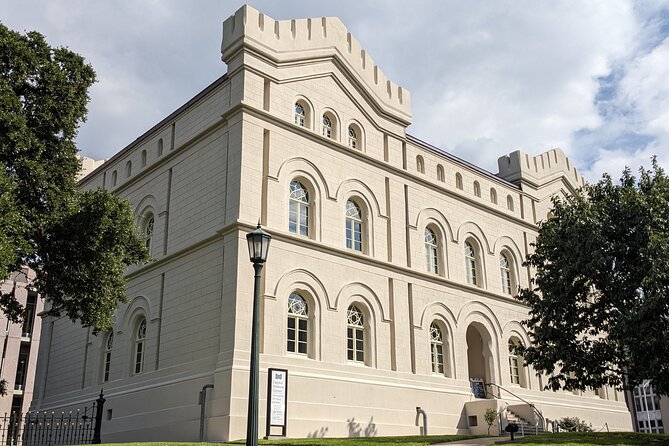
The Capitol Complex Visitors Center does not fit neatly with its neighbors, and that is precisely why it earns a stop. From outside, you discuss what is described as the oldest and possibly strangest state building still standing in Austin.
This gives the tour one of its more curious moments. Instead of presenting every building as polished and harmonious, the guide points out an awkward fit and asks what it tells you about the city’s development.
The stop lasts about 10 minutes. You will not go inside, but the exterior discussion helps you notice how later civic planning can sit beside older structures. That kind of contrast is easy to miss when you are walking through downtown without context.
I would expect this to appeal to anyone who likes odd corners of city history. It is less about a famous postcard view and more about why one building survived, how it relates to its surroundings, and what makes it unusual.
The Paramount Theatre, viewed across the street
The final listed stop is the Paramount Theatre, seen from across the street for about five minutes. The focus is the theatrical ornamentation of this 1915 building.
Five minutes is short, but it is enough to look at the facade and hear how its decoration suits a theater. This is a fitting end because the route moves from government buildings and private homes into the commercial and entertainment side of downtown.
You will not enter the theater on this tour. The stop is about the exterior, so the guide can point out details you might otherwise pass without noticing. If you have time later, the Paramount may be worth revisiting at a slower pace, but that would be separate from this experience.
What you get for $56
At $56, this is not simply a stroll through downtown. You are paying for an English-speaking guide who connects eight places into one story and helps you notice changes that are easy to miss on your own.
The value is strongest if you are new to Austin, interested in architecture, or short on time. In less than two hours, you see a hotel interior, a Victorian residential block, a pre-Depression courthouse, the Governor’s Mansion, the State Capitol, Saint Mary Cathedral, an unusual state building, and a historic theater facade.
The value is weaker if you want long interior visits or free time for photographs. Only the Driskill is entered, and many stops last 10 minutes or less. You are buying interpretation and route design, not access to a series of attractions.
A maximum of 25 people keeps the price below what a private tour would cost while still allowing questions. Emily’s approach, as reflected in the tour’s guide feedback, includes answering detailed questions and sometimes adding nearby places for people with a strong interest in architecture. That personal touch can make the price feel fair, especially for preservation fans and architecture students.
Who should book this walk?
I would recommend it to first-time Austin visitors who want a useful orientation to the historic center without spending half a day indoors. It also suits anyone who likes to understand why a city looks the way it does, rather than simply collecting photographs.
The tour is an especially good match for:
- Architecture and historic preservation enthusiasts
- Visitors with one morning available in central Austin
- Couples or small groups who enjoy asking questions
- People who want local suggestions for the rest of their stay
- Anyone curious about the contrast between public buildings and older homes
It may not suit you if you dislike walking, need frequent indoor breaks, or want a detailed tour inside the State Capitol and cathedral. The route is also less appealing in poor weather, since the experience depends on outdoor stops and may be canceled if conditions are unsuitable.
Book with the start of your Austin stay in mind if you want the guide’s local suggestions to shape the rest of your visit. The tour begins at 9:45 am and returns to its starting point, so you can follow it with lunch or another downtown activity.
Cancellation and practical details
You receive confirmation when booking, and service animals are allowed. The tour is near public transportation, but you should still plan to arrive at 103 E 5th St. before the 9:45 am start.
You can cancel for a full refund up to 24 hours before the experience begins. Cancellations or changes made within 24 hours are not refunded or accepted. If poor weather forces cancellation, you are offered another date or a full refund.
Should you book the Downtown Austin Historical Architecture Walk?
Book it if you want a compact, guided explanation of central Austin’s buildings and the forces that shaped them. The route is broad rather than exhaustive, but its mix of the Driskill, Bremond Block, Capitol, courthouse, cathedral, mansion, visitors center, and Paramount Theatre gives you a useful range in one morning.
The strongest reason to go is the guide’s storytelling, especially if you can ask questions and take advantage of Emily’s interest in adding relevant nearby places. The main caution is that most stops are exterior views, so architecture fans who want extended access should treat this as an introduction, not a full preservation tour.
For $56, I think it is a sound choice for a first look at Austin’s historic center, provided you are comfortable walking at a steady pace and do not need every building opened up from the inside.
FAQ
Where does the Downtown Austin Historical Architecture Walk begin?
The tour begins at 103 E 5th St., Austin, Texas 78701.
What time does the tour start?
The scheduled start time is 9:45 am.
How long does the tour last?
The walk lasts approximately 1 hour and 45 minutes.
Where does the tour end?
The activity ends back at the meeting point on 103 E 5th St.
Which building do you enter during the tour?
The Driskill is the one building you enter. The other listed stops are viewed from outside.
Is the tour suitable for people with limited mobility?
The tour requires a moderate level of physical fitness. It is a walking activity through central Austin.
How many people can join the tour?
The tour has a maximum of 25 travelers.
What happens if the weather is poor?
The experience requires good weather. If it is canceled because of poor weather, you are offered a different date or a full refund.
What is the cancellation policy?
You can cancel at least 24 hours before the start time for a full refund. Cancellations or changes made less than 24 hours before the start time are not accepted or refunded.
More History Walks around the USA
- Charleston’s Best Highlights: History, Culture & Architecture
★ 5.0 · 422 reviews - Palm Springs Modernism Architecture & History Bike Tour
★ 5.0 · 359 reviews - Charleston: History and Architecture Guided Walking Tour
★ 4.8 · 349 reviews - Historic Georgetown: History, Gossip, & Architecture Walking Tour
★ 5.0 · 321 reviews
New to the itinerary around the USA
- Washington, DC: Georgetown Architecture Walking Tour★ 5.0 · 8 reviews
- Wilmington History and Architecture Tour★ 4.8 · 18 reviews
- Washington DC: Dupont Circle & Embassy Row Architecture Tour★ 5.0 · 6 reviews
- New Orleans : Garden District Architecture Walking tour★ 4.8 · 5 reviews
- Private Colonial Williamsburg Architectural Tour★ 5.0 · 5 reviews
- Tulsa: Art Deco Walking Tour of Tulsa★ 5.0 · 8 reviews
- Castle to Capitol: Museums of the National Mall Architecture Tour★ 4.5 · 9 reviews
- Monuments and Memorials Architectural Walking Tour★ 5.0 · 17 reviews
USA Architecture Tours, compared.


Chicago River: 1.5-Hour Guided Architecture Cruise
Read our review →
Chicago Architecture Center River Cruise aboard First Lady
Read our review →
Architecture River Cruise Skip-the-Ticket Line
Read our review →
Chicago River 45-Minute Architecture Tour from Magnificent Mile
Read our review →
45-Minute Family-Friendly Architecture River Cruise
Read our review →Other lists with this tour