
Review · BOSTON
Boston: Freedom Trail History and Architecture Walking Tour
Boston’s Freedom Trail is more than a red line through downtown. In just 70 minutes, this walk links the Old State House, Faneuil Hall, churches, cemeteries, and meeting houses into one clear story about how Boston grew from a small colonial settlement into a modern city. I like that you get both history and architecture, rather than a parade of dates.
I especially like the route from Faneuil Hall to Boston Common, which keeps you moving through the heart of downtown. I also like the local guide’s role: Allan, one of the guides named by participants, has been praised for patient answers and a friendly manner. The main drawback is the English-only format. If you need a slower translation-based tour, the pace and detail may be hard to follow.
Key points at a glance
- A compact Freedom Trail route: Walk from Faneuil Hall to Boston Common in 70 minutes.
- Many major sites in one outing: See the Old State House, Boston Massacre Site, King’s Chapel, Old Granary Cemetery, and more.
- Architecture is part of the story: Compare colonial buildings, civic landmarks, churches, and newer downtown surroundings.
- A local guide adds context: Allan has been singled out for being personable, patient, and ready to answer questions.
- Good for families with older children: Teenagers have enjoyed the walk, including its open question-and-answer style.
- Strong value at $30: You get a focused introduction to central Boston without paying separate admission to the sites along the route.
A short walk through Boston’s long story
The smart thing about this tour is its scale. You are not trying to cover every Freedom Trail stop in Boston. Instead, you get a concentrated downtown walk connecting important places from Faneuil Hall to Boston Common.
That makes this a useful first look at the city. You hear how Boston began, how public life took shape, and how the streets changed over time. The guide also points out the odd mix of old and new buildings, so the city feels less like a row of isolated monuments and more like a working place built in layers.
The route is packed with names familiar from American history: the Boston Massacre Site, the Old South Meeting House, the Old State House, and the churches and burial grounds nearby. The value is in the links between them. A good explanation can turn a quick look at a building into a sense of why that spot mattered.
The tour is conducted in English, with a live guide. That is a strength if you want conversation and the chance to ask questions. It is also the main limitation if your English is not strong. One participant specifically found it easy to lose the thread without a firm command of the language, so keep that in mind before booking.
More Walking Tours in the USA
- The Official Art Deco Walking Tour by The Miami Design Preservation League
★ 5.0 · 1,580 reviews - Chicago in a Day: Food, History & Architecture Walking Tour
★ 5.0 · 1,153 reviews - Miami South Beach Art Deco Walking Tour
★ 5.0 · 1,039 reviews
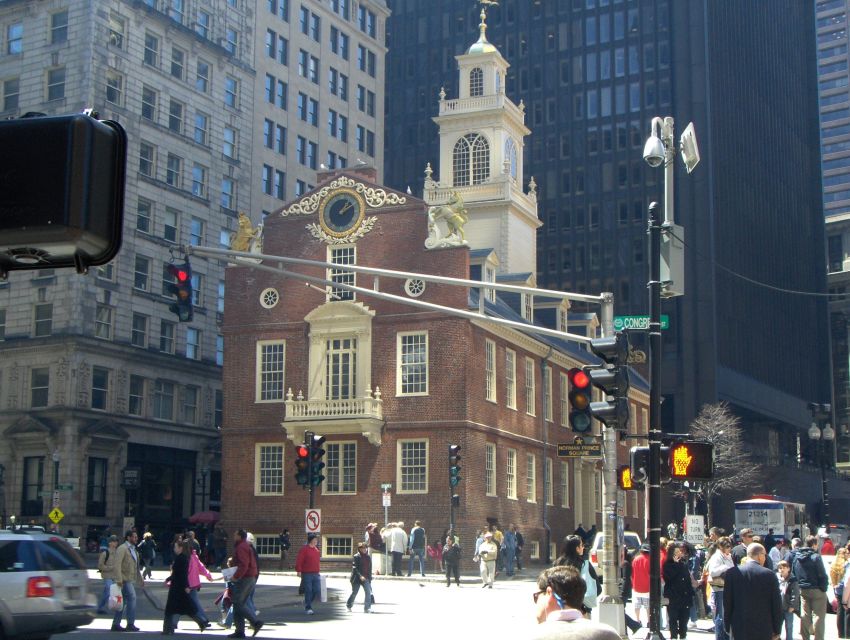
Starting outside the Old State House

The meeting point is the northwest corner of State and Congress Streets, outside 28 State Street, at the Citizens Bank and across from the Old State House. This is a practical central location, but look for the exact corner rather than simply heading toward Faneuil Hall.
The Old State House gives the tour a fitting starting point. It is one of the most recognizable historic buildings in downtown Boston, and its position helps you see how the colonial center sits among newer offices, shops, and traffic. You begin with Boston’s past directly beside its present-day city life.
From here, the guide can set the basic timeline. Boston was first settled, public buildings gathered around important streets, commerce expanded, and political tensions grew. That broad framework matters because the tour moves quickly. You will get more from each stop if you already understand how the pieces fit.
Plan to arrive with enough time to find the corner. The walk is short, but the opening explanation sets the pace for the rest of the outing.
Faneuil Hall and the center of public life
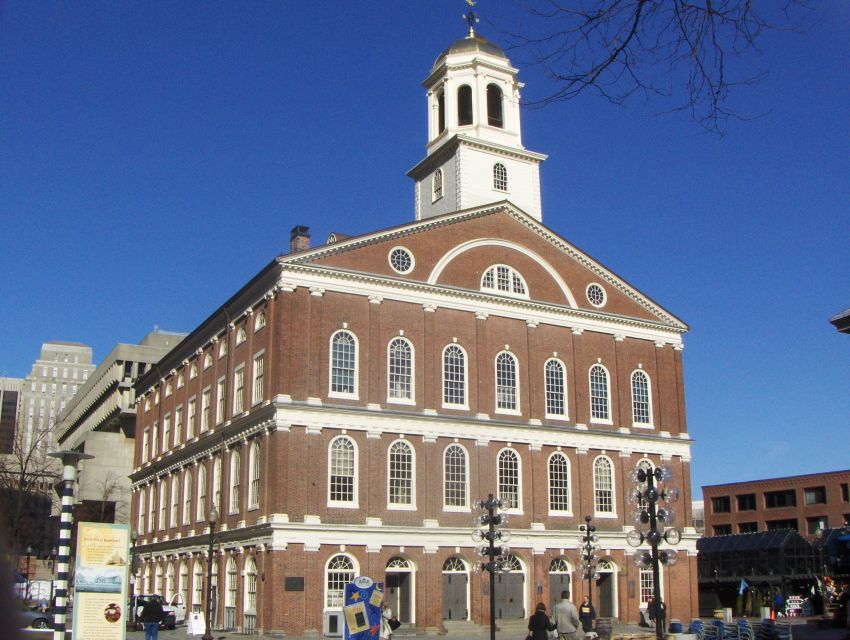
Faneuil Hall is one of the route’s strongest stops because it combines architecture, business, and politics. It was not simply a pretty old building. It was a place where people met, traded, argued, and heard ideas that helped shape Boston’s public life.
The tour helps place Faneuil Hall within the surrounding downtown streets. You can look beyond the building itself and consider how markets and civic spaces shaped the city. This is one reason I prefer a guided walk to simply following the red trail on your own. The guide can explain why a building mattered, not just tell you its name.
The area can feel busy, and the route includes several points close together. That is useful for covering ground, though it means you should expect a city walk rather than a quiet museum visit. Keep your attention on the guide when the group is moving between sites.
At $30 per person, the tour makes sense for someone who wants a clear introduction before spending time at individual museums and historic buildings. You are paying for the guide’s connection between the stops, not for entry to every attraction.
The Boston Massacre Site and the pressure of history
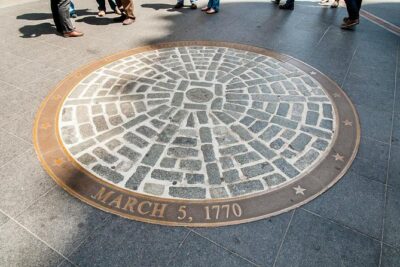
The Boston Massacre Site is a small marker in a busy part of downtown. Its size is part of the lesson. Major events do not always happen at places that look grand or set apart.
Here, the guide can explain how tension between local residents and British soldiers grew into a moment that became powerful political material. The stop works best when you listen for the relationship between the physical setting and the way the event was remembered and used.
You will not spend a long time at each location. That is the tradeoff of a 70-minute tour. You get a broad introduction, but you will not receive the same depth as you would from a private history seminar or a full-day walk.
Still, the compact timing can suit you if you are fitting Boston into a busy visit. It gives you enough context to decide which sites deserve a longer return visit.
Same streets, read through a different style:
- Chicago Architecture River Cruise
★ 5.0 · 15,756 reviews - Chicago River 90-Minute Architecture Tour
★ 4.5 · 9,629 reviews - Chicago River: 1.5-Hour Guided Architecture Cruise
★ 4.8 · 8,046 reviews - Chicago Architecture Center River Cruise aboard First Lady
★ 5.0 · 5,536 reviews
Churches, meeting houses, and Boston’s changing architecture
The route includes King’s Chapel, Park Street Church, and the Old South Meeting House. Together, these places show how religion, politics, and public speech shaped Boston.
King’s Chapel adds an architectural point of comparison. Park Street Church brings another prominent religious building into view. The Old South Meeting House is especially important for understanding how large gatherings and public debate worked in the colonial city.
You will also pass the Old Corner Bookstore, one of the city’s older commercial landmarks. Its presence helps widen the story beyond revolutionary events. Boston’s identity was also built through books, trade, worship, and ordinary city business.
I like this part of the route because it gives architecture a useful purpose. You are not asked to admire façades without context. Instead, you can compare buildings by their function and period, then see how later construction was placed around them.
The mixed architecture may appeal to you if you enjoy cities that show their age openly. It can also feel visually uneven. Old masonry, newer offices, traffic, signs, and modern storefronts share the same streets. That is not a flaw in the tour. It is the real character of downtown Boston, but visitors expecting a preserved historic district should adjust their expectations.
Old Granary Cemetery and the people behind the names
Old Granary Cemetery is one of the most memorable types of stop on this route because it brings the past down to human scale. Instead of hearing only about institutions and famous events, you encounter a place connected with the people who lived through Boston’s early years.
The cemetery also shows how close major historic sites are to ordinary urban streets. You may pass from traffic and shops into a quieter, enclosed space, then return to the city a few minutes later. That change helps explain how much Boston has been rebuilt around its older core.
The tour also includes the First Schoolhouse Site. A small site like this can be easy to miss without guidance. Its value lies in showing that the city’s story is not limited to grand halls and revolutionary speeches. Education, community life, and daily routines mattered too.
The guide’s explanations are important here because the physical remains may be modest. If you prefer large buildings and dramatic interiors, this part may feel less impressive at first. If you like finding meaning in small urban markers, you will likely appreciate it.
Old City Hall, the Old Corner Bookstore, and layers of downtown
Old City Hall adds another period to the walk. Along with the Old and New State Houses, it lets you compare different kinds of civic architecture and different ideas about what a public building should look like.
The tour’s architecture theme is most useful when you pay attention to these contrasts. Boston did not stop changing after the colonial era. Government grew, commerce shifted, and new buildings appeared beside older ones. The result is a downtown where several centuries can be visible within a few blocks.
The Old Corner Bookstore adds a more intimate scale. Its connection with books and publishing gives the route a cultural side, not just a political one. This is the kind of detail that can make a short walk feel more rounded.
You may want to take notes or mark the buildings you would like to revisit. Seventy minutes is enough to get oriented, but the number of sites means some details will pass quickly.
The Irish Famine Memorial and Boston today
The Irish Famine Memorial helps connect Boston’s past to later waves of immigration and the city’s continuing cultural identity. It is a useful reminder that Boston’s story did not end with the American Revolution.
This stop broadens the tour beyond the best-known colonial landmarks. You see how different communities became part of the city, and how public memorials shape the way Boston remembers hardship and survival.
The setting also reinforces the tour’s central idea: old history is woven into an active modern city. You are not visiting a closed historical park. You are walking through downtown, where memorials, offices, shops, churches, and streets continue to serve present-day purposes.
That blend will suit you if you want a city tour with local character rather than a purely academic lesson. The guide’s comments help turn the route into a story about Boston’s culture, not only its dates.
What the guide adds to the experience
The guide is the main reason to choose this walk instead of following a map alone. The route itself is easy to identify, but the connections between sites are harder to build without someone explaining them.
Allan has been specifically praised for being personable, well informed, and willing to answer every question, including questions from teenagers. That matters for families. A guide who welcomes interruptions can keep younger visitors involved instead of asking them to listen silently for 70 minutes.
The tour’s rating is 4.8 from 18 reviews, with repeated praise for the guide’s friendliness, clear explanations, and patience. The feedback is not entirely one-sided, though. Strong English is needed to keep up, especially when several historical subjects are covered in a short time.
You should feel comfortable asking questions in English and listening while walking. The format is conversational, but it is still a compact group tour, not a private lesson.
Is $30 a fair price?
At $30 per person, I consider this a fair price for a guided introduction to central Boston. The route includes many important sites, and the guide gives you a usable framework for exploring the city afterward.
The value is highest on a first visit. If you have never walked the Freedom Trail, the tour helps you understand where the key places are and why they matter. You can then return to the Old State House, Faneuil Hall, the meeting houses, or the cemetery with better questions in mind.
The value is lower if you already know downtown Boston well or have read extensively about each stop. In that case, the short duration may feel basic. You are also paying for the guide rather than admission to interiors, so do not book it expecting a series of museum entries.
Still, the limited duration is a benefit for many people. You can fit it into one morning and keep the rest of your day open for other Boston sights.
Who should book this Freedom Trail walk?
I would recommend it to first-time visitors, families with teenagers, and anyone who wants historical context without committing to a long tour. It also suits visitors who care about architecture and want to see how old and new Boston share the same streets.
It may be a good first activity after arriving in Boston because it introduces the downtown layout. The route runs from Faneuil Hall toward Boston Common, so you finish near one of the city’s best-known central green spaces.
You may want a different format if you need another language, prefer a quiet pace, or want detailed access inside each historic building. The English-only presentation and 70-minute schedule keep the tour focused, but they also limit how slowly the guide can cover each subject.
The walk is best approached as an introduction. Let the guide give you the map and the main story, then choose the buildings and memorials you want to explore more fully.
Practical details before you go
The tour lasts 70 minutes and is offered in English with a live local guide. Check the available start times when booking, since the schedule can vary.
The meeting point is outside 28 State Street, at the Citizens Bank on the northwest corner of State and Congress Streets, across from the Old State House. Use the address and corner description together so you do not wait at the wrong side of the intersection.
You can cancel up to 24 hours before the tour for a full refund. You can also reserve now and pay later, which is useful if your Boston schedule is still changing.
Wear comfortable shoes for city walking and keep your attention on the guide between stops. The route is short, but the number of landmarks means you will be moving and listening at the same time.
Should you book it?
Book this tour if you want a short, well-organized introduction to Boston’s historic center and value a local guide who can answer questions. The mix of civic buildings, churches, cemeteries, memorials, and architecture gives you more than a simple list of Freedom Trail stops.
Skip it if your English is limited, if you already know the route well, or if you want extensive time inside each site. For most first-time visitors, though, $30 is a sensible price for gaining the city’s basic story in one manageable morning walk.
FAQ
How long does the Boston Freedom Trail tour last?
The tour lasts 70 minutes.
What language is the tour conducted in?
The tour is conducted in English with a live English-speaking guide.
Where is the meeting point?
Meet at the northwest corner of State and Congress Streets, outside 28 State Street at Citizens Bank, across from the Old State House.
What sites are included on the route?
The route includes Faneuil Hall, the Old and New State Houses, the Boston Massacre Site, Park Street Church, King’s Chapel, the Old South Meeting House, Old Granary Cemetery, Old City Hall, the First Schoolhouse Site, the Old Corner Bookstore, Boston Common, and the Irish Famine Memorial, among other downtown sites.
Does the tour include a professional guide?
Yes. A professional local guide leads the tour.
Can I cancel for a refund?
Yes. You can cancel up to 24 hours in advance for a full refund. You can also reserve now and pay later.
More History Walks around the USA
- Charleston’s Best Highlights: History, Culture & Architecture
★ 5.0 · 422 reviews - Palm Springs Modernism Architecture & History Bike Tour
★ 5.0 · 359 reviews - Charleston: History and Architecture Guided Walking Tour
★ 4.8 · 349 reviews - Historic Georgetown: History, Gossip, & Architecture Walking Tour
★ 5.0 · 321 reviews
New to the itinerary around the USA
- Washington, DC: Georgetown Architecture Walking Tour★ 5.0 · 8 reviews
- Wilmington History and Architecture Tour★ 4.8 · 18 reviews
- Washington DC: Dupont Circle & Embassy Row Architecture Tour★ 5.0 · 6 reviews
- New Orleans : Garden District Architecture Walking tour★ 4.8 · 5 reviews
- Private Colonial Williamsburg Architectural Tour★ 5.0 · 5 reviews
- Tulsa: Art Deco Walking Tour of Tulsa★ 5.0 · 8 reviews
- Castle to Capitol: Museums of the National Mall Architecture Tour★ 4.5 · 9 reviews
- Monuments and Memorials Architectural Walking Tour★ 5.0 · 17 reviews
Boston Architecture Tours, compared.
Downtown Freedom Trail Walking Tour – History & Architecture
Read our review →
Boston’s Architecture, History + Photo Walking Tour (SMALL Group)
Read our review →
Boston: Harbor and Charles River Architecture Boat Tour
Read our review →Other lists with this tour