Review · BISHKEK
Bishkek : City Tour (History, Architects, Statues & Culture)
Bishkek’s story is written in wide public squares, Soviet mosaics, statues, and grand government buildings. This 2.5-hour walk gives you a useful first look at the capital, from the Kyrgyz flag and Manas statue to Lenin, Victory Square, the opera house, and the Parliament area.
I like the strong local storytelling, especially when guides such as Alex, Anna, Sofia, Sophia, Talgat, and Tareen connect monuments to Kyrgyz culture and daily life. I also like the practical advice built into the walk, including suggestions for hotels, public transport, local food, nearby nature, and other cities.
The main caution is value. At $29 per person, the price is reasonable for a private or small-group introduction, but it can feel high if you are paying $58 for two people mainly for a city-center walk. Hot weather, rain, or tiredness after an early arrival can also affect the experience.
Key points to know before booking
- Ala-Too Square anchors the walk: You begin and finish beside the city’s main flag and civic space.
- Soviet and Kyrgyz stories share the route: Expect Lenin, Marx and Engels, Soviet mosaics, national monuments, and Kyrgyz symbols in one tour.
- The guides are the real strength: Alex, Anna, Sofia, Sophia, Talgat, and Tareen have all been praised for clear explanations, humor, patience, and useful advice.
- The walk covers many central sights: You see theaters, statues, government buildings, Victory Square, the circus, and the Friendship of Peoples monument.
- It is best for a first day in Bishkek: You get orientation plus ideas for restaurants, hotels, public transport, and trips beyond the capital.
- Pack for walking, not sightseeing by car: Wear comfortable closed-toe shoes and leave large bags at your accommodation.
Why this Bishkek walk is worth your time
Bishkek can seem spread out at first. Its streets are broad, its central spaces are formal, and its landmarks do not always explain themselves. A statue may look like a simple photo stop until someone tells you why it is there, whose memory it protects, or how it fits into Kyrgyzstan’s move from Soviet republic to independent country.
That is where this tour earns its keep. You are not simply ticking off buildings. You are given a basic framework for understanding Bishkek: nomadic traditions, Soviet rule, national identity, public memory, and the symbols used by the modern Kyrgyz Republic.
The experience is especially useful at the beginning of a visit. After two and a half hours, you should know the central area better and have a clearer idea of where to return on your own. You also receive suggestions about natural places near the city, hotels, public transport, and other Kyrgyz cities.
The tour is offered with an English or Russian-speaking guide. The guide assigned to you may vary. Alex receives repeated praise for making history easy to follow and for helping with timing in bad weather. Anna is noted for warmth, humor, and a lively way of telling stories. Sofia and Sophia are described as friendly and engaging, while Talgat and Tareen are praised for clear explanations and patience.
That variety matters. This is not a recorded audio route where every group gets the same flat script. Your experience will depend partly on the guide’s style and your questions. The strongest guides appear to make the tour personal, bringing in legends, local life, food suggestions, and practical help.
More History Walks around the world:
- Chicago in a Day: Food, History & Architecture Walking Tour
★ 5.0 · 1,153 reviews - Charleston’s Best Highlights: History, Culture & Architecture
★ 5.0 · 422 reviews - Palm Springs Modernism Architecture & History Bike Tour
★ 5.0 · 359 reviews
Ala-Too Square and the Kyrgyz flag
The walk begins at Ala-Too Square, the main civic space in central Bishkek. This is the right starting point because the square brings several themes together: state power, national symbolism, public ceremony, and the changing story of the country.
Your guide introduces the Kyrgyz flag and explains the meaning attached to it, along with the role of nomadic life in Kyrgyz identity. That context is useful because the flag is not just a national marker for photographs. It points toward the country’s traditions, its connection to the steppe, and the symbols used to express independence.
The square also provides an orientation point for the rest of the walk. You return here at the end, so you do not need to learn a complicated pickup arrangement or find your way through an unfamiliar neighborhood after the tour.
Allow yourself a few minutes before the official start to locate the meeting point. Confirmation is handled through WhatsApp, and the precise starting time should be checked when booking.
Kurmanzhan Datka and Kyrgyz national memory
The Kurmanzhan Datka Statue introduces one of the most important figures in Kyrgyz national memory. The stop gives the tour a useful balance. You are not looking only at Soviet-era monuments and official buildings. You also hear about a Kyrgyz figure whose story belongs to the country’s own political and cultural past.
This is one of the points where a good guide can make a large difference. Ask questions about her role and why the statue matters in Bishkek. The supplied route lists a guided visit and sightseeing time here, so expect an explanation rather than a quick pass-by.
The statue also helps set up the later Manas stop. Together, these monuments show how Kyrgyzstan presents its identity through people, stories, and symbols. You may find that this national focus makes the Soviet architecture easier to place rather than treating it as the whole story.
State History Museum and the Soviet city
The State History Museum is listed as a short stop of about ten minutes. That is enough for an outside explanation and a brief look, but you should not expect a full museum visit within this schedule. Entrance fees are not included, so any admission would be your own expense.
The surrounding area lets the guide explain how Bishkek developed as a Soviet city. The tour focuses on buildings, public spaces, monuments, and architecture, so you will hear about the Kyrgyz Soviet Socialist Republic, often shortened to KSSR, and the way Soviet government shaped the capital.
The value here is context. A broad avenue or formal building can seem plain without a guide. With explanation, it becomes part of a larger story about administration, public order, ideology, and the transition to an independent state.
More Architecture Tours around the world:
- Chicago Architecture River Cruise
★ 5.0 · 15,756 reviews - Chicago River 90-Minute Architecture Tour
★ 4.5 · 9,629 reviews - Chicago River: 1.5-Hour Guided Architecture Cruise
★ 4.8 · 8,046 reviews - Barcelona: Park Güell and Gaudí House Museum Entry Ticket
★ 4.5 · 6,326 reviews
Victory Square and the cost of war
Victory Square is one of the more serious stops. The guide explains its historical meaning and the way public monuments remember wartime sacrifice. The planned time is about fifteen minutes, enough for the memorial area and an explanation of its symbols.
Do not treat this as just another statue stop. Victory monuments across the former Soviet world often carry a heavy mixture of grief, pride, and official memory. A local guide can explain how that memory fits into Kyrgyz society and the wider Soviet experience.
The open setting may feel exposed in strong sun. If you are visiting in summer, bring water and use the pace of the walk to your advantage. One person found the tour enjoyable despite the heat, but the weather clearly affects comfort on a route with several outdoor stops.
Opera and Ballet Theater
The Opera and Ballet Theater gives you one of Bishkek’s most notable cultural buildings. Here the emphasis is on architecture and the city’s performing arts tradition.
The planned visit is brief, around ten minutes. That usually means an exterior look and a guide’s explanation rather than time for a performance or a long interior visit. No ticket to a performance is included.
I like this stop because it breaks up the political monuments. Bishkek is not only squares and government offices. A theater points to music, dance, and formal cultural life, while the nearby buildings show how the capital was designed to function as a national center.
Lenin, Marx, and Engels: Soviet symbols in plain view
The Vladimir Lenin Statue is one of the clearest reminders that Bishkek still contains visible Soviet symbols. The route gives this stop about fifteen minutes, allowing your guide to explain Lenin’s place in the former Soviet system and how public monuments change meaning after political transformation.
The route also includes the Karl Marx and Friedrich Engels Monument. Seeing these sites on foot lets you compare different types of Soviet symbolism rather than hearing about them in isolation.
This is a good section for questions. You can ask how Kyrgyzstan handles Soviet memory, which symbols remain, and how people understand these statues today. The tour does not present the city as a simple before-and-after story. It shows that old monuments and new national symbols share the same public spaces.
Friendship of Peoples and the White House
The Stele of Friendship of Peoples is another Soviet-era monument. Its message centers on unity among the peoples of the former Soviet Union. The guide places it within the political language of the period and helps you read it alongside the country’s later national symbols.
The White House, identified as the Government of the Kyrgyz Republic, brings the tour into the modern political center. You receive a guided explanation and sightseeing time of about ten minutes.
Together, these stops make an important point about Bishkek. Public architecture often carries political messages, even when it looks decorative or monumental. Soviet ideals, Kyrgyz nationalism, state authority, and public memory appear side by side across the center.
Photography may be easy at many outdoor locations, but follow your guide’s advice around government buildings and official sites. The tour is designed to keep moving, so ask early if a particular building interests you.
Manas Statue and the return to Ala-Too Square
The Manas Statue is one of the final major stops and receives about twenty minutes. Manas is central to Kyrgyz cultural identity, and this is where the tour’s themes of nomadic tradition, oral storytelling, and national pride come together.
The guide explains the figure and the monument’s place in Bishkek. This can be one of the most useful points for connecting what you heard at Ala-Too Square with the city’s wider cultural story.
From here, you return to Ala-Too Square. Ending where you began keeps the route simple. It also leaves you in the center, ready to continue on foot, use public transport, or follow the guide’s suggestions for food, hotels, and excursions outside Bishkek.
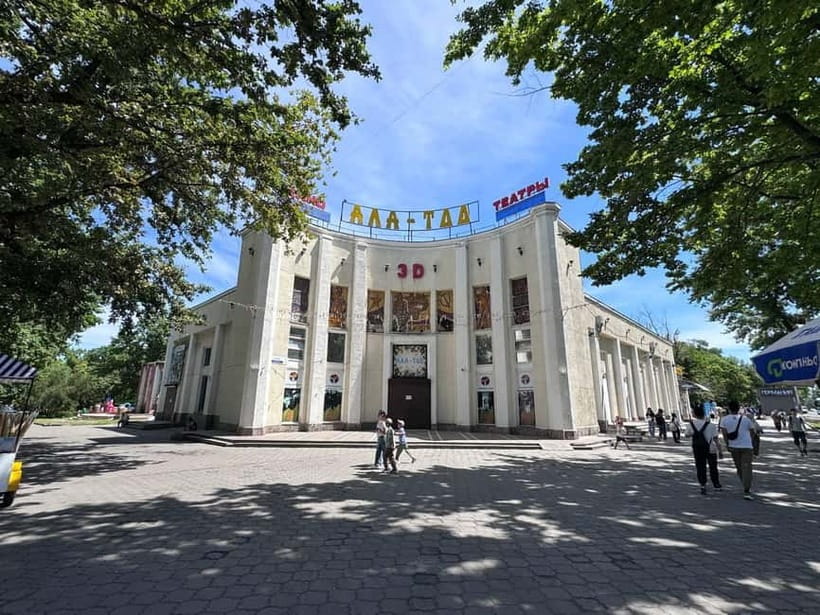
The wider route may also include the Ala-Too Movie Theater, National Museum of Fine Arts, National Academic Drama Theatre, Parliament, the circus, and Soviet mosaics marking a 100-year celebration. Not every listed place receives the same amount of time, so think of the tour as a guided overview rather than a full visit to each building.
The mosaics and the visual side of Bishkek
The Soviet mosaics are among the more unusual details in the experience. They add color and visual interest to a route otherwise filled with stone monuments, formal buildings, and open squares.
The mosaics also reveal how Soviet public art worked. They were designed to communicate ideas through large images and shared public spaces. Your guide can help you notice details you might otherwise walk past.
The information provided does not guarantee a specific mosaic location or a long stop at every example. If this is a major reason for booking, tell the guide at the beginning that you want to pay close attention to them. The same applies to the National Museum of Fine Arts and the theaters, since the main itinerary focuses on outside sightseeing and guided explanations.
What the $29 price really buys you
At $29 per person, the cost is fair if you want a live introduction, clear orientation, and local recommendations. You are paying for the guide’s time, explanations, route planning, and help making sense of Bishkek’s public spaces.
The value is stronger for a first visit or a short stay. If you have only one day in the capital, the tour can help you decide what deserves a longer return visit. The practical advice about public transport and nature spots may also save time later.
The price is less attractive if you mainly want a long museum visit or transport between distant sights. This is a walking tour in the city center, and entrance fees are not included. One direct criticism put the cost at $58 for two people and considered that high for two to two and a half hours of walking.
Private groups are available, which may improve the value if you want to ask many questions or set a comfortable pace. For a larger group, the per-person cost may be easier to justify. Before booking, check whether you are joining a shared walk or arranging a private group.
Weather, walking, and what to bring
Wear comfortable closed-toe shoes. The route includes outdoor squares and several walking sections, so supportive footwear matters more than smart clothing.
Leave oversized luggage and large bags at your accommodation. The activity is not designed for people carrying heavy belongings.
Rain is worth planning for. One guide adjusted the starting time during heavy rain, and another tour continued smoothly despite wet conditions. That shows some flexibility, but you should still confirm the plan through WhatsApp and bring suitable clothing.
Heat can also slow you down. The walk is described as comfortable, but comfort depends on the day. People with altitude sickness are listed as unsuitable for the activity, as are people over 95 years old. The tour does not involve a mountain excursion, but those restrictions should be taken seriously when deciding if it fits your needs.
Who should book this city tour?
I would choose this experience if you want an easy introduction to Bishkek’s central sights without spending a full day in museums. It suits first-time visitors, solo visitors who want a local point of contact, couples, and small groups interested in politics, public art, architecture, and Kyrgyz culture.
It is also useful if you plan to travel beyond the capital. The guide can suggest natural places near Bishkek and other cities in Kyrgyzstan, giving you a better starting point for planning the rest of your trip.
I would think twice if you dislike outdoor walking, want extensive interior visits, or already know Bishkek’s center well. The route contains many stops, but most are short. The experience is about explanation and orientation, not lengthy time inside every attraction.
Should you book it?
Book this tour if you want the city’s monuments to make sense rather than simply pass by them. The best value comes from the guides: Alex, Anna, Sofia, Sophia, Talgat, and Tareen are all associated with clear storytelling, patience, humor, and useful local advice.
At $29, it is a sensible first-day activity for many visitors. Just keep expectations realistic. You are buying a focused walking introduction, not admission to every museum or a full cultural program. Wear good shoes, avoid large bags, check the weather, and ask for the guide’s suggestions before you finish at Ala-Too Square.
FAQ
Where does the Bishkek city tour start and finish?
The tour starts at Ala-Too Square and returns to Ala-Too Square at the end.
How long does the tour last?
The stated duration is 2.5 hours.
How much does the tour cost?
The price is $29 per person.
What languages are available?
The tour is offered with a live guide in English or Russian.
Is a private group available?
Yes, a private group option is available.
Are entrance fees included?
No. Entrance fees are not included in the tour price.
What should I bring?
Bring comfortable closed-toe walking shoes. Oversized luggage and large bags are not allowed.
Can I cancel the booking?
You can cancel up to 24 hours in advance for a full refund. You can also reserve now and pay later.
New to the itinerary around the world
- Washington, DC: Georgetown Architecture Walking Tour★ 5.0 · 8 reviews
- Wilmington History and Architecture Tour★ 4.8 · 18 reviews
- Walk & Discover KL’s Architectural and Heritage Gems★ 5.0 · 7 reviews
- Washington DC: Dupont Circle & Embassy Row Architecture Tour★ 5.0 · 6 reviews
- New Orleans : Garden District Architecture Walking tour★ 4.8 · 5 reviews
- Vicenza: Palladian Architecture Private Walking Tour★ 3.3 · 3 reviews
- Unveiling Brno: History, Culture & Architectural Delights★ 5.0 · 2 reviews
- Private Colonial Williamsburg Architectural Tour★ 5.0 · 5 reviews
Bishkek Architecture Tours, compared.
USSR History, Soviet Architects ,Statues & Mosaics
Read our review →