
Review · LOS ANGELES
The History and Architecture of Downtown Los Angeles
Downtown Los Angeles is at its best when you look up, slow down, and let someone explain what you’re seeing. This three-hour walk connects Angels Flight, Art Deco banks, movie palaces, Little Tokyo, and Grand Central Market, showing a side of LA that is easy to miss from a car.
I like the included ride on Angels Flight and the stop at Fugetsu-Do for traditional mochi. I also like the small group, capped at 15 people, and guide Chris’s habit of using photos and stories to make buildings easier to understand. The main drawback is that the route does not include Olvera Street or much of the city’s Mexican and Spanish founding story, so you may want to visit that area separately.
Key things to know before you book
- Angels Flight is included: Begin with a ride on the short hillside railway, then hear how it once served Bunker Hill’s Victorian residents.
- The route covers several sides of DTLA: You’ll walk through Bunker Hill, the Civic Center, Little Tokyo, the Historic Core, Broadway, and the old bank district.
- Fugetsu-Do adds a real food stop: The tour includes mochi from the long-running Japanese American confectionery.
- Architecture is the main thread: Frank Gehry, the Bradbury Building, movie palaces, Beaux Arts banks, and Art Deco facades all fit into one walk.
- The guide shapes the experience: Chris leads the tour, answers questions, and uses pictures to explain buildings and lost parts of the city.
- Plan for sun and walking: Bring a hat, especially in warm weather, and remember that the three-hour route includes several outdoor stops.
Why this Downtown LA walk works
This is not a tour built around celebrity homes or Hollywood trivia. It is about the city beneath the familiar LA image: old railways, civic buildings, immigrant communities, theaters, banks, museums, and food halls.
That focus gives the tour a useful shape. Instead of treating Downtown Los Angeles as a collection of unrelated sights, Chris connects the pieces. You learn how a small settlement grew into a major city, how money changed the old commercial district, how Bunker Hill was rebuilt, and how Japanese American businesses helped shape Little Tokyo.
The pace is active but not rushed. Most stops last between five and 30 minutes, and the full route takes about three hours. That is long enough to cover a lot of ground, but short enough to fit into a day of sightseeing.
The group limit of 15 matters here. Downtown sidewalks can be busy, and architectural explanations are easier to follow when you are not standing at the back of a large crowd. If the group is small on your date, Chris has also shown a willingness to adjust the emphasis. One couple who already knew Little Tokyo received more time in other parts of the route.
More History Walks around the USA:
- Chicago in a Day: Food, History & Architecture Walking Tour
★ 5.0 · 1,153 reviews - Charleston’s Best Highlights: History, Culture & Architecture
★ 5.0 · 422 reviews - Palm Springs Modernism Architecture & History Bike Tour
★ 5.0 · 359 reviews
Starting with Angels Flight and Bunker Hill
The meeting point is at 341 South Hill Street, beside Angels Flight. The tour begins with a ride on the railway, and the ticket is included.
Angels Flight is a tiny ride, but it carries a large piece of Downtown LA’s story. The railway connects the modern financial district with the slope of Bunker Hill, where Victorian homes once overlooked the growing city. Chris explains what happened to those houses and how the area changed as Los Angeles built taller, more commercial structures.
This opening works well because you get an immediate sense of the city’s layers. You are not only looking at a landmark. You are considering the vanished neighborhood that once occupied the hill and the modern district that replaced it.
From here, the tour introduces the skyscrapers that have appeared in films, including the kind of dramatic downtown towers recognizable from Independence Day. The movie connection is a nice extra, but the more useful point is how these buildings helped create LA’s image as a major American city.
Bunker Hill’s modern art and bold architecture
Bunker Hill is home to the Museum of Contemporary Art and The Broad, both of which you see from outside during the walk. The tour does not include museum admission, but both museums are free to visit independently.
At MOCA, Chris discusses the architect behind the building and the early struggles of his career. At The Broad, you get an explanation of the museum’s name and pronunciation, along with the story behind its unusual exterior and future plans.
These are short stops, about five minutes each, so do not expect time to enter the galleries or study the collections. Instead, you get a quick architectural reading and a sense of how Bunker Hill became a major arts district.
If you want to visit either museum properly, plan a separate stop before or after the tour. The walk gives you useful context, but the schedule is designed to keep moving.
Frank Gehry’s Walt Disney Concert Hall
The Walt Disney Concert Hall receives more time, about 15 minutes, and rightly so. Its sweeping steel forms make it one of the easiest buildings in Los Angeles to recognize, but the story behind the hall is as interesting as the design.
Chris explains Frank Gehry’s role and the long process behind the building. You hear how the project developed and why the hall is considered such an important work by one of the world’s leading architects.
This stop is especially good if you normally admire buildings without knowing what you are looking at. The guide’s visual material helps make sense of the hall’s shapes and construction. You do not need an architectural background to follow the discussion.
The hall is also a good reminder that Downtown LA is not frozen in its past. The tour moves from Victorian homes and old banks to contemporary museums and concert halls, making the city’s architectural changes easy to see.
More Architecture Tours around the USA:
- Chicago Architecture River Cruise
★ 5.0 · 15,756 reviews - Chicago River 90-Minute Architecture Tour
★ 4.5 · 9,629 reviews - Chicago River: 1.5-Hour Guided Architecture Cruise
★ 4.8 · 8,046 reviews - Chicago Architecture Center River Cruise aboard First Lady
★ 5.0 · 5,536 reviews
City Hall, Grand Park, and the civic center
At City Hall, the focus shifts from private money and culture to public power. You walk through Grand Park and hear how Los Angeles grew from a town of only 44 people into a city of millions.
That number gives the city’s expansion a human scale. Los Angeles can feel too large to understand, but the route keeps returning to specific buildings and neighborhoods. The civic center shows how the city organized itself as its population and political influence grew.
The City Hall section is brief, around ten minutes, so it is not a full government-building tour. Think of it as a bridge between Bunker Hill and Little Tokyo, with enough context to help you read the central part of downtown.
Little Tokyo and the Fugetsu-Do mochi stop
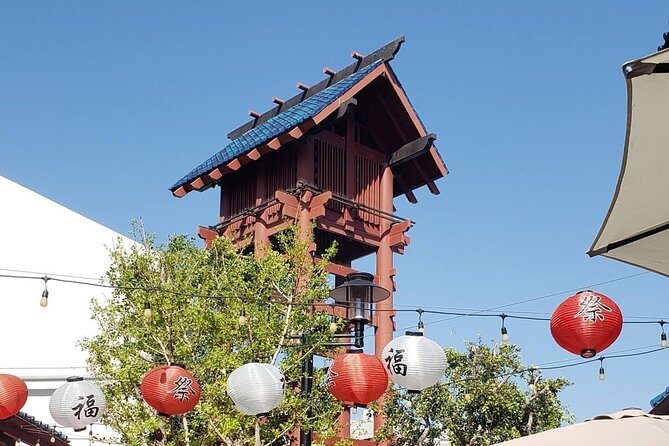
Little Tokyo is one of the strongest parts of the tour. You spend about 30 minutes here, more than at any other listed stop, learning about Japanese immigration, community businesses, historic markers, and local food.
The stop at Fugetsu-Do gives the history a direct, edible connection. The Kito family opened the business in 1903, and the shop continued through two world wars, the Great Depression, and more than 120 years of change. You sample mochi there as part of the tour.
This is the kind of stop I value on a city walk. You are not only looking at a plaque or hearing a date. You are entering the story through a family business that still operates. The snack is modest, but it makes the neighborhood’s history more immediate.
Little Tokyo also gives the tour an important balance. Downtown LA is often presented through skyscrapers, finance, and entertainment. Here, the emphasis shifts to migration, family businesses, food, and community life.
The tour does not cover every cultural story in central Los Angeles. In particular, it gives limited attention to the Mexican and Spanish founders of the city and does not visit Olvera Street. If that history is central to your interests, add Olvera Street on another outing. The guide has explained that Little Tokyo fits the closed-loop route better and that adding Olvera Street would lengthen the walk considerably.
St. Vibiana’s Cathedral and Broadway’s movie palaces
St. Vibiana’s Cathedral is the oldest building on the route, dating from 1876. Chris uses the building to explain how small Los Angeles once was. At the time, nearly one-fifth of the city’s population could fit inside the cathedral.
It is a short stop, but the scale comparison is memorable. You begin to see that downtown was once the entire center of a much smaller city, not simply one district in a giant metro area.
The route then reaches Broadway and the Million Dollar Theatre. Broadway contains one of the largest surviving collections of historic movie palaces in the United States, and the Million Dollar is among the grandest.
You will hear about the theaters and their connection to Hollywood premieres, including stars such as Charlie Chaplin. The tour does not turn into a theater interior visit, so the value is in the exterior details and the story of Broadway as an entertainment corridor.
This section is a highlight for anyone who likes old cinemas, urban history, or buildings designed to make an ordinary night at the movies feel grand. It also shows how downtown changed when the entertainment business became a major part of Los Angeles life.
The Bradbury Building and the old bank district
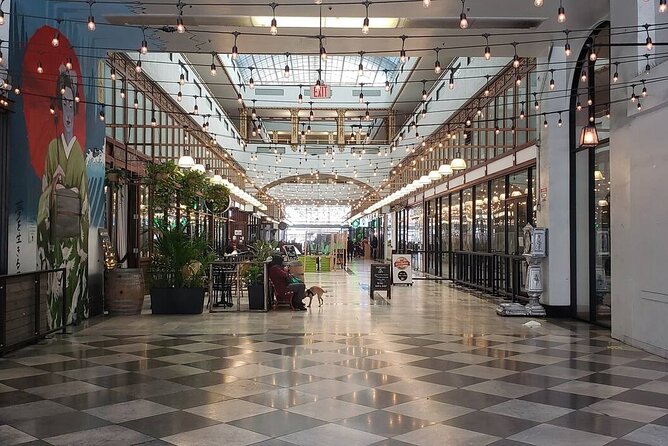
The Bradbury Building is one of the tour’s most important architectural stops. Completed in 1893, it is known for its dramatic interior, unusual light, and ironwork. Chris shares the story behind the building and explains why it has become such a celebrated piece of downtown architecture.
The stop lasts about ten minutes. The tour’s details focus on the building’s story rather than giving you a long time to wander inside, so pay attention to the visual details as you approach and enter.
From there, the route continues down Spring Street through the old bank district. This is where the architectural timeline becomes especially clear. You see iron, steel, Beaux Arts design, and Art Deco forms appearing in sequence.
Spring Street once functioned as the Wall Street of the West. The buildings reflect the wealth and ambition of early 20th-century Los Angeles. This part of the walk rewards anyone who likes comparing facades, materials, entrances, and decorative styles.
Without a guide, you might simply see a row of old commercial buildings. With the historical context, the street becomes evidence of how the city’s economy grew and how its business center shifted over time.
The Last Bookstore and Grand Central Market
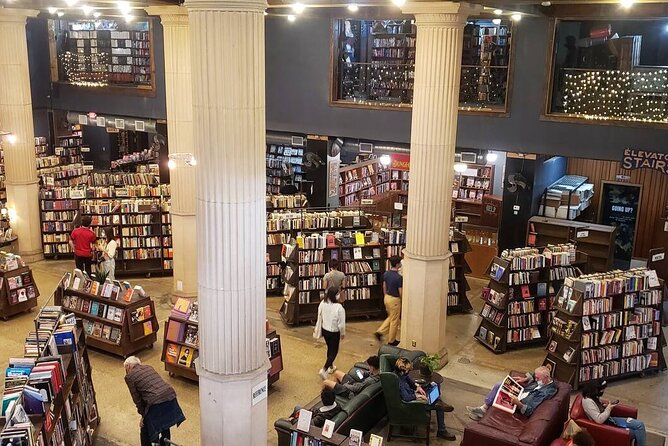
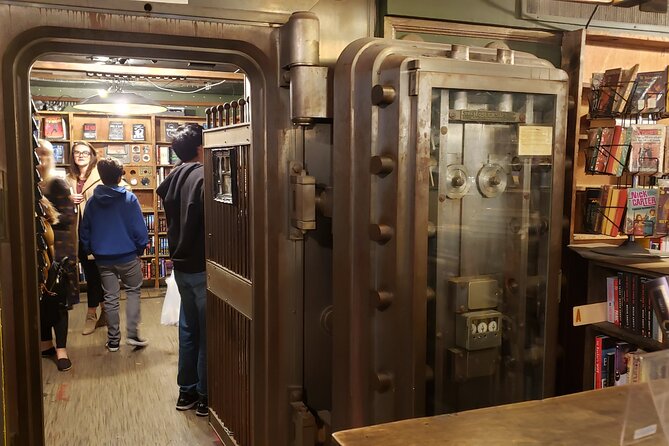
The Last Bookstore is one of the more relaxed stops. You go inside the former bank building, see the original vault, and get time to look around the shop’s unusual interior.
The visit lasts about ten minutes, so it is not a browsing session for serious book shopping. Still, the store adds a welcome dose of present-day downtown life after the earlier focus on older buildings. It is also a good place for photos.
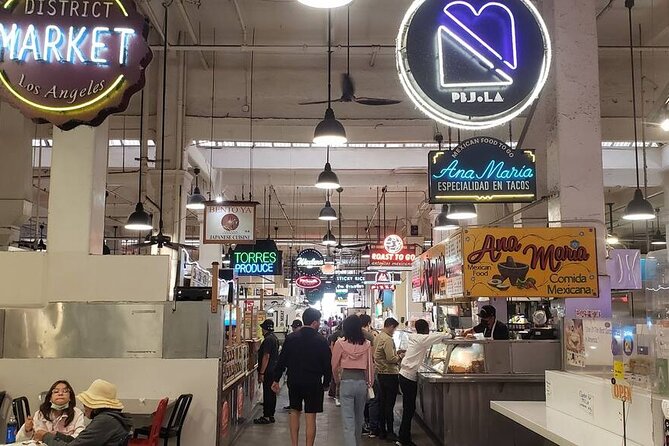
The final stop is Grand Central Market, a food hall operating for more than a century. The tour ends back at the original meeting point, but the market gives you a useful place to continue exploring on your own.
Chris offers food suggestions during the tour, and Grand Central Market is a practical place to put them to use. Since the listed visit is about ten minutes, you may want to return later if you hope to eat a full meal or inspect more of the vendors.
What you get for $39.20
At $39.20 per person, the tour offers solid value if you want structure and context rather than a quick list of landmarks. The price includes the Angels Flight ride and the mochi sample, while the museums and other stops are viewed without separate admission.
You are also paying for three hours with a local guide, a small group, and a route that links several neighborhoods. A self-guided walk through the same area would cost less, but you would need to research the buildings, navigate the route, and work out the connections between them.
The value is strongest for first-time visitors, curious local residents, and anyone who enjoys architecture but does not want a technical lecture. It is less useful if you prefer to spend a long time inside museums or move at your own pace.
The experience is usually booked about 18 days ahead, so do not leave it until the last minute if your schedule is fixed. You receive a mobile ticket, the tour is offered in English, and the group is limited to 15 people.
Practical planning for the three-hour walk
Wear comfortable clothing for an outdoor walking route and bring a hat. The guide has been attentive about finding shade, but Los Angeles sun can still be strong, including in winter.
The tour is near public transportation, and most people can participate. Service animals are allowed. The experience depends on good weather and a minimum group size. If weather or group numbers force a cancellation, you can choose another date or receive a full refund.
You can cancel for a full refund up to 24 hours before the start time. Changes or cancellations made within 24 hours are not refunded.
Because the route returns to the starting point, it is easier to plan around a parked car or a later downtown activity. The closed loop also keeps the walk from stretching farther south or east than the advertised three hours.
Who should book this tour?
I would choose this walk if you want to understand how Downtown Los Angeles developed, not simply photograph its best-known buildings. It suits people who enjoy city architecture, local food, immigrant history, old theaters, and the odd detail that makes a place memorable.
It is also a strong choice for LA residents. Several long-time locals have found that the route showed them buildings and stories they had never noticed. Chris has led downtown tours for years, and his connection with local businesses adds a personal touch to the route.
Families can manage it if everyone is comfortable walking for three hours. Couples, solo visitors, and small groups also fit the format well. The guide’s friendly, patient approach is useful if you have questions or need the pace adjusted.
I would skip it if your main goal is Olvera Street, the city’s Spanish and Mexican founding history, or extended museum time. Those interests are not the center of this route. For architecture, Little Tokyo, downtown history, and a practical introduction to DTLA, the tour earns its price.
FAQ
How long is the Downtown Los Angeles tour?
The tour lasts approximately three hours.
Where does the tour begin?
It begins at 341 South Hill Street, Los Angeles, California 90013, at Angels Flight.
Where does the tour end?
The activity ends back at the original meeting point.
Is the Angels Flight ride included?
Yes. The cost of the Angels Flight ride is included in the tour price.
Does the tour include food?
Yes. The route stops at Fugetsu-Do in Little Tokyo, where you sample traditional mochi.
How large is the tour group?
The tour has a maximum of 15 people.
What happens if I need to cancel?
You can receive a full refund if you cancel at least 24 hours before the start time. Cancellations or changes made within 24 hours are not refunded.
New to the itinerary around the USA
- Wilmington History and Architecture Tour★ 4.8 · 18 reviews
- Washington, DC: Georgetown Architecture Walking Tour★ 5.0 · 8 reviews
- Washington DC: Dupont Circle & Embassy Row Architecture Tour★ 5.0 · 6 reviews
- New Orleans : Garden District Architecture Walking tour★ 4.8 · 5 reviews
- Private Colonial Williamsburg Architectural Tour★ 5.0 · 5 reviews
- Tulsa: Art Deco Walking Tour of Tulsa★ 5.0 · 8 reviews
- Castle to Capitol: Museums of the National Mall Architecture Tour★ 4.5 · 9 reviews
- Monuments and Memorials Architectural Walking Tour★ 5.0 · 17 reviews
Los Angeles Architecture Tours, compared.
Downtown Los Angeles History and Architecture Walking Tour
Read our review →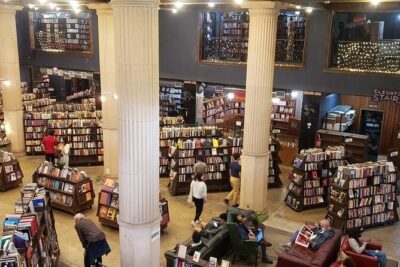
The History and Architecture of Downtown Los Angeles
Read our review →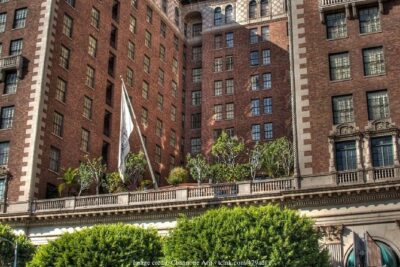
LA’s Art Deco & Beaux Art Architecture: Private Walking Tour
Read our review →
Downtown LA’s History & Architecture: Private Walking Tour
Read our review →Other lists with this tour