
Review · POLAND
Private Walking Tour of Old Gdańsk with an architect-guide
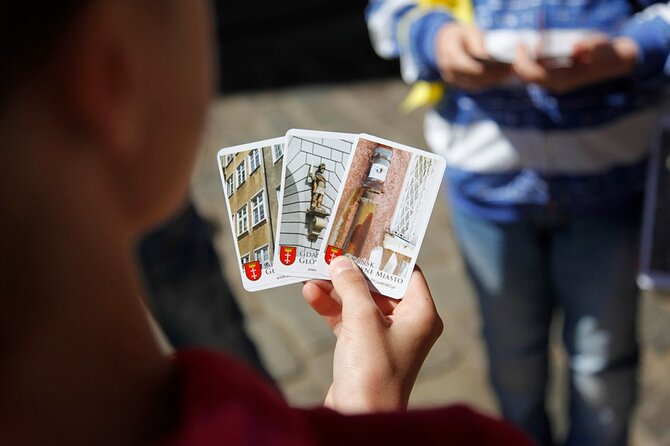
Gdańsk makes more sense when you see it as two cities in one walk: the Old Town around the Radunia Canal, then the grander Main Town built around merchants, churches, gates, and Baltic trade. This private tour uses that change of scale well, with architect-guide Agnieszka explaining buildings through old photographs, anecdotes, and clear architectural details.
I like the personal format, with only your group taking part, and I like that the route links major sights instead of treating them as isolated photo stops. The Great Mill and St. Mary’s Church are especially useful stops because they show both the city’s working past and its enormous civic ambition.
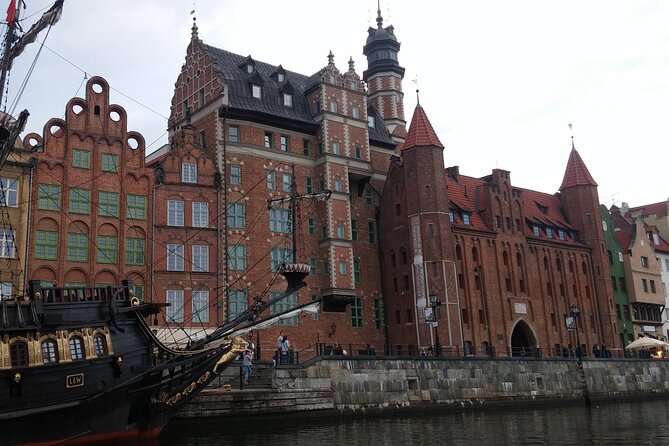
The main drawback is that the tour price is high for one group, and several museums are optional rather than included. You should also allow extra time if you want to climb the tower museum, visit the Amber Museum, or enter Artus Court and Uphagen’s House.
Key points to know before you book
- Agnieszka brings an architect’s eye: Expect attention to buildings, street plans, reconstruction, and the way Gdańsk changed over time.
- The route crosses two historic districts: Begin near the Old Town City Hall, then move through the medieval fortifications into the larger Main Town.
- Old photographs add useful context: The Great Mill area is shown as it looked before the Second World War.
- The walk can last 1.5 to 4 hours: The longer version leaves room for questions and extra sights.
- Most major stops have no admission fee: Museums such as the Amber Museum, Artus Court, Uphagen’s House, and the Prison Tower cost extra.
- The tour ends near the old city gates: You finish at Katownia, a convenient point for continuing through central Gdańsk.
Starting beside the Radunia Canal
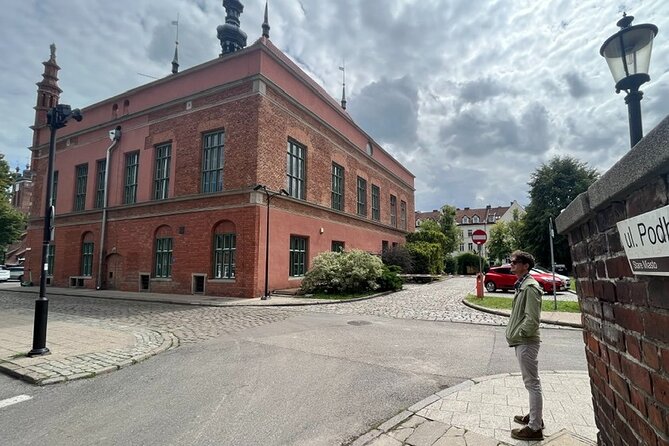
Your walk begins at Ratusz Staromiejski, the Old Town City Hall on Korzenna Street. This is a good starting point because Gdańsk’s story does not begin with the famous Long Market alone. The Old Town around the Radunia Canal grew as a working part of the city, shaped by water, mills, trade, and the influence of the Teutonic Order.
Agnieszka’s background in architecture matters here. Instead of giving you only a list of dates, she can help you read the relationship between the canal, the city hall, and the surrounding buildings. You get an early lesson in how Gdańsk functioned, not just how it looked.
The first stop is brief, about 12 minutes, and admission is free. That makes it an efficient introduction, although you should not expect a long interior visit. The value is in the explanation and in setting up the rest of the walk.
More Private Architecture Tours in the world:
- Sagrada Familia & Gaudi Tour Private or Small Group with Tickets
★ 4.5 · 1,188 reviews - Treasures of Barcelona: Private Gaudi Walking Tour
★ 5.0 · 128 reviews - Sagrada Familia & Gaudi Guided Tour Private or Small Groups
★ 4.7 · 106 reviews
The Great Mill and the city before the war
From the city hall, the route moves to the Great Mill, one of the most useful stops for understanding medieval Gdańsk. Its size and position beside the water point to the practical side of the city. This was not simply a town of grand façades and merchant residences. It needed mills, canals, storage, craft, and trade to support its wealth.
You will see old photographs showing what this area looked like before the Second World War. That visual comparison is important in Gdańsk, where wartime destruction and later rebuilding affect how you read almost every street. The photographs help separate surviving fabric from reconstructed form without turning the visit into a dry lecture.
The stop lasts about 10 minutes and does not include museum admission. I would strongly consider visiting the Amber Museum in the Great Mill building, either before the walking tour or afterward. It is not part of the tour, so you need to plan and pay for it separately, but the location makes it an easy addition.
This is also a good place to ask Agnieszka questions about the rebuilding of Gdańsk. Her explanations are reported as lively and supported by photographs, which should suit you if you learn best by comparing past and present.
A choice for strong legs: the tower clock museum
One church stop can be added to the discussion rather than treated as a fixed part of the main route. The church still operates as a place of worship and also houses the Museum of Turret Clocks.
The museum is in the tower, so you need strong legs for the climb. Inside are centuries-old timekeeping devices, Poland’s biggest concert carillon, and the world’s first pulsar clock. These are unusual details, and they offer a different side of Gdańsk from the usual church architecture.
This stop is not part of the basic tour. Discuss it with Agnieszka before or during the visit. If you want to include it, allow extra time beyond the shortest 90-minute version.
Crossing from Old Town into Main Town
The route then reaches the highest tower of the medieval fortifications of Main Town. This is where the walk changes character. You leave the smaller Old Town setting and begin to understand the scale of Gdańsk’s principal historic district.
That distinction is easy to miss if you simply follow a map between famous sights. Agnieszka’s route makes the change part of the story. Main Town was the stage for the city’s wealth, merchant life, public ceremonies, and connection to Baltic trade.
The fortification tower also helps you see why the gates matter. Gdańsk was not only a port but a defended commercial city, and its entrances controlled movement between the town, the waterfront, and the roads beyond.
More Walking Tours in the world:
- The Official Art Deco Walking Tour by The Miami Design Preservation League
★ 5.0 · 1,580 reviews - Lecce: Baroque Architecture and Underground Walking Tour
★ 4.6 · 1,248 reviews - Chicago in a Day: Food, History & Architecture Walking Tour
★ 5.0 · 1,153 reviews - Miami South Beach Art Deco Walking Tour
★ 5.0 · 1,039 reviews
The Great Armoury and Renaissance wealth
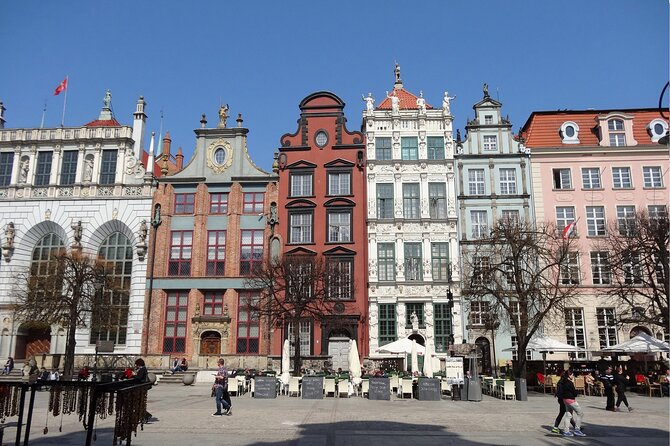
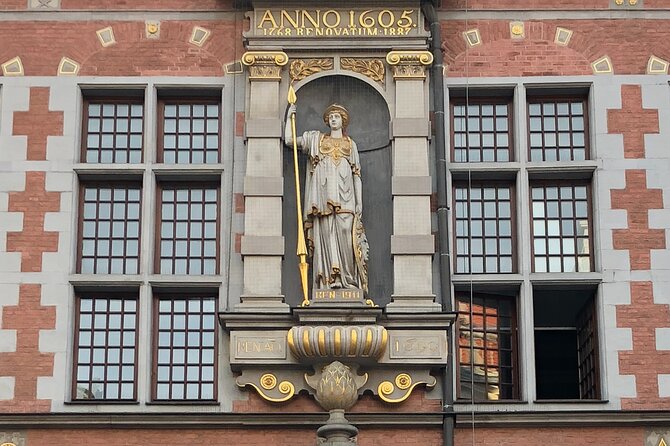
The Great Armoury, or Wielka Zbrojownia, is a short stop of about five minutes, but it carries a lot of visual weight. Its unusual design makes you look twice. The building was built for a practical military purpose, yet its decoration reflects the money available to Gdańsk during the Renaissance.
That contrast is the point. A wealthy city could turn an armoury into an architectural statement. You are not just looking at an attractive façade. You are seeing public confidence, defensive needs, and civic display combined in one building.
The Great Armoury now houses the Academy of Fine Art. It is sometimes open during student exhibitions, but you should not count on an interior visit. The tour treats it mainly as an architectural and historical stop, with no admission charge.
St. Mary’s Church and the astronomical clock
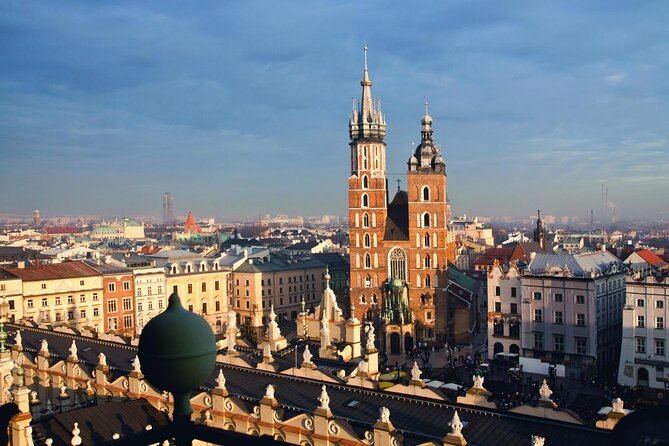
St. Mary’s Church is one of the route’s major highlights. It is described as the biggest brick church in the world, and its scale is hard to understand from a photograph. Inside, the most unusual feature mentioned on this walk is the huge astronomical clock from the 15th century.
At noon each day, the clock chimes. Timing your visit around that moment could make this 15-minute stop more rewarding, although the tour schedule may not always line up with noon. Ask Agnieszka when booking or at the start if this matters to you.
The church stop is free according to the tour details, but the visit remains fairly short. If you want time for quiet looking, more detailed church art, or the tower experience, you may need to extend the walk or return later.
I like this stop because it gives the tour a strong sense of scale. The Great Mill shows how the city worked. St. Mary’s shows what the city was willing to build when money, faith, and civic pride came together.
Mariacka Street, amber, and old-town atmosphere
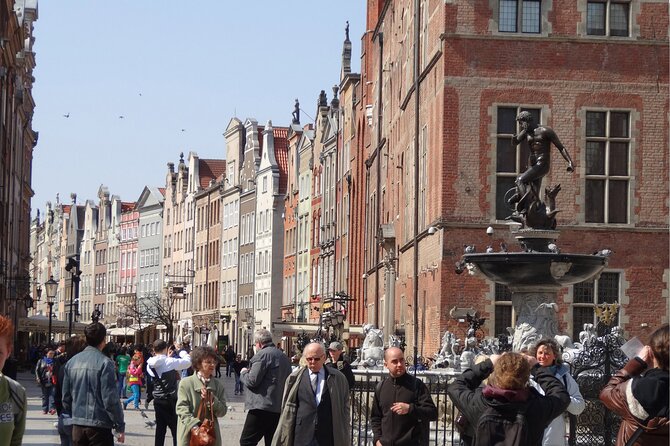
Mariacka Street is one of the most atmospheric parts of the walk. It is known for its old-style appearance and close connection with Gdańsk’s amber trade. The route allows around 20 minutes here, longer than at several of the architectural stops, and that is sensible.
This is where you can slow down and notice details instead of rushing from one landmark to another. The street leads toward the waterfront through a sequence of historic façades and raised entrances. You can get a feel for the old city’s scale and texture, though the walk remains guided rather than a free shopping stop.
If amber interests you, combine Mariacka Street with the Amber Museum at the Great Mill. The museum is not included, but the two stops complement each other. One gives you the street atmosphere and commercial setting. The other provides a formal museum visit.
Brama Mariacka and Gdańsk’s maritime trade
Passing through Brama Mariacka brings you toward the Long Seashore, where the subject shifts to maritime trade. This short stop lasts about five minutes, so expect a focused explanation rather than a long waterfront break.
The location helps connect the inland streets with Gdańsk’s role on the Baltic coast. The grand town houses and gates were tied to trade, shipping, and merchant wealth. You can better understand why the Main Town’s public buildings were made so elaborate once you see their relationship to the waterfront.
This is one of the tour’s stronger transitions. Rather than presenting the riverfront as a pretty backdrop, the walk uses it to explain why Gdańsk became one of the richest cities on the Baltic coast.
Green Gate and the main market area
The Green Gate marks the entrance to the Great Market, the place to be in historic Gdańsk. The stop lasts about 10 minutes and gives you a useful orientation before the route moves into the city’s most famous civic spaces.
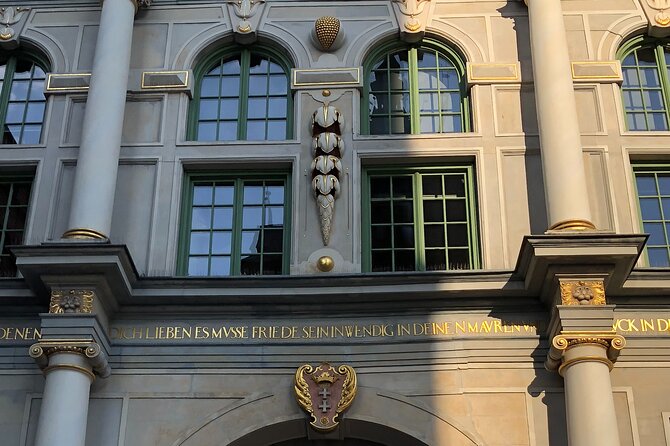
The gate is part of the larger story of arrival and display. Visitors, merchants, and officials entered a city that wanted its wealth seen. The setting also prepares you for Artus Court and the Main Town Hall, both located nearby.
The corner around these buildings deserves extra time. Artus Court served as a meeting place for merchants and is now a museum of history and art. The Main Town Hall also has interesting interiors. Neither is listed as an included admission on this walking tour, so treat them as optional follow-up visits.
If you enjoy interiors, I would not try to squeeze every museum into the shortest version of the walk. Use the guided route to understand what you are seeing, then return to one or two buildings with enough time to look properly.
Uphagen’s House and a glimpse of domestic life
Uphagen’s House offers a different view of Gdańsk. The Great Armoury and Main Town Hall represent public power. This house lets you peek into an interior and imagine how a wealthy resident lived.
The tour allows about five minutes for the stop, and admission is not included. That is enough to point it out, but not enough for a full museum visit. You will need to decide if you want to go inside, either during the tour if timing permits or on your own afterward.
I find this kind of optional stop useful because it keeps the main walk moving while still showing you where to return. A private guide can tell you which interiors fit your interests, rather than forcing everyone into the same museum schedule.
Ending at Katownia and the Prison Tower
The tour finishes at the Prison Tower, near Katownia on Targ Węglowy. The location gives the walk a darker final note. The route ends where some lives ended, at the old judicial and prison complex.
That closing is more than a dramatic phrase. It reminds you that Gdańsk’s wealth and fine architecture existed alongside punishment, law, and harsh civic control. The stop lasts about 10 minutes and does not include admission to the Prison Tower.
The end point is practical. You finish at the series of gates leading into Main Town, so you can continue exploring on foot or return to a museum you skipped earlier. The tour does not loop back to the starting point, so remember that when planning your day.
What the flexible duration means
The advertised duration ranges from about 1 hour 30 minutes to 4 hours. That is a wide range, but the route explains why. A quick version can cover the main architectural landmarks and keep moving. A longer version gives you room for questions, old photographs, optional church details, and decisions about museums.
For a first look at Gdańsk, I would aim for the longer end if your schedule allows. The city’s history is complicated, and the architect’s perspective becomes more useful when you can stop to compare buildings and ask about reconstruction.
The tour is private for your group, with a maximum of seven people at the listed price. That matters on narrow streets and inside busy public areas. You can also set the pace more easily than on a large group walk.
Price, language, and practical value
The price is $264.35 per group of up to seven people. For one or two people, that is a serious expense. For six or seven, the per-person cost becomes much easier to justify, especially if you value a private guide and a flexible pace.
The price does not cover the optional museums. You should budget separately if you want the Amber Museum, Museum of Turret Clocks, Artus Court, Uphagen’s House, or Prison Tower. Several main outdoor stops and the listed church visit have no admission charge.
The tour is offered in English. Agnieszka has also led visits in French, and past descriptions specifically praise her fluent French, humor, energy, and use of photographs. If you need French rather than English, confirm the language when booking instead of assuming it is guaranteed.
Pickup is offered, and the start point is near public transportation. Service animals are allowed, and most people can participate. You receive confirmation within 48 hours, subject to availability, and free cancellation is available until 24 hours before the start time. Changes or cancellations inside that window are not accepted for a refund.
Who will get the most from this walk
I would choose this tour if you want Gdańsk explained through architecture, urban change, and local stories rather than a fast checklist of landmarks. It suits couples, families, and small groups who want to ask questions and adjust the pace.
It is also a good match if you have already seen the postcard views and want help understanding them. The old photographs at the Great Mill and the movement from Old Town into Main Town give the visit a clear structure.
You may prefer a different plan if you want a museum-heavy day. The tour points out several excellent interiors, but it does not include admission or long visits inside them. In that case, use the walk as an orientation, then return independently to the museums that interest you most.
Should you book this Gdańsk walking tour?
Book it if you want a private, flexible introduction led by an architect-guide who uses buildings, photographs, and humor to explain the city. The best value comes when you have a group of several people and can extend the walk toward four hours.
Skip it if you only want a short, cheap walk or if you plan to spend most of your day inside museums. For everyone else, the combination of Old Town, Main Town, the Great Mill, St. Mary’s Church, Mariacka Street, and the old gates gives you a strong framework for exploring Gdańsk on your own afterward.
FAQ
Where does the tour start?
It starts at Ratusz Staromiejski, Korzenna 33/35, in Gdańsk’s Old Town, beside the Radunia Canal.
Where does the tour end?
It ends at Katownia, Targ Węglowy 26, near the series of gates leading into Gdańsk Main Town.
How long does the walking tour last?
The tour lasts approximately 1 hour 30 minutes to 4 hours, depending on the version arranged for your group.
What language is the tour offered in?
The tour is offered in English. French has also been used for visits with Agnieszka, but you should confirm the requested language when booking.
Are museum admissions included?
No. Admission is not included for the Amber Museum, Museum of Turret Clocks, Uphagen’s House, and Prison Tower. Artus Court and the Main Town Hall are also optional interior visits.
How many people can join the private tour?
The listed price covers a private group of up to seven people. Only your group takes part in the activity.
New to the itinerary around the world
- Washington, DC: Georgetown Architecture Walking Tour★ 5.0 · 8 reviews
- Wilmington History and Architecture Tour★ 4.8 · 18 reviews
- Washington DC: Dupont Circle & Embassy Row Architecture Tour★ 5.0 · 6 reviews
- New Orleans : Garden District Architecture Walking tour★ 4.8 · 5 reviews
- Walk & Discover KL’s Architectural and Heritage Gems★ 5.0 · 7 reviews
- Unveiling Brno: History, Culture & Architectural Delights★ 5.0 · 2 reviews
- Vicenza: Palladian Architecture Private Walking Tour★ 3.3 · 3 reviews
- Private Colonial Williamsburg Architectural Tour★ 5.0 · 5 reviews
Private Architecture Tours, compared.

Sagrada Familia & Gaudi Tour Private or Small Group with Tickets
Read our review →
Barcelona 1.5h Private Old Town, Gothic & Ramblas Walking Tour
Read our review →
Treasures of Barcelona: Private Gaudi Walking Tour
Read our review →
Sagrada Familia & Gaudi Guided Tour Private or Small Groups
Read our review →
Best of Chicago: Architecture & Highlights City Private Tour
Read our review →
Private Harajuku Omotesando Architecture Walking Tour
Read our review →
Private Santa Barbara History and Architecture Walking Tour
Read our review →
Private Barcelona Modernism and Gaudí Walking Tour
Read our review →Other lists with this tour