
Review · BERLIN
Private Taxi Tour City East & West History and Architecture 3-4h
Berlin’s great strength is its scale. The Brandenburg Gate, Checkpoint Charlie, Alexanderplatz, the old West Berlin shopping streets, and the government quarter are spread across a large city. This private taxi tour lets you cover them in three to four hours, with Gunter Bauer explaining what you are seeing as you ride between stops. It is a quick way to get your bearings without spending the day on buses and trains.
I like the door-to-door pickup within the S-Bahn ring and the warm, private vehicle, especially in cold or wet weather. I also like the mix of famous sights and less obvious details, such as the former Palace of Tears, the Nordic embassies, the Berlin Wall route, and the story behind the Pregnant Oyster building. The main drawback is simple: this is a broad overview, not a slow museum tour. You will see many places from the car and have limited time on foot.
Key points at a glance
- Private tour with Gunter Bauer: Your group travels alone, allowing the route and explanations to be adjusted to your interests.
- East and West Berlin in one ride: The tour links Ku’damm, KaDeWe, Checkpoint Charlie, Alexanderplatz, the Brandenburg Gate, and the former Wall border.
- Useful in poor weather: The heated, air-conditioned taxi gives you shelter while still allowing regular photo stops.
- Strong historical range: The route covers Prussian Berlin, the Nazi period, World War II, the Cold War, reunification, and today’s capital.
- Pickup and practical extras included: Pickup within the S-Bahn ring, private transport, WiFi, parking fees, and child seats on request are included.
- Best for a first look: It suits couples, families, older visitors, and anyone with limited time who wants a clear introduction to Berlin.
A fast introduction to Berlin’s two halves

This tour is built around Berlin’s split personality. In the former West, you see the Kaiser Wilhelm Memorial Church, the Kurfürstendamm, KaDeWe, the Zoo district, the embassies, and the government buildings near the Tiergarten. In the former East, you pass Alexanderplatz, the Red City Hall, Nikolaiviertel, the old Jewish quarter, Friedrichstrasse, and the reconstructed Berlin Palace.
The taxi matters because Berlin is not a compact old town. The route moves from Charlottenburg to Mitte, then through the government district and back toward Potsdamer Platz and Checkpoint Charlie. You can cover ground in comfort, but you should expect a mixture of short walks, photo stops, and commentary from the vehicle.
Gunter Bauer is the guide and driver. His style, based on the tour details and guest feedback, is conversational and personal. He has also helped visitors with train tickets after the tour and has taken photos at places such as the Brandenburg Gate and Humboldt Forum. If you want a particular subject, such as World War II, the Cold War, architecture, or Berlin’s royal past, tell him before setting off.
More Private Architecture Tours in Germany:
- Private walking Tour: Berlin Architecture Tour
★ 5.0 · 14 reviews - Lübeck: Architecture and Local Craft Private Guided Tour
★ 4.0 · 6 reviews - Lübeck: Private Historical and Architectural Walking Tour
★ 4.5 · 6 reviews
Charlottenburg and the polished face of West Berlin
The western section begins around the Kaiser Wilhelm Memorial Church. Its damaged tower was preserved after World War II, while the modern church beside it was designed by Egon Eiermann. Berliners gave the new buildings playful nicknames because of their blue glass blocks and unusual shapes. Inside, the blue light creates a quiet space despite the traffic and crowds outside.
You also see Berlin Zoological Garden, one of Germany’s oldest zoos and home to about 16,000 animals from around 1,600 species. The elephant gate and lion gate are the most recognizable exterior features. The taxi does not turn this into a zoo visit, but the stop helps explain why this part of the city grew around the old hunting grounds and later became a major West Berlin district.
Nearby, the Theater des Westens recalls the era when wealthy Berliners moved away from crowded Mitte into the greener western suburbs. Its decorative exterior looks almost too sweet, with elaborate details piled around the facade. The theater still serves as a musical venue and contains an imperial box.
The route then moves from Kantstrasse to the Kurfürstendamm, usually shortened to Ku’damm. This boulevard once carried the glamour of West Berlin. It was modeled partly on Paris’s Champs-Élysées and once held villas, cafes, cinemas, and entertainment venues. Today, its role is more commercial, with designer shops and large stores such as Apple and Tesla.
At Tauentzienstrasse, you reach Kaufhaus des Westens, better known as KaDeWe. With about 60,000 square meters, it is one of Europe’s largest department stores. The upper gourmet floor is the main attraction, offering chocolates, bread, cheese, oysters, champagne, and other specialty foods. You get roughly 15 minutes here, so plan on a quick look rather than a full shopping trip.
A quick stop at the old West Berlin center
The tour passes Wittenbergplatz, a major transport junction with an ornate station building. This area once marked the meeting point of several subway lines and the edge of the old city of Charlottenburg. The guide uses the station and surrounding streets to explain how Berlin’s separate towns and railway systems grew together.
At Urania, you get another glimpse of postwar West Berlin. The institution was founded to make science accessible to a broad audience, and the strange metal arc outside commemorates Berlin’s 750th anniversary. The broad green strip around Lützowplatz reflects an abandoned vision of a car-focused city, with major elevated roads cutting through Berlin. Thankfully, that plan was never carried out.
The route then enters the Tiergarten. Today it is a large central park, but it began as a royal hunting ground. Frederick the Great opened part of it to the public, and landscape designer Peter Joseph Lenné later shaped its paths, lakes, and views. World War II left the park badly damaged, with trees cut down and potatoes planted in the open ground. Allied help later supported its replanting.
You pass the House of World Cultures, once the American-sponsored Congress Hall. Its sweeping roof led to the nickname Pregnant Oyster. The roof collapsed in 1980, killing a journalist, but the building was reconstructed and now hosts non-European art, performances, and cultural events.
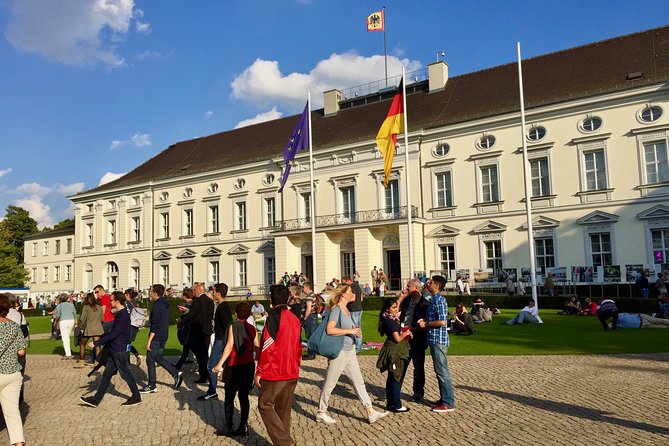
The route also includes Bellevue Palace, the official Berlin residence of the German Federal President. This small palace was built for August Ferdinand, the younger brother of Frederick the Great. Its earlier view toward Charlottenburg Palace has disappeared behind the modern city, but the building remains an important part of the capital’s political geography.
Victory Column and the government quarter
Berlin’s Victory Column is easy to recognize from its gold figure of Victoria. It was first built near the Reichstag with three sections honoring victories over Denmark, Austria, and France. Hitler later moved it to its present location and added another section for a victory that never came. The guide connects this monument with the city’s imperial ambition and later political history.
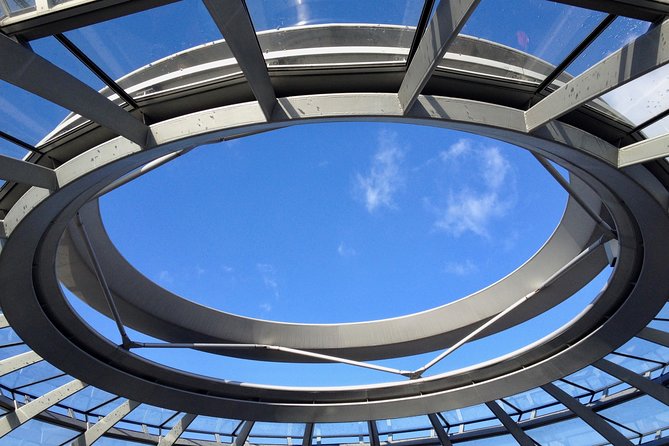
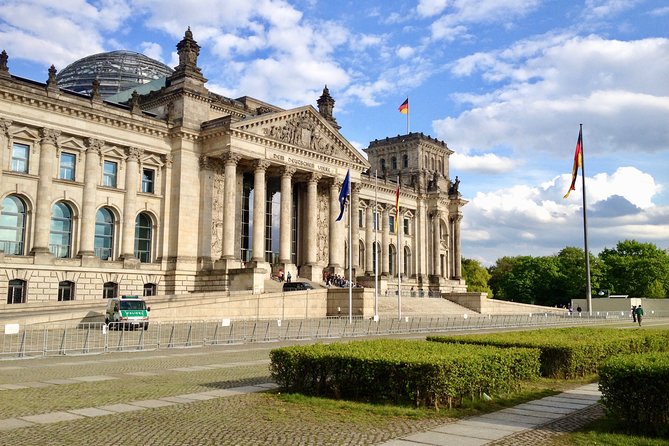
The Reichstag is one of the most important stops. This grand nineteenth-century building was damaged in the war, neglected during the Cold War, wrapped by Christo, and rebuilt for the reunited German parliament. The glass dome now symbolizes a more open political system, though visiting the dome is not part of this taxi tour.
From there, you see the modern parliamentary buildings along the Spree. The Paul-Löbe Building contains committee rooms where much of the real parliamentary work takes place. The Federal Chancellery is a massive structure with ten floors and hundreds of offices, while the nearby press building has a broad window where government briefings take place.
The tour also reaches the Brandenburg Gate and Pariser Platz. This is Berlin’s classic picture, but its history is heavier than the postcard suggests. The gate once sat beside the Wall, isolated from normal city life. After reunification, the surrounding buildings were rebuilt in modern form while keeping the historic proportions. The French and American embassies, the Academy of the Arts, and the Liebermann House now frame the square.
You also pass the former Soviet embassy, a grand building designed to show Soviet power in the center of Berlin. The route continues along Unter den Linden, the city’s historic ceremonial boulevard. You see Humboldt University, the State Opera, the State Library, and the Forum Fridericianum. At Bebelplatz, a glass panel in the pavement marks the Nazi book burning of May 10, 1933.
More History Walks around Germany:
- Private Munich Tour for History Buffs with Architectural Gems and WWII sites
★ 5.0 · 3 reviews - Private Taxi Tour of City East History and Architecture 2-3h
★ 5.0 · 2 reviews - Chicago in a Day: Food, History & Architecture Walking Tour
★ 5.0 · 1,153 reviews - Charleston’s Best Highlights: History, Culture & Architecture
★ 5.0 · 422 reviews
Museum Island, the palace, and old Berlin
The tour pauses at the reconstructed Berlin Palace, now home to the Humboldt Forum. The original palace was badly damaged during World War II and later demolished by the East German government. Its exterior and the Schlüter courtyard were rebuilt, while the interior contains modern exhibition space and collections connected with non-European art and Humboldt University.
You then see the German Historical Museum in the former armory. The building’s exterior and courtyard decoration recall the military past of the site. This is an important reminder that Berlin’s grand architecture often carries several political lives, not just one.
Gendarmenmarkt is another short stop. Many people consider it Berlin’s most beautiful square, framed by the French Cathedral, the German Cathedral, and the concert hall. The two domed buildings are not true cathedrals. They are churches with decorative towers added under Frederick the Great. The French Cathedral still serves a French-speaking Reformed congregation, while the German Cathedral houses an exhibition on German parliamentary history.
At Nikolaiviertel, you see a reconstructed version of Berlin’s oldest central quarter. Much of what appears historic was rebuilt during the East German period, but the Nikolaikirche and Knoblauchhaus offer useful links to the original city. The Knoblauchhaus presents Biedermeier interiors and the life of a prosperous cloth-making family. Small restaurants line the area near the Spree.
The nearby Mühlendamm crossing marks the old ford where Berlin and Cölln developed on opposite sides of the river. The area once held mills powered by the water. Today, the lock and surrounding buildings help explain how the two settlements became the core of modern Berlin.
Alexanderplatz, Friedrichstrasse, and the former border
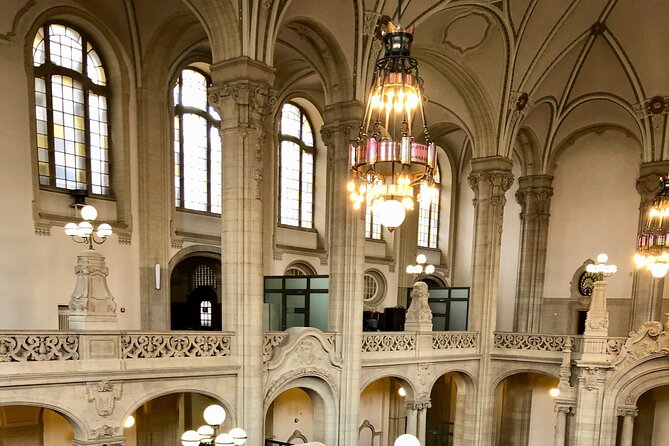
Alexanderplatz shows a different Berlin. Its original name referred to cattle trading, but the GDR rebuilt the square as a broad socialist plaza for parades and public gatherings. The television tower remains the dominant feature. At 368 meters, it is Germany’s tallest structure and was meant to display East German engineering.
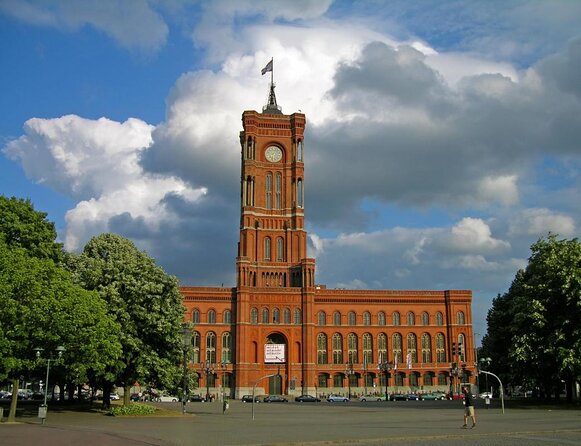
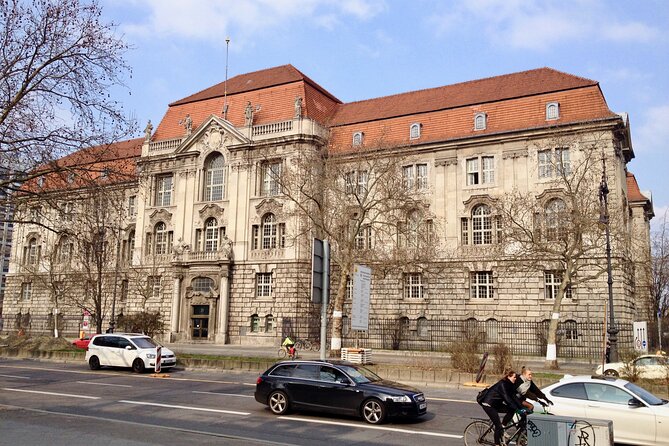
The Red City Hall gets its name from its red brick, not from the political party in power. It served as East Berlin’s city hall during the division and now houses Berlin’s governing mayor. You also pass Friedrichstrasse, which changes character several times along its route. The northern end has been undergoing renewal, while the central section is known for shops, offices, and the former crossing station.
Friedrichstrasse station was the only place where a direct rail journey from East to West Berlin continued during the Wall years. It also handled international trains, including the Paris to Moscow service. The adjacent Palace of Tears preserves the emotional reality of the station, where East Berliners said goodbye to relatives who were leaving.
Hackesche Höfe provides a lighter change of mood. This group of Art Nouveau courtyards was built in 1908 for a mix of homes, workshops, printing businesses, and small factories. After years of neglect, it was restored with shops and studios. You get about 10 minutes, enough to walk into the courtyards and see the tiled facades.
The route also passes the New Synagogue on Oranienburger Strasse. Its Moorish details and gold dome are striking, but the original synagogue was badly damaged in the war. The front section now contains an exhibition on Jewish life in Berlin, with airport-style security at the entrance.
Checkpoint Charlie and Berlin’s Cold War scars
Checkpoint Charlie is a photo stop, not an intact border crossing. The guard booth and famous sign are modern replicas, and much of the surrounding setting has been altered by tourism and new construction. Still, the site matters because American and Soviet tanks faced each other here during the October 1961 crisis.
You also cross the former East-West boundary near the port where Günter Litfin was shot while trying to escape by swimming after the Wall was built. These brief references are valuable because they connect grand political events with individual lives. The route gives you a broad picture, but a dedicated Wall museum or memorial would be better for a slower, more detailed study.
The tour may also include Potsdamer Platz, once a busy entertainment center and later a no-man’s-land beside the Wall. Today it has the Sony Center, major corporate buildings, hotels, shops, and theaters. The modern district is impressive in scale, though it can feel planned rather than old and lived-in.
Near the end, you pass the Topography of Terror. The outdoor documentation center occupies the former Gestapo and SS headquarters area and preserves one of the remaining sections of the Berlin Wall. A 15-minute stop gives you time for the exhibit and restrooms. This is one of the most serious stops and deserves more time if Nazi history is your main interest.
The tour can finish near the Kaiser Wilhelm Memorial Church and the DomAquarée aquarium. The aquarium’s large cylindrical tank is housed inside a hotel and is visible from the lobby area. It is an interesting architectural extra, though it is not a central part of the history tour.
Price, comfort, and who gets the best value
The listed price is about $150.18 per person. That is a substantial cost for a three to four hour outing, but this is a private vehicle, not a standard group bus. The value improves with a small group because you are paying for a dedicated driver, pickup, parking, and a route tailored to your interests.
The tour includes WiFi, air-conditioning, parking fees, and pickup from your hotel or apartment within the S-Bahn ring. Pickup from BER Airport or outside the ring costs extra. You should also allow more time if you are staying outside central Berlin.
This is especially useful in winter. One family found the warm taxi a major help and appreciated the frequent stops that broke up the driving. Older visitors also benefit from less walking, and a child seat for toddlers or a booster seat for older children can be requested. A baby seat can be brought on request.
The tour is less suitable if you want long museum visits, a relaxed walk through each quarter, or a detailed look inside every landmark. The sheer number of sights means some stops are brief. Bring water, since one visitor specifically found it useful during the ride, and wear shoes suitable for short walks over city streets.
Should you book this Berlin taxi tour?
Book it if you have limited time, want to understand Berlin’s divided past quickly, or prefer a private car to public transport. It is also a smart choice for families, older visitors, and anyone visiting in poor weather. Gunter Bauer’s friendly explanations, flexibility, photo help, and personal attention add real value.
Skip it if you already know Berlin well or want to spend hours inside museums and memorials. In that case, use the taxi tour as a first-day overview, then return independently to the Reichstag, Topography of Terror, Jewish Museum, Berlin Wall memorials, or Humboldt Forum.
With a 4.9 rating from 42 reviews and a full recommendation rate, the experience has a strong record. The best way to improve it is to tell Gunter what matters most before pickup. Ask for more Cold War detail, more architecture, or more royal history, and accept that a broad city tour cannot give every subject equal time.
FAQ
How long is the private taxi tour?
The tour lasts approximately three to four hours.
What is the price?
The listed price is $150.18 per person.
Is hotel pickup included?
Pickup is included from your desired hotel or apartment within Berlin’s S-Bahn ring.
Is airport pickup included?
Pickup from BER Airport is not included in the standard price. It is available for an additional charge based on the Berlin taxi tariff.
Is this a private tour?
Yes. Only your own group takes part in the activity.
Which language is offered?
The tour is offered in English.
Are transport and parking included?
Yes. Private transportation, an air-conditioned vehicle, WiFi on board, and parking fees are included.
Are child seats available?
A toddler seat for children from six months to three years and a booster seat for older children are available. A baby seat can be brought on request.
Can I cancel for a full refund?
Yes. You can cancel at least 24 hours before the start time for a full refund. Changes or cancellations made less than 24 hours before the start time are not accepted for a refund.
New to the itinerary around Germany
- Munich Your Way: Private Tour with Architect & Guide★ 5.0 · 2 reviews
- Hidden Architectural Gems of Munich (Max. 16 guests)★ 5.0 · 2 reviews
- Architectural Frankfurt: Private Tour with a Local Expert★ 5.0 · 2 reviews
- Berlin Architecture/River Spree Full Day Photography Tour★ 5.0 · 2 reviews
- Private Taxi Tour of City East History and Architecture 2-3h★ 5.0 · 2 reviews
- Architectural Berlin: Private Tour with a Local Expert★ 4.0 · 3 reviews
- Lübeck: Private Historical and Architectural Walking Tour★ 4.5 · 6 reviews
- Lübeck: Architecture and Local Craft Private Guided Tour★ 4.0 · 6 reviews
Private Architecture Tours, compared.
Sagrada Familia & Gaudi Tour Private or Small Group with Tickets
Read our review →
Barcelona 1.5h Private Old Town, Gothic & Ramblas Walking Tour
Read our review →
Treasures of Barcelona: Private Gaudi Walking Tour
Read our review →
Sagrada Familia & Gaudi Guided Tour Private or Small Groups
Read our review →
Best of Chicago: Architecture & Highlights City Private Tour
Read our review →
Private Harajuku Omotesando Architecture Walking Tour
Read our review →
Private Santa Barbara History and Architecture Walking Tour
Read our review →
Private Barcelona Modernism and Gaudí Walking Tour
Read our review →Other lists with this tour