
Review · BERLIN
Private walking Tour: Berlin Architecture Tour
Berlin’s architecture is a political story written in stone, glass, concrete, and vacant space. This private tour links imperial Berlin, the divided city, socialist East Berlin, and the rebuilt capital in one long route, with stops at Museum Island, the Reichstag, Potsdamer Platz, Kreuzberg, and more.
I like the private format, since you can ask for more design detail, more Berlin history, or a route shaped around your own interests. I also like the chance to compare East and West Berlin directly, especially in places such as Friedrichstrasse, Potsdamer Platz, Friedrichshain, and the Kulturforum. The main drawback is the price: at $191.87 per person, this makes the most sense for a small group that will actively use the guide’s time and expertise.
Key points
- A four-hour private route: Meet your English-speaking guide at your central Berlin hotel and finish with hotel drop-off.
- Architecture with political context: See how monarchy, Nazism, war, division, socialism, and reunification shaped the city.
- Ten major stops: The route includes Museum Island, Gendarmenmarkt, the Philharmonie, Reichstag, Potsdamer Platz, Kreuzberg, Friedrichshain, and Hackescher Höfe.
- A flexible experience: Ask for specific sights or request the tour on foot or by bike.
- Strong guide element: Sara, Thomas, Tom, Daniel, Heiko, and Tarek Ibrahim have been praised for clear explanations, warmth, and flexibility.
- Plan for the cost: Food and drinks are not included, but hotel pickup, drop-off, and a private guide are included.
Berlin Architecture as a Map of Power
I like this tour because it does not treat buildings as isolated photo stops. The real subject is how Berlin changed when political power changed hands.
Your guide can explain the contrast between the grand buildings of the German Empire, the damage left by World War II, the concrete apartment blocks of East Berlin, the modern office towers of the reunited city, and the cultural buildings created by West Berlin during the Cold War.
That makes the tour useful even if you are not an architecture specialist. The buildings give you something to look at, while the political story explains why they look the way they do.
The route is also private and adjustable. You can ask to focus on design, urban planning, German history, or photography. If you are traveling with interior designers or anyone who works with buildings, the detail level can be pushed much further than on a standard group walk.
More Private Architecture Tours in Germany:
- Private Taxi Tour City East & West History and Architecture 3-4h
★ 5.0 · 42 reviews - Lübeck: Architecture and Local Craft Private Guided Tour
★ 4.0 · 6 reviews - Lübeck: Private Historical and Architectural Walking Tour
★ 4.5 · 6 reviews
Starting at Museum Island
Museum Island is a smart opening because it gives you several architectural periods in one compact setting. You begin around the Altes Museum, where the broad colonnade and neoclassical design create a formal entrance to Berlin’s museum district.
The Pergamon Museum adds another monumental classical facade, while the Bode Museum brings a domed, baroque note to the Spree River skyline. The Neues Museum is especially useful for understanding Berlin’s approach to restoration because wartime damage and modern design meet in the same building.
You have about 20 minutes here, so this is mainly an exterior architecture visit rather than a museum tour. Admission to the stop is listed as free, but the tour does not include a full museum visit or museum admission.
The Berliner Dom is also included in the route as a separate stop. Its enormous dome, symmetrical facade, heavy stonework, columns, sculptures, and ornate interior make it one of Berlin’s clearest examples of grand Baroque and Renaissance Revival design.
Gendarmenmarkt and the Classical Center
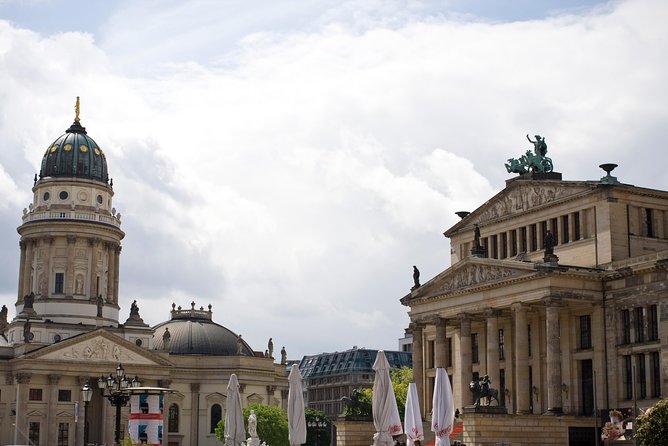
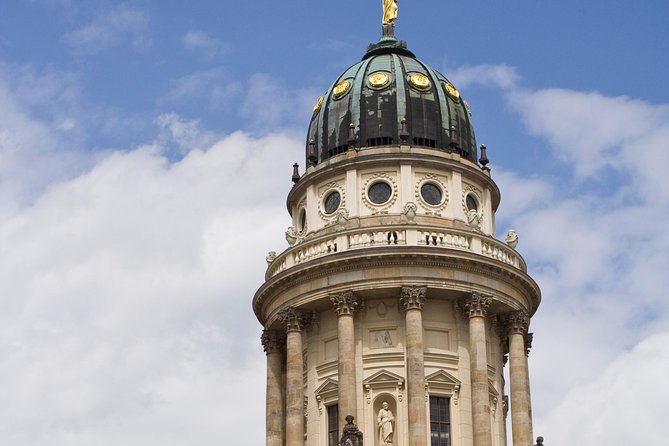
Gendarmenmarkt is one of the tour’s strongest visual stops. In a relatively small square, you see the Französischer Dom, the Deutscher Dom, and Schinkel’s Konzerthaus arranged as a formal architectural group.
The two domed cathedrals frame the square, while the Konzerthaus provides the central classical focus. Friedrich Schiller’s statue occupies the middle, adding a literary touch to a space already loaded with cultural meaning.
The stop lasts about 15 minutes, enough for an explanation and photographs but not a long interior visit. If you want strong pictures, ask your guide how the buildings look from different points in the square. The light can be especially attractive late in the day, though the tour schedule and time of day will determine what you get.
Friedrichstrasse and the Idea of New Berlin
Friedrichstrasse helps explain Berlin’s attempt to rebuild a central commercial and cultural axis after reunification. The street combines references to the city’s Golden Twenties with newer offices, coffee shops, restaurants, boutiques, and department stores.
Galeries Lafayette is one of the most recognizable modern additions. Your guide can use the street to discuss urban renewal, commercial architecture, and the challenge of creating a new city center without erasing older layers.
This is a useful part of the tour for anyone interested in how a city rebuilds its identity. It is less about one perfect building and more about the relationship between old streets, new construction, retail, and public life.
More Walking Tours in Germany:
- Düsseldorf: Guided City Architecture Walking Tour
★ 4.6 · 61 reviews - Potsdam: Guided Walking Tour of UNESCO Site and Architecture
★ 4.7 · 49 reviews - Berlin: Guided Architectural Walking Tour of Hansaviertel
★ 4.9 · 5 reviews - The Official Art Deco Walking Tour by The Miami Design Preservation League
★ 5.0 · 1,580 reviews
The Philharmonie at the Kulturforum
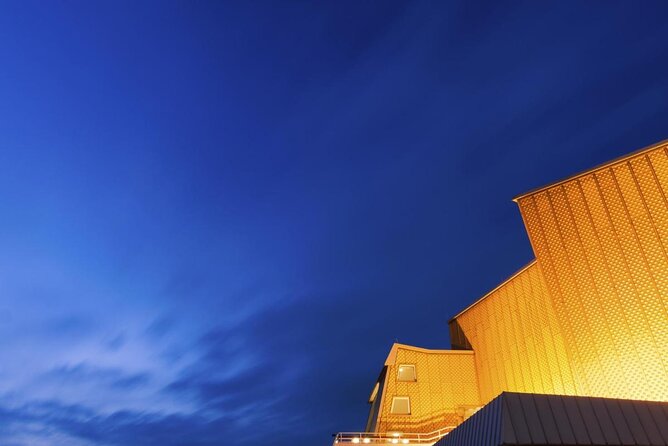
The Berliner Philharmonie is the tour’s most expressive modern building. Its tent-like shape, asymmetrical form, and bold yellow exterior make it easy to recognize, even among Berlin’s other major cultural buildings.
Inside, the concert hall is designed around the orchestra, with seating arranged to create a close connection between musicians and audience. The tour focuses on the exterior and architectural idea, not a concert performance, so do not book this expecting entry to a show.
The Philharmonie belongs to the Kulturforum, a group of museums, libraries, concert halls, and cultural institutions developed largely in the 1950s and 1960s. West Berlin built this cultural center after many important collections and institutions were left on the other side of the Wall.
That political background gives the stop extra weight. The buildings were not simply cultural projects. They were also part of West Berlin’s effort to create a new center for art and learning.
You have about 15 minutes here, including time for photographs. The building’s unusual silhouette makes it one of the best stops for design-minded visitors.
The Reichstag and Modern Democracy
The Reichstag offers a direct contrast between old and new. Its 1894 facade uses classical forms, detailed decoration, and a grand portico. The glass dome designed by Norman Foster was added during renovation after German reunification.
The dome’s transparent design is meant to suggest openness and democratic government. Its interior also creates striking reflections and changing patterns of light.
The planned stop is about 10 minutes, making it a brief exterior explanation and photo opportunity. The itinerary lists the stop as free, but you should not assume that this includes a full visit to the dome or interior. Ask your guide or the operator about any special access you want.
Potsdamer Platz and the Rebuilt Capital
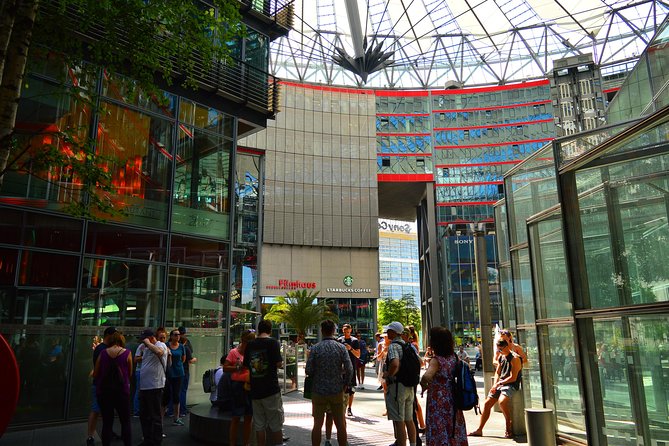
Potsdamer Platz may be the clearest example of Berlin’s twentieth-century upheaval. Before World War II, it was a major center of city life. After wartime destruction and Cold War division, it became part of the empty border zone near the Berlin Wall.
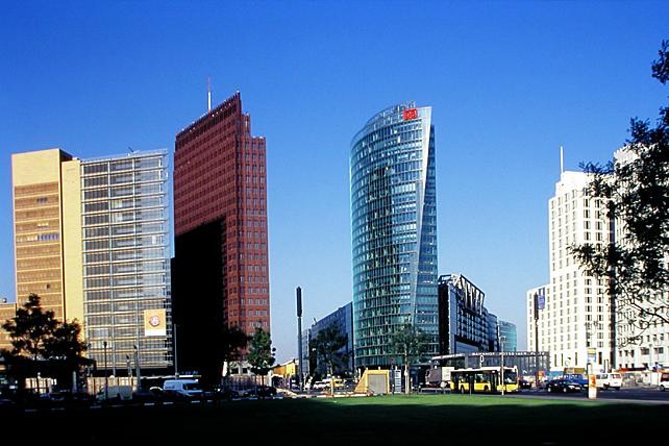
Today, modern office towers, public spaces, and large commercial projects fill the area. The Sony Center is the visual anchor, with its sweeping glass roof and flowing structure. The DB Tower adds a sleek glass form to the skyline, while the Panoramapunkt offers a high view over the city.
The tour allows about 20 minutes here. That is enough to discuss the site and see the main forms, but not enough for a full architectural survey of every building.
I find Potsdamer Platz valuable because it forces you to think about what happens when a city center is wiped out, divided, and then rebuilt almost from scratch. The result is impressive, though some people may find the area more commercial and polished than the older parts of Berlin.
Kreuzberg and the Oberbaum Bridge
Kreuzberg shifts the mood. Here, older apartment buildings, industrial conversions, alternative culture, and newer construction share the same streets.
The traditional Altbau buildings have ornate facades, tall windows, and high ceilings. They sit beside more rough-edged industrial structures and newer urban projects. That mix helps you see how Berlin grew through adaptation rather than one clean master plan.
The Oberbaum Bridge is the major visual landmark. Its red brick towers and Gothic-inspired arches connect Kreuzberg with Friedrichshain across the Spree. It is a fine place for photographs and a useful point for discussing how neighborhoods on opposite sides of the former border now connect.
The itinerary allows 30 minutes in Kreuzberg. That gives you more breathing room than at the Reichstag or Gendarmenmarkt, though the tour still cannot cover every corner of the neighborhood.
Friedrichshain and the Berlin Wall
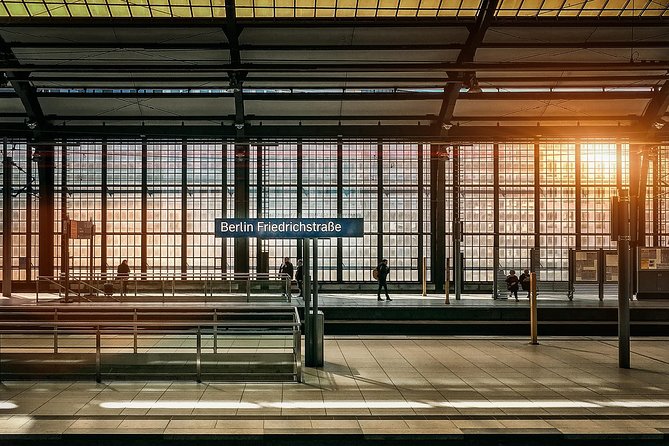
Friedrichshain adds more East Berlin context. You will see prewar Altbau buildings with restored facades, high ceilings, and large windows alongside socialist-era structures and newer development.
The East Side Gallery is the neighborhood’s best-known historic feature. This surviving section of the Berlin Wall carries colorful murals by artists from around the world. It is both an open-air art site and a physical reminder of the division that shaped daily life in Berlin.
The stop lasts about 30 minutes. That is useful for seeing the wall section and discussing the neighborhood’s changing architecture, but the tour is not a dedicated Berlin Wall history walk.
The East Berlin and West Berlin comparisons are one of the most valuable parts of the experience. You are not just looking at different building materials. You are seeing different ideas about housing, public space, government, and the role of the city.
Pariser Platz and Berlin’s Symbolic Gate
Pariser Platz gathers several architectural styles around the Brandenburg Gate. The gate itself is a neoclassical triumphal arch with a long colonnade and a powerful symbolic role in modern German history.
The square also includes the Hotel Adlon, the French Embassy, the American Embassy, the Academy of Arts, and the DZ Bank building by Frank Gehry. Gehry’s modern interior and sculptural forms provide a sharp contrast with the classical buildings around the square.
This is one of the best places to see how Berlin manages historic reconstruction beside modern design. The surrounding buildings follow rules that preserve the character of the square, but they do not all copy the past.
You have about 20 minutes here. That works well for a guided overview and photographs, especially if you want to understand why the Brandenburg Gate is more than a famous backdrop.
Hackescher Höfe and Art Nouveau Detail
Hackescher Höfe closes the route with smaller-scale detail. The interconnected courtyards were built in 1906 and designed by August Endell. Their art nouveau facades use colored tiles, curved lines, ironwork, and carefully handled brickwork.
The eight courtyards do not all look alike. Each has its own treatment, and together they show how early twentieth-century Berlin mixed practical urban functions with decorative design.
This is a pleasant counterpoint to the Reichstag, Philharmonie, and Potsdamer Platz. Instead of monumental public buildings, you are looking at courtyards designed for everyday urban life.
The scheduled visit is about 20 minutes. Shops and cafes are present in the complex, but food and drinks are not included in the tour.
How the Private Format Changes the Day
A private tour is only good value if you use its flexibility. Tell your guide at the start if you care most about modern design, imperial architecture, Cold War planning, photography, or Berlin’s cultural institutions.
The guides associated with this experience include Sara, Thomas, Tom, Daniel, Heiko, and Tarek Ibrahim. Sara has an architecture background, while other guides have been praised for historical skill, clear communication, warmth, and their ability to adjust the timing.
That flexibility matters. One guide adapted the schedule to suit the group, and another continued walking with the group to a lunch reservation after the tour. You should not assume every guide will provide the same extra help, but it shows why a private booking can be useful when your day has a particular shape.
Pickup and drop-off at your hotel are included. The meeting point is a central Berlin hotel lobby, and the experience is offered in English. A bike version is also available, which may suit you if you want to cover more ground, though the provided details do not explain bike rental arrangements or route conditions.
Price, Pace, and Who Should Book
At $191.87 per person, this is a serious purchase. For one or two people, the cost may feel high for a four-hour city walk. For a larger private group, the price can be easier to justify because the guide’s attention is shared only among your party, and group discounts may be available.
The value comes from interpretation, not admission tickets. The stops are listed as free, and food and drinks are extra. You are paying for a customized route, hotel service, private conversation, and a guide who can connect scattered sights into one clear story.
The route also moves at a brisk pace. Ten stops across central Berlin, Kreuzberg, Friedrichshain, and several major squares means you will spend part of the four hours walking between locations. If you prefer slow museum visits or long time inside each building, this may feel rushed.
I would recommend it most for first-time Berlin visitors who want a strong city orientation, architecture students and design professionals, families who want a flexible private day, and anyone who enjoys history explained through buildings. It is less suitable if you want extensive interior access or a low-cost sightseeing option.
Free cancellation is available up to 24 hours before the start time. Changes or cancellations made later do not qualify for a refund.
Should You Book This Berlin Architecture Tour?
Book it if you want Berlin explained as a city shaped by competing political ideas, and if you are willing to pay for a private guide rather than a simple list of landmarks.
I especially like the combination of Museum Island, the Kulturforum, the Reichstag, Potsdamer Platz, Kreuzberg, Friedrichshain, and Hackescher Höfe. It gives you grand monuments, modern design, neighborhood buildings, Wall history, and urban planning in one outing.
Before booking, be clear about your priorities. Ask for the guide you prefer if available, request a focus on architecture or history, and confirm whether you want to walk or cycle. If your group will ask questions and use the customization, the price can be justified. If you mainly want photographs of Berlin’s famous buildings, a less expensive group tour may serve you just as well.
FAQ
How long is the Berlin Architecture Tour?
The tour lasts approximately four hours.
Is this a private tour?
Yes. Only your group participates in the activity.
What language is the tour offered in?
The tour is offered in English.
Where does the tour begin?
The guide meets you in the lobby of a central Berlin hotel.
Is hotel pickup included?
Yes. Hotel pickup and hotel drop-off are included.
Can I request particular sights or subjects?
Yes. The experience is customized, so you should discuss specific attractions or interests with the guide.
Can I take the tour by bike?
Yes. You can choose to do the tour on foot or by bike.
Are food and drinks included?
No. Food and drinks are not included.
Which Berlin locations are included?
The route includes Museum Island, Gendarmenmarkt, the Berliner Philharmonie, the Reichstag, Potsdamer Platz, the Berliner Dom, Kreuzberg, Friedrichshain, Pariser Platz, and Hackescher Markt with Hackescher Höfe.
What is the cancellation policy?
You can cancel up to 24 hours before the experience for a full refund. Cancellations or changes made less than 24 hours before the start time are not accepted for a refund.
New to the itinerary around Germany
- Munich Your Way: Private Tour with Architect & Guide★ 5.0 · 2 reviews
- Hidden Architectural Gems of Munich (Max. 16 guests)★ 5.0 · 2 reviews
- Architectural Frankfurt: Private Tour with a Local Expert★ 5.0 · 2 reviews
- Berlin Architecture/River Spree Full Day Photography Tour★ 5.0 · 2 reviews
- Private Taxi Tour of City East History and Architecture 2-3h★ 5.0 · 2 reviews
- Architectural Berlin: Private Tour with a Local Expert★ 4.0 · 3 reviews
- Lübeck: Architecture and Local Craft Private Guided Tour★ 4.0 · 6 reviews
- Lübeck: Private Historical and Architectural Walking Tour★ 4.5 · 6 reviews
Private Architecture Tours, compared.

Sagrada Familia & Gaudi Tour Private or Small Group with Tickets
Read our review →
Barcelona 1.5h Private Old Town, Gothic & Ramblas Walking Tour
Read our review →
Treasures of Barcelona: Private Gaudi Walking Tour
Read our review →
Sagrada Familia & Gaudi Guided Tour Private or Small Groups
Read our review →
Best of Chicago: Architecture & Highlights City Private Tour
Read our review →
Private Harajuku Omotesando Architecture Walking Tour
Read our review →
Private Santa Barbara History and Architecture Walking Tour
Read our review →
Private Barcelona Modernism and Gaudí Walking Tour
Read our review →Other lists with this tour