
Review · NEW YORK CITY
New York Soho and the Village Art and Architecture Tour
New York’s streets make more sense when you stop looking only at the storefronts. This two-hour architecture walk links Cooper Square, the Bowery, SoHo, NYU, Silver Towers, and Washington Square Park, showing how grand banks, modern apartments, university buildings, and public spaces fit together. Guide Ivan is praised for explaining both building design and the city’s urban planning in a way that keeps the walk lively.
I like the small group of no more than 15 people, which gives you room to ask questions, and I like the personal headsets, especially on busy streets. The $49 price is fair for a focused tour with an architecture guide, though two hours moves quickly and includes several stops where you look from outside rather than go in.
Key points to know before you book
- Start at Cooper Square at 5:30 pm: The walk begins near the Cooper Union Foundation Building and finishes at Washington Square Arch.
- See three different sides of New York: The route connects SoHo, the Villages, the Lower East Side area, and NYU rather than sticking to one style or neighborhood.
- Architecture is the main subject: You’ll discuss Herzog and de Meuron, SANAA, McKim, Mead & White, Aldo Rossi, university design, and public art.
- Bobst Library is an interior stop: Most stops are viewed from the street, but the tour includes entering NYU’s Bobst Library.
- Ivan leads the experience: His approach includes building design, city planning, and answers tailored to the group’s interests.
- Plan around the weather: The walk requires good weather, and cancellation is free up to 24 hours before the start time.
Why this route works for curious New York visitors
Many New York walking tours follow famous names and famous facades. This one takes a different route. It asks you to compare old commercial buildings with new residential design, formal civic architecture with university housing, and carefully planned public spaces with streets that changed over time.
That makes the tour useful even if you already know downtown Manhattan. One review came from a local who said the walk changed how she looked at buildings she passed often. That is the real promise here: not just a list of addresses, but a better habit of looking up, around, and across the street.
The route also has a practical shape. It starts in the Cooper Square area and works generally westward, ending at Washington Square Park. You are not asked to spend two hours inside a museum or sit through a lecture. You walk, stop, listen, and examine the city in place.
The tour is capped at 15 people. That matters in SoHo and the Village, where sidewalks can be tight and traffic noise can swallow a guide’s voice. Each person receives a professional headset, so you can keep looking at the building instead of standing shoulder to shoulder around the guide.
More Architecture Tours around New York City:
- Manhattan Architecture Yacht Cruise
★ 5.0 · 1,395 reviews - NYC: Around Manhattan Official NYC Architecture Cruise
★ 4.8 · 402 reviews - Art Deco and Architecture Midtown Landmarks Tour
★ 5.0 · 142 reviews
Cooper Union and the first lesson in city design
The Cooper Union Foundation Building is the opening stop, with about 10 minutes set aside for it. The building gives the tour a useful starting point because Cooper Union is tied to education, public life, and the changing character of the neighborhood around Cooper Square.
You receive a brief visit here rather than a long interior tour. That is important to understand from the start. The experience is built around reading the city from its streets, with the guide pointing out design choices and explaining why a building matters.
From Cooper Square, the walk moves toward several sharply different examples. The early section helps set up the main question of the tour: how do older New York buildings and newer projects share the same blocks without looking or functioning alike?
40 Bond Street and modern residential design
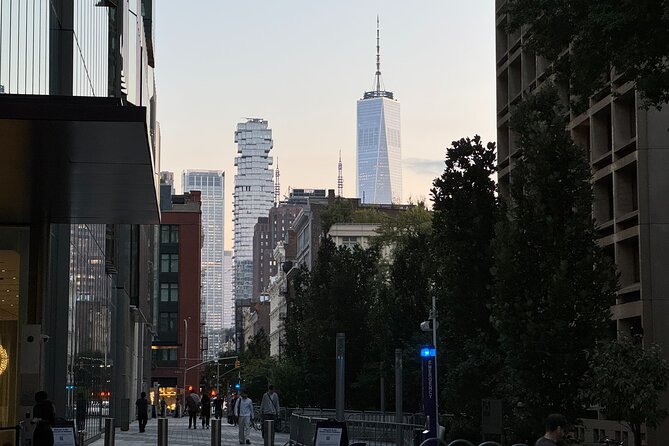
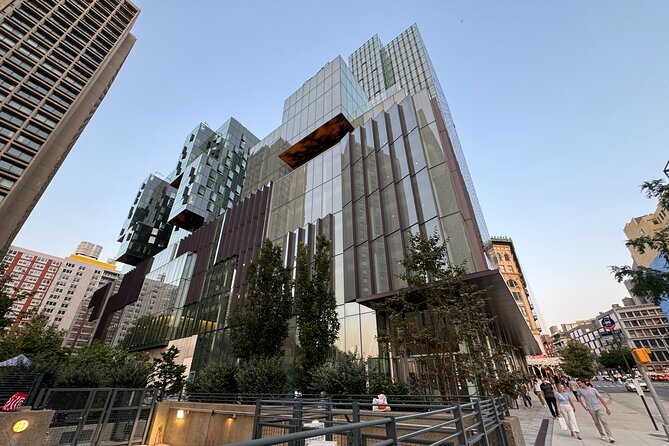
The stop at 40 Bond Street lasts about five minutes. You look at the residences designed by Herzog and de Meuron, a major name in contemporary architecture.
This is a useful contrast with the older buildings nearby. Instead of treating modern design as something separate from historic New York, the tour places it within the existing street pattern. You can consider the building’s relationship to its neighbors, its scale, and the way a new residence changes a familiar block.
The time here is short, so do not expect a full technical lecture. The value comes from having a guide direct your attention to details you might otherwise pass without noticing. If contemporary architecture interests you, this is one of the stops where Ivan’s design-focused approach should be most helpful.
The New Museum and SANAA’s clean break
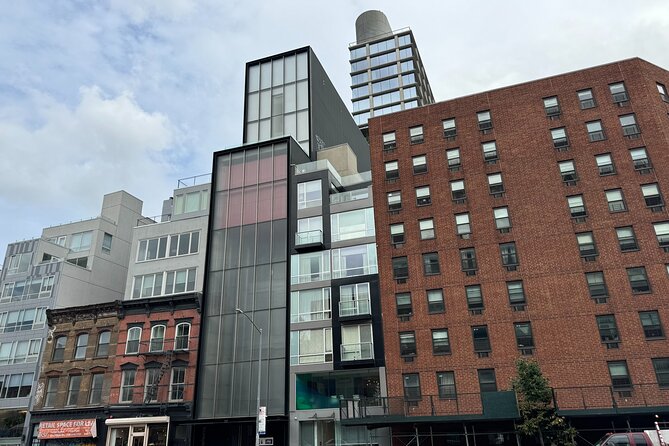
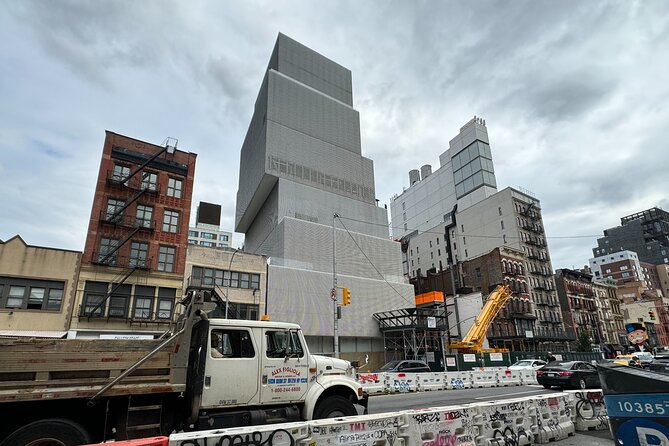
The New Museum of Contemporary Art is another brief stop, with about five minutes devoted to the building by SANAA. Its design gives you a clear example of how an art institution can announce itself through architecture.
The museum is important not only because of its exhibitions, but because the building itself became part of the neighborhood’s visual identity. Here, you can think about the difference between a traditional cultural building and a newer structure that uses form and arrangement to attract attention.
The stop does not include an admission visit to the museum. You are examining the exterior as part of the walking route. That keeps the tour moving, but you should book this experience for architecture and urban observation rather than for time inside art galleries.
Same streets, read through a different style:
- Tribeca Architecture And History Walking Tour
★ 5.0 · 141 reviews - New York City The Official Rockefeller Center Tour
★ 4.5 · 119 reviews - 3 Hour Midtown Manhattan Architectural Tour
★ 5.0 · 81 reviews - New York City: Art Deco and Architecture Landmarks Tour
★ 5.0 · 76 reviews
Public Hotel, Capitale, and the Bowery’s changing face
The Public Hotel comes next, followed by Capitale, the former Bowery Savings Bank. Each stop lasts roughly five minutes, but they serve different purposes.
The Public Hotel gives you another contemporary building to compare with 40 Bond Street and the New Museum. The focus is on how newer hospitality design fits into an area with older commercial and financial buildings.
Capitale offers the strongest historical counterpoint. The building began as the Bowery Savings Bank and was designed by McKim, Mead & White in 1895. That name and date provide a firm anchor for understanding late nineteenth-century civic and commercial architecture.
You are not simply looking at a grand old facade. You are considering why a bank would have been designed with such a formal presence, and how the building’s use has changed over time. The tour’s strength is this kind of comparison: old money, new hotels, art institutions, and residences appear within the same downtown walk.
The itinerary also includes the Little Singer Building, the Scholastic Building by Aldo Rossi, and New York’s old cathedral. These are passed or visited along the way without a stated time for each. Because of that, you should expect short explanations rather than lengthy stops.
The Little Singer Building adds another historic commercial example. The Scholastic Building brings Aldo Rossi into the route, giving you a chance to compare his work with the other modern buildings. The old cathedral adds a religious and civic layer to a route otherwise filled with banks, galleries, hotels, and residences.
NYU, Houston Street, and the problem of campus edges
The tour then reaches New York University’s main campus, including newer additions and residences along Houston Street and around Washington Square. This section shifts the subject from individual buildings to a larger institution and its effect on the neighborhood.
University buildings can be hard to understand when viewed one at a time. They are part of a wider system of classrooms, housing, public paths, and open spaces. The tour gives you a chance to consider how NYU has added to its campus and how those additions meet the surrounding streets.
This is also where the boundaries between campus and city become interesting. Washington Square is a public park, while NYU buildings and residences occupy much of the surrounding area. The walk helps you think about how an institution uses space in a neighborhood that remains open to everyone.
The NYU section is listed at about five minutes, so it is not a full campus tour. If you want a detailed history of the university, this will feel too short. If you want to understand how university growth affects city blocks and public life, it earns its place on the route.
Silver Towers and the art of public space
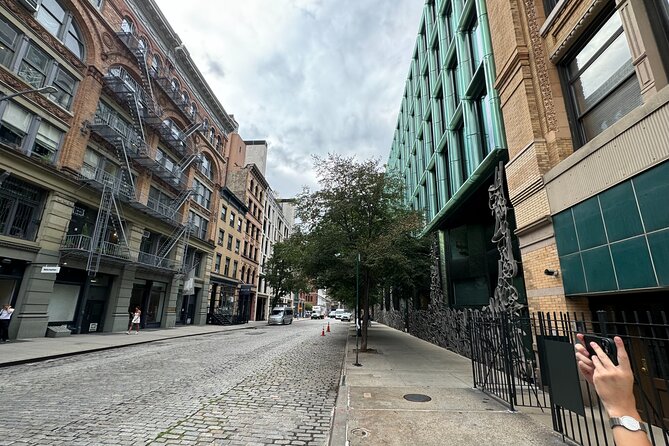
Silver Towers receives about 10 minutes, making it one of the longer stops. Here the focus is not just on the buildings, but also on the public spaces and art around them.
That wider view is one of the most useful parts of the experience. Architecture does not end at the front door. The distance between buildings, the paths people use, the open areas, and the art placed around a housing complex all shape how a place feels and works.
Silver Towers also gives the tour a chance to discuss residential planning. You can compare private residences such as 40 Bond Street with a larger housing development and ask how each handles shared space, movement, and the street.
The tour does not promise a full interior visit to Silver Towers. Instead, expect to study the buildings and the public setting from the route. The 10-minute stop gives Ivan more time to answer questions, which is helpful if you want to talk about planning rather than only facade details.
Bobst Library and Washington Square Park
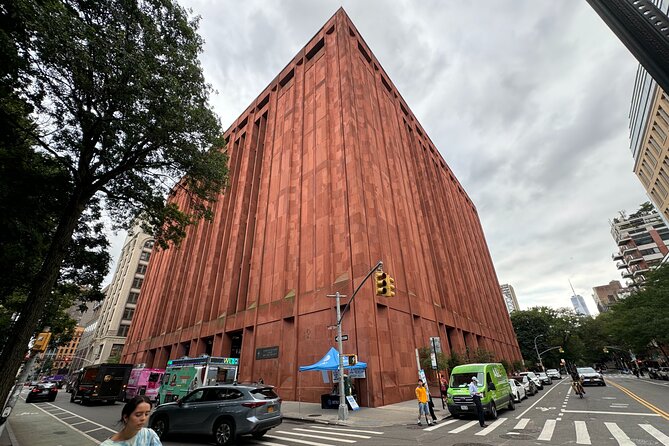
At NYU’s Bobst Library, the tour includes entry into the building. This is a welcome change from the many exterior stops because you get to experience architecture from inside, not just judge it from the sidewalk.
The library stop lasts about five minutes. That is enough for a focused look, but not enough for a long exploration. Keep your expectations in line with the format: this is a quick architectural visit within a walking tour, not a library tour.
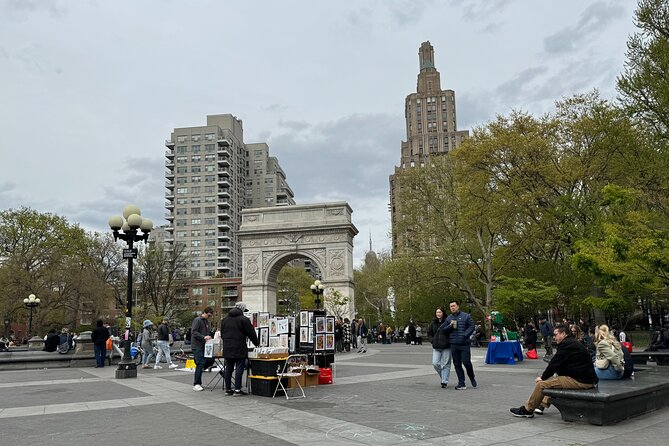
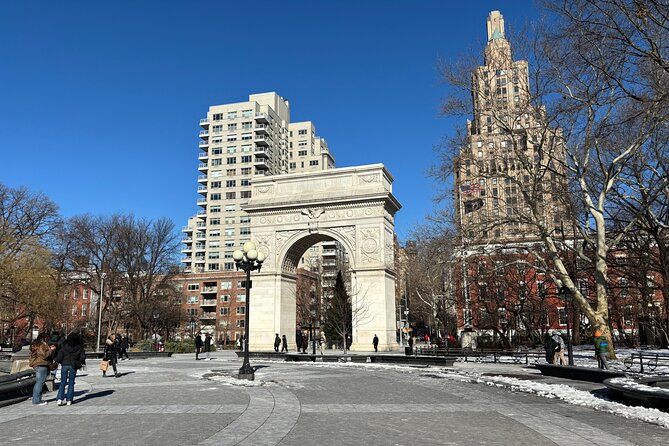
The final stop is Washington Square Park, with about 10 minutes planned there. You finish under the Washington Square Arch, a fitting end because the park brings together architecture, public space, university life, and everyday New York activity.
The ending is also practical. Washington Square is a central downtown location, and you finish at a recognizable landmark rather than returning to the starting point. You can continue exploring the Village afterward, though the tour itself ends at the arch.
What the guide and headsets add
Ivan is the named guide associated with this experience, and the comments about his work are unusually specific. He is described as explaining architectural design, building history, and urban planning, while adjusting the discussion to the group’s interests.
That last point matters. Architecture tours can become dry when every stop follows the same script. A guide who welcomes questions can help you spend more time on modern housing, historic banks, art institutions, or city planning, depending on what catches your attention.
The headsets solve a simple but real problem. Downtown streets are noisy, and a group walking near traffic can easily lose parts of a talk. With individual headsets, you should be able to hear the guide while looking at the building instead of crowding close to him.
This is still a walking tour, not a private lesson. The group can include people with different levels of interest and experience. The maximum of 15 keeps it personal, but you should not expect every minute to be tailored only to your questions.
Is $49 a fair price?
At $49 per person, the tour sits in a reasonable range for a two-hour guided walk with a small group and individual headsets. The strongest value comes from the interpretation. You could pass many of these buildings for free, but you would likely miss the connections between their design, function, neighborhood setting, and public space.
The price is less compelling if you want paid admissions or long interior visits. The New Museum, for example, is viewed from outside, and most stops are street-based. Bobst Library is the main stated interior visit, and the tour does not include museum entry, food, or gratuities.
I would judge the price by your interests. If you already enjoy architecture, urban design, and New York history, $49 buys a compact route with a guide who can answer questions. If you mainly want a general sightseeing walk, a broader neighborhood tour may give you more landmarks and less design detail.
Timing, comfort, and practical limits
The tour starts at 5:30 pm and lasts about two hours. The late afternoon start can fit well after daytime sightseeing, but you need to arrive at Cooper Square on time. Travel time is included in the two-hour duration, so the walk itself is not two full hours of stationary discussion.
Wear comfortable shoes. The route covers several downtown areas and includes repeated walking and standing. The tour is near public transportation, and most people can take part. Service animals are allowed.
The experience requires good weather. You can cancel for a full refund up to 24 hours before the start time. If the operator cancels because of poor weather or because the minimum number of participants is not met, you are offered another date or experience, or a full refund.
A mobile ticket keeps arrival simple. Tips are not included, so plan to tip the guide separately if you feel the tour earned it.
Who should book this walk?
I would choose this tour if you want to understand New York through buildings rather than simply photograph them. It suits architecture students, design fans, repeat visitors, and locals who pass through SoHo and the Village but have never had the street-level story explained.
It also works for a visitor with a busy schedule. Two hours is short enough to fit between other plans, and the route ends in a part of Manhattan with plenty more to see.
I would hesitate if your priority is indoor art, shopping time, or a long historical lecture. Several stops are brief, most sights are viewed from the street, and the route covers a lot of ground. The tour rewards attention, so you will get more from it if you are willing to pause and look closely.
FAQ
Where does the tour start?
The tour starts at Cooper Square, New York, New York 10003.
Where does the tour end?
It ends at Washington Square Park under the Washington Square Arch, on Washington Square North.
What time does the tour begin?
The scheduled start time is 5:30 pm.
How long does the tour last?
The experience lasts approximately two hours, including travel time along the route.
How large is the group?
The tour has a maximum of 15 participants.
Are headsets provided?
Yes. Each participant receives a professional individual headset so the guide can be heard clearly.
What happens if the weather is poor?
The experience requires good weather. If it is canceled because of weather, you are offered a different date or experience, or a full refund. You can also cancel for a full refund up to 24 hours before the start time.
Should you book the SoHo and Village Art and Architecture Tour?
Book it if you want a sharper eye for downtown New York. The mix of Cooper Union, 40 Bond Street, the New Museum, Capitale, NYU, Silver Towers, Bobst Library, and Washington Square Park gives you more than a collection of pretty facades. It shows how old and new buildings, institutions, residences, art, and public space meet on the same streets.
The main tradeoff is pace. You will not linger long at every stop, and most of the route is outdoors. But with Ivan’s focused guidance, a small group, and clear headsets, the $49 fee is a sensible choice for anyone who wants to really see the city rather than simply walk past it.
New to the itinerary around New York City
- Race to the Sky: NYC Architecture Tour With SUMMIT One Ticket★ 5.0 · 3 reviews
- Private Flatiron Food, History and Architecture Tour★ 5.0 · 8 reviews
- New York Upper West Side Art and Architecture Tour★ 5.0 · 4 reviews
- Chelsea and the High Line NYC Architecture Walking Tour★ 5.0 · 6 reviews
- New York Midtown South Art and Architecture Tour★ 5.0 · 2 reviews
- New York Upper East Side Art and Architecture Tour★ 5.0 · 3 reviews
- Chelsea Galleries and High Line; Art, Architecture and History★ 5.0 · 14 reviews
- Custom Private New York Architecture, Art and City Tour★ 5.0 · 3 reviews
New York City Architecture Tours, compared.


Around Manhattan Official NYC Architecture Cruise
Read our review →
Art Deco and Architecture Midtown Landmarks Tour
Read our review →

New York City The Official Rockefeller Center Tour
Read our review →


Midtown Manhattan Art and Architecture Walking Tour
Read our review →Other lists with this tour