
Review · SERBIA
Private 4 Hours Space Architecture Tour in Belgrade
Belgrade’s architecture tells a political story in concrete, steel, and glass. This private tour takes you from the hilltop Avala Tower to the brutalist Eastern and Western City Gates, with guides such as Stefan, Novica, Nemanja, and Mihailo adding the history behind each bold structure.
I like the easy hotel pickup and drop-off, especially because these sights sit far apart. I also like the private format, which lets you ask about Yugoslavia, socialism, Serbian history, or architectural details without keeping pace with a large group. The main drawback is simple: much of the four hours is spent in the vehicle, and the tour suits architecture fans more than visitors seeking Belgrade’s old town.
Key points to know before booking
- Avala Tower gives you the widest view: The rebuilt telecommunications tower rises on Belgrade’s tallest mountain and includes an observation deck.
- The route covers distant landmarks: You visit six major sites that would be awkward to connect by public transport in one morning.
- The architecture is political as well as visual: The Eastern Gate, Palace of Serbia, Sava Center, and Genex Tower reflect Yugoslav ideas about progress and public life.
- Private guiding makes a difference: Only your group takes part, with space for questions and route adjustments.
- Driving time counts toward four hours: Expect a brisk survey rather than long visits inside each building.
- The price works best for two or three people: At $175.14 per group of up to three, the cost is shared rather than charged per person.
Belgrade told through concrete, glass, and ideology
This is not a standard city sightseeing drive. You are not moving from one old church or museum to the next. Instead, you follow Belgrade’s twentieth-century ambitions, from a mountain communications tower to huge residential blocks and conference buildings built to project confidence.
The word space in the tour name points toward a broad view of architecture and urban planning. You will look at how buildings occupy public space, how they express a government’s priorities, and how Belgrade grew into a modern capital during the socialist period.
The guides bring more than architectural labels. Stefan, who has degrees in history, has been especially effective at connecting brutalist design with Serbian society and Yugoslav politics. Novica is suited to anyone who likes a strong historical narrative, while Nemanja has experience shaping the program around particular interests, including socialist architectural heritage and monuments.
Mihailo has also been praised for explaining what you see from the moment you get into the vehicle. Drivers can add local context too, so the time between stops does not have to feel like dead time.
More Private Architecture Tours in the world:
- Sagrada Familia & Gaudi Tour Private or Small Group with Tickets
★ 4.5 · 1,188 reviews - Treasures of Barcelona: Private Gaudi Walking Tour
★ 5.0 · 128 reviews - Sagrada Familia & Gaudi Guided Tour Private or Small Groups
★ 4.7 · 106 reviews
Avala Tower: the tour’s opening view
The drive from central Belgrade to Avala Tower takes about 30 to 45 minutes. That is a useful first stretch because your guide can introduce the city, Serbia, and Yugoslavia before the architecture begins in earnest.
Avala is Belgrade’s tallest mountain, and the telecommunications tower gives you a high viewpoint over the capital. The current tower was rebuilt in 2010 after the original was destroyed during the NATO bombing in 1999. That detail turns the visit into more than a photo stop. The structure carries a clear story of loss, reconstruction, and national identity.
You have about 45 minutes here, with admission included. The observation deck is the main reason to come, and the view helps you understand the scale of Belgrade before you spend the rest of the morning examining individual buildings.
The mountain setting also gives the tour a change of mood. Afterward, you return to the city and move into the dense, monumental architecture of New Belgrade and its surrounding districts.
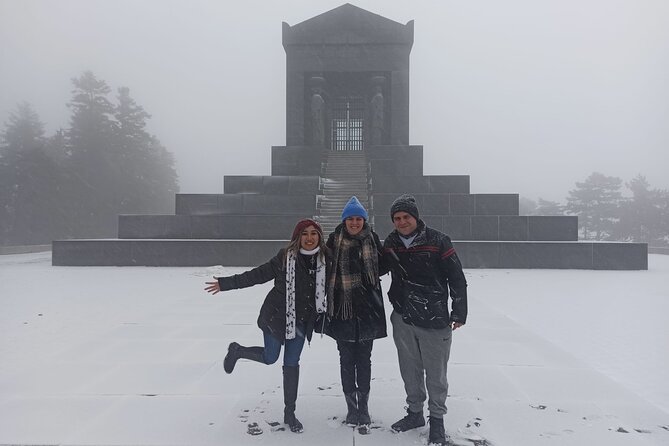
Weather may affect the feel of this stop. One tour reached the tower with snow on the ground, so ask about conditions if your visit falls in winter. The drive can take longer in poor weather, and the four-hour schedule leaves limited room for delays.
Eastern City Gate: three towers from the socialist era
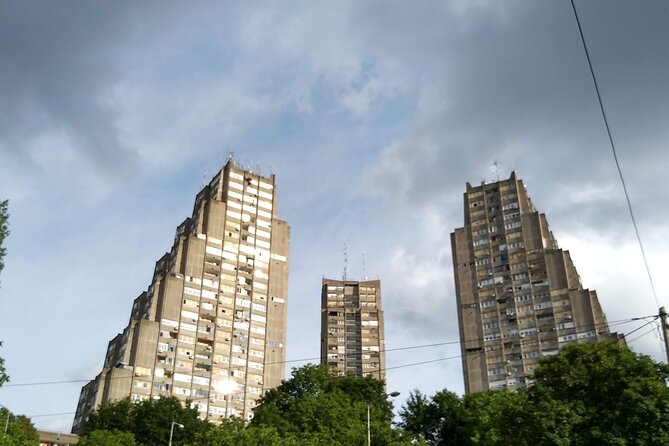
From Avala Tower, allow another 30 to 45 minutes to reach the Eastern City Gate. Officially called Rudo, this complex consists of three residential buildings, each about 85 meters high.
The towers are among Belgrade’s clearest examples of brutalist residential design. Their height and repeated forms give them a strong sculptural quality, but they were also practical buildings meant for ordinary urban life. This is where the tour can help you look beyond the usual question of whether you like the style.
Your guide can explain how the buildings fit into the ideals of Yugoslav socialism, when large-scale housing projects were tied to ideas of modern living and collective progress. The Eastern Gate is often treated as one of the city’s symbols, so it offers a useful counterpoint to the more official buildings later in the route.
You have about 20 minutes here, and there is no separate admission fee. Do not expect a long indoor visit. The value comes from seeing the group in its urban setting and hearing how the design relates to Belgrade’s growth.
Ada Bridge: engineering over the Sava
The trip from the Eastern Gate to Ada Bridge takes around 10 to 15 minutes. The stop is brief, about 20 minutes, but it brings a different type of architecture into the program.
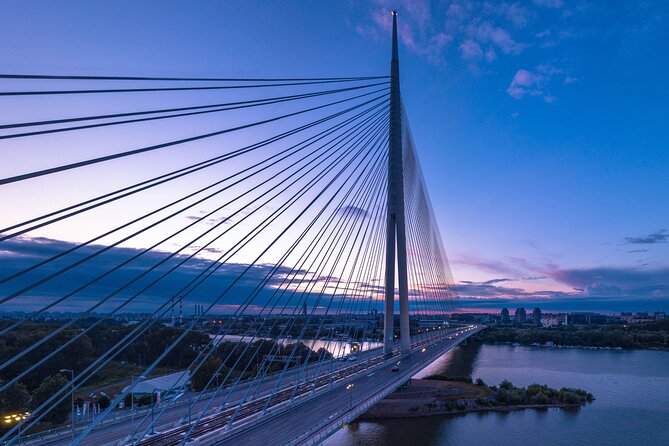
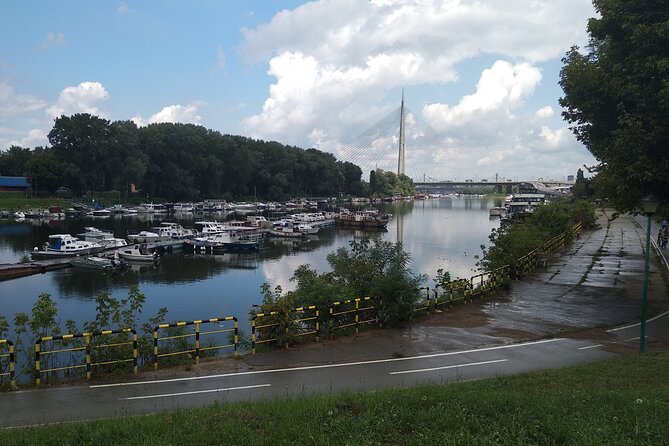
Ada Bridge crosses the Sava River and is described as Europe’s highest single-pylon bridge. Its construction was featured on the Discovery Channel, which gives you an easy starting point for discussing the engineering behind the structure.
You cross the bridge rather than spend a long period examining it from one fixed point. That matters because the experience is partly about movement, scale, and the relationship between bridge and river. You may also get a better sense of how modern infrastructure connects the city’s separate districts.
This is one of the tour’s less historically dense stops. It is more about structure and urban connection than socialist symbolism. Still, it breaks up the sequence of large concrete buildings and gives your eyes a different set of lines and materials to study.
More Architecture Tours around the world:
- Chicago Architecture River Cruise
★ 5.0 · 15,756 reviews - Chicago River 90-Minute Architecture Tour
★ 4.5 · 9,629 reviews - Chicago River: 1.5-Hour Guided Architecture Cruise
★ 4.8 · 8,046 reviews - Barcelona: Park Güell and Gaudí House Museum Entry Ticket
★ 4.5 · 6,326 reviews
Sava Center: a conference hall built for international ambition
After roughly 10 minutes on the road, you reach Sava Center. The visit lasts about 15 minutes, so think of it as an architectural introduction rather than a full interior tour.
The complex was built for the 1977 Conference on European Security and Cooperation in Belgrade. It was the first and largest conference center in former Yugoslavia, giving the project an important diplomatic role as well as an architectural one.
The design uses polyhedral forms across a very large complex. Your guide can point out how the building’s structure supports its purpose: this was a place designed to host major meetings, handle crowds, and present Yugoslavia as a modern state with an international role.
Sava Center is useful for understanding how public buildings can function as political messages. It was not simply an office block or hall. Its size and design announced that Belgrade wanted to host serious international events.
Because the stop is short, listen closely and ask questions while you are there. If you are an architecture student or professional, you may want to tell the guide in advance so the explanation can focus more closely on structure and planning.
Palace of Serbia: architecture for a federal government
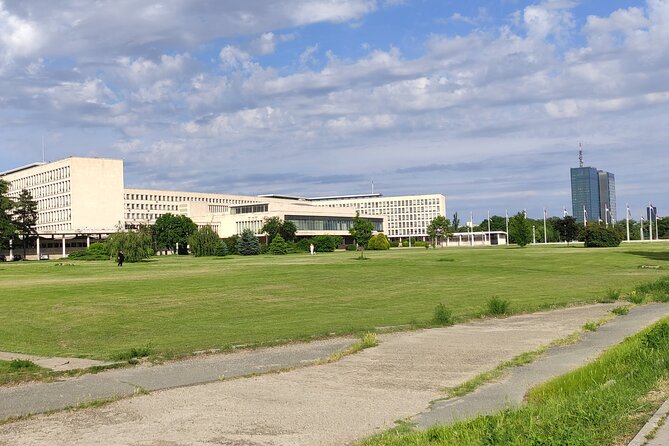
Only about five minutes separates Sava Center from the Palace of Serbia. You spend roughly 15 minutes outside this enormous late-modernist building, formerly known as the Federal Executive Council.
The palace was the first major New Belgrade project after World War II. Its size reflects the federal government it housed, but the design was not meant to feel crude or merely functional. It combines a huge scale with a more formal and elegant appearance.
This is one of the best stops for discussing how design can express authority. The building presents government as orderly, permanent, and capable of directing a new society. Your guide can place it within the story of postwar Yugoslavia and explain why New Belgrade became such an important setting for that vision.
You will likely remain outside, so this stop will appeal most to people interested in exteriors, planning, and political symbolism. The short visit also means you can see the building without losing too much time from the rest of the route.
Western City Gate: Belgrade’s most dramatic skyscraper
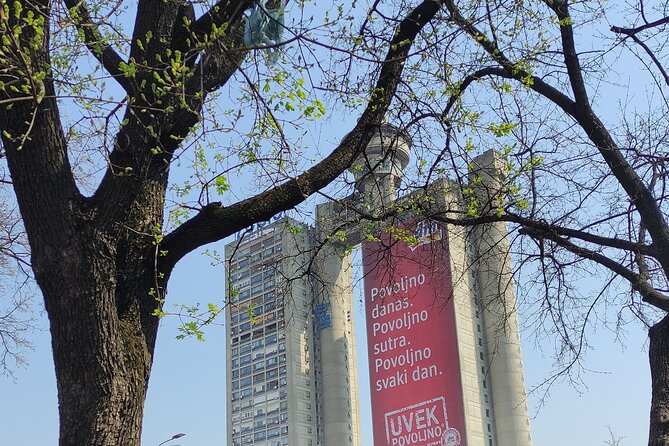
The final architectural stop is about 10 minutes away. The Western City Gate, better known as Genex Tower, is a 36-story skyscraper designed in 1977 by Mihajlo Mitrović in the brutalist style.
Its shape is hard to confuse with an ordinary high-rise. Two towers are joined by a two-story bridge, creating a powerful gateway form at the western entrance to Belgrade. The structure was designed to be seen at a distance, so viewing it from outside is central to the experience.
Genex Tower also shows that brutalism is not limited to low, heavy blocks. Here, the style reaches upward, using height, repetition, and a strong silhouette to mark the edge of the city.
This is a good final stop because it leaves you with one of the route’s boldest images. By this point, you have seen communications infrastructure, housing, bridges, conference facilities, government offices, and commercial or residential towers. Together, the sites show how broad the Yugoslav building program was.
The visit lasts about 15 minutes, so the tour does not offer time for a long exploration of the building. You are there to understand its form, take in its position, and hear the story behind it.
What the private format adds
The private setup is the strongest practical feature. Only your group participates, and the vehicle picks you up at your accommodation and returns you there afterward. That removes the need to reach distant sites on your own.
The route would be difficult to recreate efficiently by walking or public transport. Avala Tower is outside the central city, while the Eastern Gate, Ada Bridge, Sava Center, Palace of Serbia, and Genex Tower are spread across different parts of Belgrade. A car also lets you see more in four hours without spending the morning changing buses.
A private guide can adjust the emphasis. If you care most about brutalism, ask for more detail on the Eastern and Western City Gates. If your interest is modern Serbian history, ask about the bombing and rebuilding of Avala Tower, the formation of New Belgrade, and the role of Sava Center.
The main tradeoff is pace. Six stops, plus driving, make this a survey of the city rather than a slow architectural study. You will have around 15 to 20 minutes at most stops, with 45 minutes at Avala Tower. Take notes during the drive if you want to remember technical details later.
Guide quality and the value of local explanation
The most important part of this experience is not the vehicle. It is the person explaining what the buildings mean.
Several guides have been associated with the tour. Stefan brings formal training in history and can connect architecture with Serbian culture and society. Novica is a strong choice for people who enjoy detailed storytelling about Serbia and Yugoslavia. Nemanja has helped shape programs around specific interests in socialist heritage and monuments. Mihailo is known for keeping the explanation going between stops and sharing enthusiasm for Belgrade’s past.
Names and assignments can change, so you should not book solely to secure one particular guide. The useful point is that the company has several guides able to discuss more than dates and building names.
The strongest guiding will help you see the gap between a building’s official purpose and its lived meaning. A residential tower can represent both a socialist ideal and the daily reality of high-rise life. A government palace can look elegant while also projecting state power. A bridge can be a piece of engineering and a symbol of a changing city.
Is $175.14 a fair price?
The price is $175.14 for a private group of up to three people. For one person, that is a costly half-day outing. For two people, the cost is shared, and for three, the per-person price becomes much easier to justify.
You are paying for more than entry tickets. Most stops are free, but Avala Tower admission is included, along with hotel pickup, an air-conditioned vehicle, a professional guide, and return transport. The real value is the time saved and the access to a route that is awkward to arrange independently.
I would consider it good value for a couple or small group with a clear interest in architecture and twentieth-century history. It is less attractive if you mainly want famous central landmarks, cafés, museums, or unstructured city time.
The four-hour length also makes it useful early in a Belgrade visit. You can get a sense of the city’s wider shape, then decide which buildings or districts deserve a second look on your own.
Who should book this experience?
Book it if you are interested in brutalism, late modernism, infrastructure, socialist planning, or the history of Yugoslavia. It is especially useful for architecture students, designers, photographers, and anyone who wants to see more than Belgrade’s central sights.
It also suits first-time visitors who dislike wasting time on complicated transport. The pickup and drop-off make the morning straightforward, and the private format gives you room to ask direct questions.
You may want to skip it if you prefer long indoor visits, markets, historic churches, or a slow walking tour. The itinerary is vehicle-based, and the stops are short. You will see a great deal, but you will not spend an hour studying each building.
Confirmation is provided when you book. Service animals are allowed, and the tour information says most people can take part. Free cancellation is available up to 24 hours before the start time. Changes or cancellations made inside that window are not refunded.
Should you book the Belgrade architecture tour?
You should book this tour if Belgrade’s socialist-era buildings are a major reason you came, or if you want a clear introduction to the city beyond the usual center. The route is well chosen: Avala Tower adds the view and wartime story, the city gates show brutalist housing and skyscraper design, and Sava Center and the Palace of Serbia explain Yugoslavia’s international and political ambitions.
I would book it for two or three people rather than alone, since the group price becomes more reasonable. Tell the company your interests before the tour, especially if you care about brutalism, Spomeniks, engineering, or postwar planning. For the right audience, this is an efficient and thoughtful way to read Belgrade through its buildings.
FAQ
How long does the tour last?
The tour lasts approximately four hours, and transportation time between stops is included in that total.
How many people can join the private tour?
The price covers one private group of up to three people. Only your group takes part.
Is pickup from my accommodation included?
Yes. Pickup and drop-off at your accommodation are included, and the pickup details state that you will be collected from your address.
Which places does the tour visit?
The route includes Avala Tower, the Eastern City Gate, Ada Bridge, Sava Center, the Palace of Serbia, and the Western City Gate, also called Genex Tower.
Is admission included?
Yes. Entrance fees are included. The stated admission at Avala Tower is included, while the other listed stops have no separate admission fee.
What happens if I need to cancel?
You can receive a full refund if you cancel at least 24 hours before the experience start time. Cancellations or changes made less than 24 hours before the start time are not accepted for a refund.
New to the itinerary around the world
- Washington, DC: Georgetown Architecture Walking Tour★ 5.0 · 8 reviews
- Wilmington History and Architecture Tour★ 4.8 · 18 reviews
- Washington DC: Dupont Circle & Embassy Row Architecture Tour★ 5.0 · 6 reviews
- New Orleans : Garden District Architecture Walking tour★ 4.8 · 5 reviews
- Walk & Discover KL’s Architectural and Heritage Gems★ 5.0 · 7 reviews
- Unveiling Brno: History, Culture & Architectural Delights★ 5.0 · 2 reviews
- Vicenza: Palladian Architecture Private Walking Tour★ 3.3 · 3 reviews
- Private Colonial Williamsburg Architectural Tour★ 5.0 · 5 reviews
Private Architecture Tours, compared.

Sagrada Familia & Gaudi Tour Private or Small Group with Tickets
Read our review →
Barcelona 1.5h Private Old Town, Gothic & Ramblas Walking Tour
Read our review →
Treasures of Barcelona: Private Gaudi Walking Tour
Read our review →
Sagrada Familia & Gaudi Guided Tour Private or Small Groups
Read our review →
Best of Chicago: Architecture & Highlights City Private Tour
Read our review →
Private Harajuku Omotesando Architecture Walking Tour
Read our review →
Private Santa Barbara History and Architecture Walking Tour
Read our review →
Private Barcelona Modernism and Gaudí Walking Tour
Read our review →Other lists with this tour