Review · PORTUGAL
Lisbon Contemporary Architecture
Lisbon’s modern face is easy to miss behind its tiled churches and grand plazas. This private four-hour tour brings it forward, from the sculptural Champalimaud Foundation on the Tagus to the sweeping roof of MAAT and the futuristic buildings of Parque das Nações. Guide Nelson Leona can tailor the outing to your interests, which is a real advantage for anyone who wants more than a standard sightseeing loop.
I like the clear focus on architecture and the mix of Belém’s riverside monuments with the newer eastern district. I also like the included cable-car ride at Parque das Nações, which gives you a useful bird’s-eye view instead of leaving you to study the buildings from street level. The main drawback is value: at $181.39 per person, this is a serious spend, and MAAT admission is not included.
Key points to know before booking
- Private four-hour tour: Your group travels alone, with the route open to some personal adjustment.
- Nelson Leona as guide: He is described as polite, personable, fluent in English, and well informed about Lisbon and Portugal.
- Four important modern sites: Expect the Champalimaud Foundation, Belém Cultural Center, MAAT, and Parque das Nações.
- MAAT admission costs extra: You can see the building from the outside without that ticket, but entering the museum requires a separate admission.
- Cable car included: The round trip at Parque das Nações gives you a high view of the district’s major structures.
- Best for architecture fans: This tour makes more sense if you are curious about design, planning, and Lisbon’s recent transformation.
Lisbon beyond the old stone streets
Most first visits to Lisbon follow a familiar path: Alfama lanes, Belém’s monastery and tower, hilltop viewpoints, and perhaps a tram ride. Those sights matter, but they tell only part of the city’s story. This experience shifts your attention to what Lisbon has built in recent decades.
You move between two very different parts of the city. Belém places ambitious new architecture beside maritime monuments and former industrial sites. Parque das Nações, rebuilt for Expo 98, offers a more planned and futuristic setting, with broad public spaces and large civic buildings.
That contrast is the heart of the tour. You are not simply ticking off modern buildings. You are seeing how Lisbon uses architecture to connect its imperial past, scientific ambitions, industrial memory, and future-facing identity.
Because this is a private activity, the pace should suit your group better than a large scheduled outing. The published duration is about four hours, enough for an overview and discussion at the principal stops. It is not enough for a lengthy museum visit at every site, so set your expectations accordingly.
More Architecture Tours around the world:
- Chicago Architecture River Cruise
★ 5.0 · 15,756 reviews - Chicago River 90-Minute Architecture Tour
★ 4.5 · 9,629 reviews - Chicago River: 1.5-Hour Guided Architecture Cruise
★ 4.8 · 8,046 reviews
The Champalimaud Foundation and the Tagus
The Champalimaud Foundation is one of the tour’s strongest stops. It sits directly on the Tagus, in a location framed by two very different reminders of Portugal’s past: the Tower of Belém and the Dock of Rocks. Against that setting, the building feels deliberately new.
Architect Charles Correa designed the complex to treat architecture almost like sculpture. Curving forms, open space, and the relationship with the river are central to the experience. The design was made for a biomedical research center, so its beauty is not separate from its purpose. The building is intended to support work connected with science, health, and the search for new knowledge.
That combination gives the stop more substance than a quick photo break. You can look at the building as an object, but you can also consider how a research institution presents itself to the public. It is a place devoted to the unknown, and the architecture takes that idea seriously.
You should expect this part to be primarily an exterior architectural visit. The supplied details do not promise an interior tour or access to research areas. That is worth keeping in mind if you hope to see laboratories or learn about the foundation’s scientific work in depth.
The riverside location also makes this a good place to think about Lisbon’s changing identity. Old symbols of navigation and national ambition sit close to a modern center devoted to medical research. That physical contrast gives the guide a natural way to explain why these buildings belong in the same story.
Belém Cultural Center beside the old city
The Belém Cultural Center, often called CCB, is one of Lisbon’s best-known modern landmarks. Manuel Salgado and Vittorio Gregotti designed it for a site where new architecture had to coexist with some of the city’s most recognizable historic buildings.
The result is not a glass tower or a flashy object. Its forms are large, ordered, and carefully placed. The modern design contrasts with old Lisbon, but it does so without trying to imitate it. That makes the building useful for understanding a central question in Lisbon: how can a city add major new structures without turning every historic district into a museum?
Your guide can help connect the CCB with the surrounding area, especially if you are interested in how public buildings shape a district. The building is cultural in purpose as well as architectural in appearance, so the stop can open a discussion about museums, performance spaces, public gathering places, and the role of design in civic life.
The limitation is that the stop may feel brief if you want to explore the center’s full interior program. The tour covers several locations in four hours, and no separate admission or extended visit is listed here. Think of the CCB as a key architectural example and an outdoor orientation stop, not a full day at a cultural complex.
MAAT, where museum and power station meet
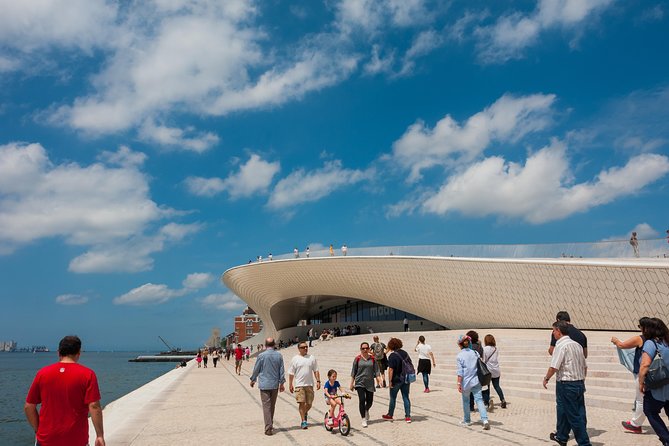
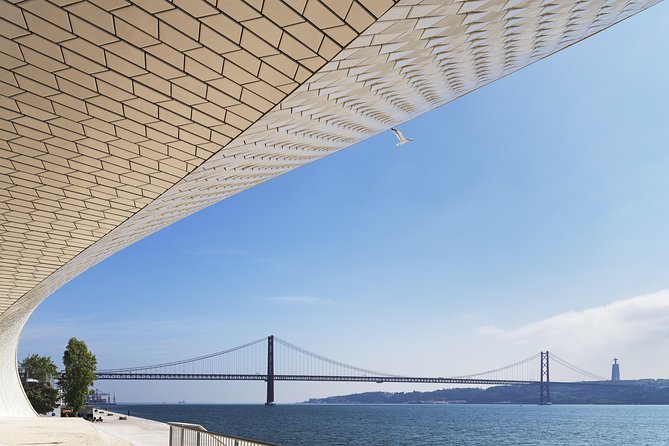
MAAT is likely to be the visual centerpiece of the Belém portion. Its design, by Amanda Levete Architects, uses a low, arching form that follows the curve of the riverfront promenade. The roof is covered with 15,000 glazed tiles, and visitors can walk over the top of the building.
That roof is more than decoration. It turns the museum into part of the public path along the Tagus. Instead of presenting the building as a sealed box, the design invites you to move across it, look back toward Belém, and consider the river from a changing height.
Inside, MAAT brings together art, architecture, and technology. Its purpose is discussion and discovery rather than a single narrow collection. The museum also connects with the Central Tejo Power Station, an important example of Portuguese industrial architecture from the first half of the twentieth century.
That pairing is especially effective. The power station represents machinery, energy, and industrial work. MAAT answers it with a smooth, contemporary form devoted to art, design, and technology. Together, the buildings show two different ideas of progress.
One practical point matters here: MAAT admission is not included. The stop is listed as lasting about one hour, but your exact time inside will depend on your plans and the separate ticket. If you are mainly interested in the exterior, the walkable roof and riverfront setting may be enough. If you want the exhibitions and the connection to Central Tejo, budget for admission.
I would ask before booking how the four-hour schedule handles your preferred balance between exterior viewing and museum time. Architecture fans may want to linger at MAAT. Others may prefer to keep moving toward Parque das Nações, where the tour offers a broader collection of modern buildings.
Same streets, read through a different style:
- Barcelona: Park Güell and Gaudí House Museum Entry Ticket
★ 4.5 · 6,326 reviews - Chicago Architecture Center River Cruise aboard First Lady
★ 5.0 · 5,536 reviews - Barcelona: Gaudi’s Casa Vicens Skip-the-Line Entrance Ticket
★ 4.7 · 4,541 reviews - Barcelona: Gaudí’s Park Güell Tour with Fast-Track Ticket
★ 4.8 · 4,512 reviews
Parque das Nações and Lisbon’s planned future
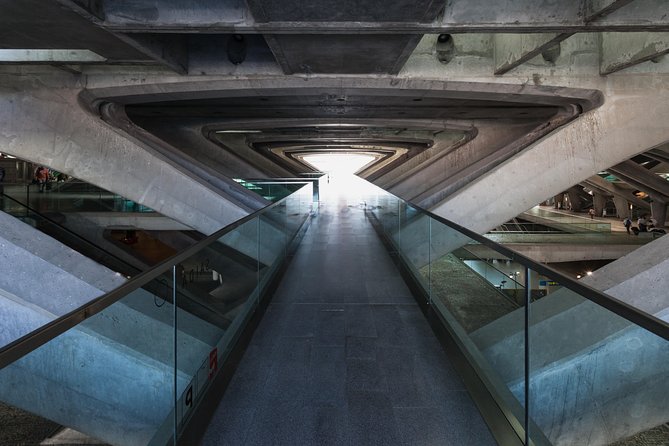
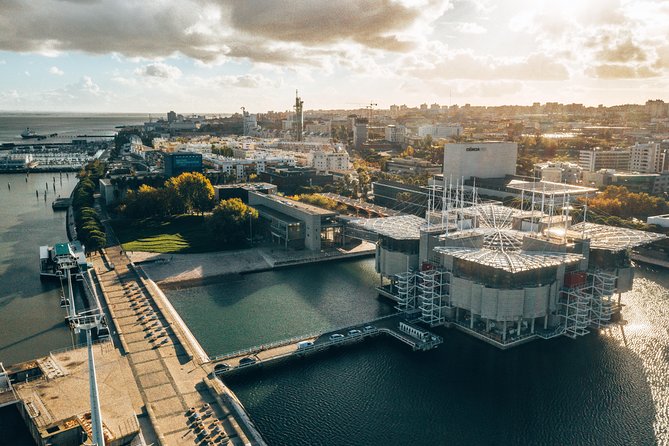
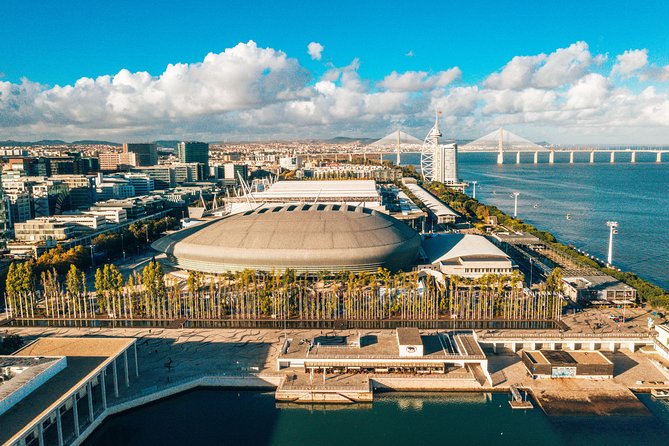
Parque das Nações is a very different experience from Belém. Rather than a historic district receiving a few modern additions, this area was planned as a new urban quarter. The redevelopment created room for varied architectural forms, large public spaces, cultural venues, transport links, and riverfront access.
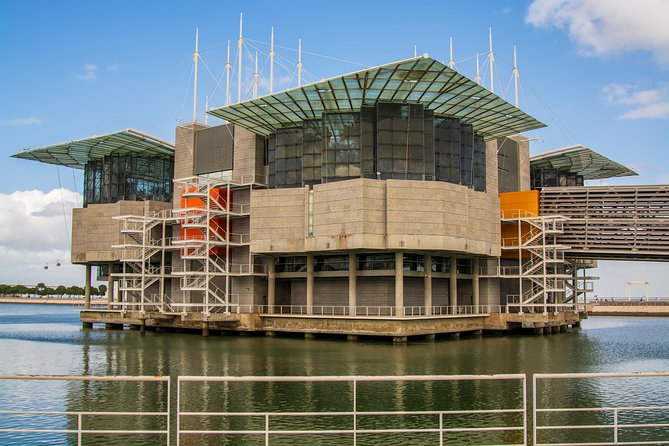
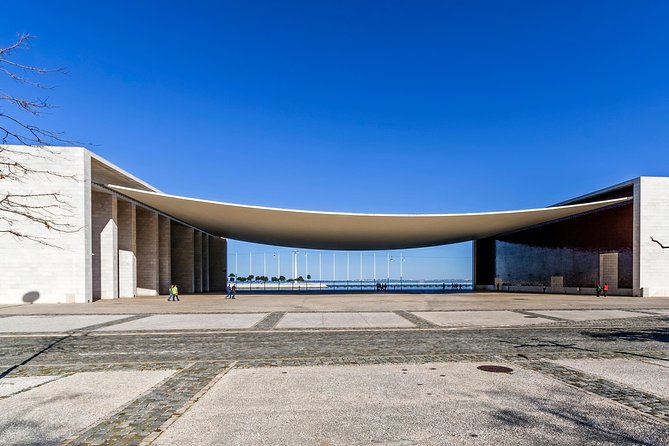
Several important buildings are associated with the district. The Portuguese Pavilion, Atlantic Pavilion, Knowledge Pavilion, Vasco da Gama Tower, and Oriente Station each offer a different answer to the question of what a modern city should look like.
The Portuguese Pavilion is known for its dramatic architectural form. The Atlantic Pavilion, now a major arena, gives the district a large-scale event space. The Knowledge Pavilion brings science and learning into the area. The Vasco da Gama Tower provides a vertical counterpoint to the low riverfront buildings, while Oriente Station combines transport with bold structural design.
You may not enter every one of these buildings. The value here is in seeing how they relate to one another across the district. A private guide can help you read the area as a planned whole instead of treating each building as an isolated object.
This part is also useful if you want to understand Expo 98’s lasting effect on Lisbon. The district was built around a major international exhibition, but it was planned to continue as part of the city. That makes it more than a temporary showcase. It is an example of how a large event can reshape an urban area.
Seeing the district from the cable car
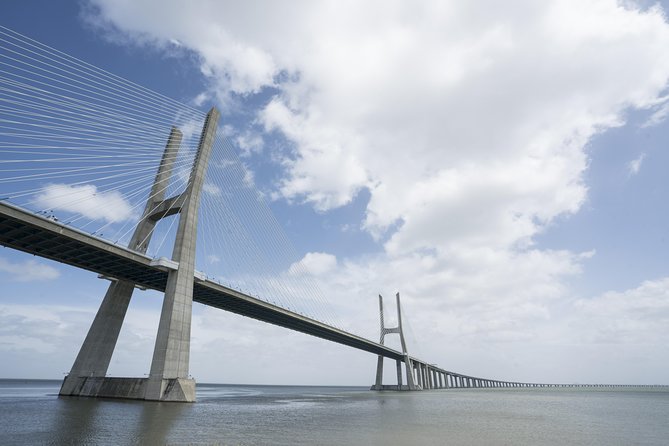
The included round trip on the Parque das Nações cable car is one of the smartest features of the tour. From the ground, large buildings can feel scattered. From above, you can see how the district fits along the Tagus and how the major structures relate to the public spaces between them.
The cable car also changes the scale of the architecture. A building that seems overwhelming at street level can become part of a wider composition from above. You get a clearer sense of the district’s planning, its riverfront position, and the contrast between horizontal promenades and tall structures.
The ride is listed as included, so you do not need to add that cost to the tour price. It is also a welcome change of pace during a four-hour architecture outing. You are not looking at facades the entire time. You are given a moving overview of the area.
Still, the cable car is a viewing experience, not a substitute for time on foot. If you want to study details, photograph entrances, or spend time inside the pavilions, you may need to arrange more time beyond the scheduled tour. Ask Nelson how much time the itinerary allows for walking in Parque das Nações before the ride.
What the private format changes
A private tour can be a good fit when your interests are specific. If you care about contemporary architecture, you can ask for more explanation of structure, materials, urban planning, or the ideas behind each project. If you are less technical, the guide can keep the discussion focused on what you can see and how the buildings fit Lisbon’s story.
Nelson Leona is the named guide connected with this experience. He is described as polite and personable, with fluent English and a strong grasp of Lisbon and Portugal. His ability to customize the route is particularly useful because the tour includes several major sites but only about four hours.
The private format also avoids the compromises of a large group. You are not waiting for strangers to finish photographs or adjusting your pace to people with different interests. The trade-off is price. At $181.39 per person, the cost is easier to justify for a small group that values personal attention than for a solo visitor on a tight budget.
Group discounts are available, though the exact savings are not specified. Since the activity is private, ask for the current price for your party before booking. The per-person figure may make more sense when shared across several people.
Timing, transport, and practical details
The tour begins and ends at the meeting point in Lisbon. The supplied information does not specify private vehicle arrangements, exact pickup details, or the transport used between stops, so confirm those points before you pay. This matters because Belém and Parque das Nações are separate parts of the city.
The activity is offered in English and runs for about four hours. It is available Monday through Sunday during the stated operating period, with opening hours from 7:00 a.m. to 8:00 p.m. The booking confirmation arrives at the time of purchase.
Most people can take part, and service animals are allowed. The experience is near public transportation, which gives you another way to reach the meeting point or continue exploring afterward. Specific accessibility details for the buildings, cable car, and walking sections are not provided, so ask directly if you have mobility needs.
MAAT admission is extra, while the cable-car ride is included. That difference is easy to overlook when comparing the total cost. If you want to enter MAAT, add its ticket to your budget.
Free cancellation is available until 24 hours before the start time. Cancellations or changes made less than 24 hours in advance are not refunded or accepted, and the cut-off follows local Lisbon time.
Who will get the most from this tour
I would choose this experience if you have already seen Lisbon’s major historic sights or if modern design is one of your main reasons for visiting. The route gives you a useful range: a research foundation, a cultural center, an art and technology museum, an industrial power station connection, and an entire planned district.
It also suits couples, families, and small groups who want a private outing in English. The guide’s ability to adjust the experience is useful for mixed interests. One person can focus on photography and form, while another can listen for history, science, or city planning.
I would be more cautious if you want a museum-heavy day. Only MAAT is listed with an admission option, and the schedule covers several outdoor sites. The tour is about seeing and understanding the buildings, not spending hours inside each one.
The price may also be too high if you simply want to visit MAAT and ride the cable car. You can explore Lisbon’s modern districts independently for less, but you would give up the private guide, the organized route, and the architectural context tying the stops together.
Should you book Lisbon Contemporary Architecture?
Book it if you want Lisbon explained through its newer buildings, especially if you prefer a private route and clear English commentary. The strongest elements are the contrast between Belém and Parque das Nações, the sculptural Champalimaud Foundation, MAAT’s remarkable roof, and the cable-car view across the eastern district.
Before confirming, decide how much of the $181.39 price you are paying for convenience and personal guidance. Ask about transportation between Belém and Parque das Nações, confirm the current group discount, and remember to add MAAT admission if you want to go inside.
For architecture fans, this is a focused way to see a side of Lisbon that many visitors miss. For anyone seeking only the classic monuments, it may be an expensive detour.
FAQ
How long does the Lisbon Contemporary Architecture tour last?
The tour lasts approximately four hours.
Where does the tour take place?
It takes place in Lisbon, Portugal, with stops in Belém and Parque das Nações.
Is the tour private?
Yes. Only your group participates in the activity.
Is the tour offered in English?
Yes. English is the offered language.
Is MAAT admission included?
No. Admission to MAAT is not included in the tour price.
Is the Parque das Nações cable car included?
Yes. The round-trip cable-car ride in Parque das Nações is included.
What is the price?
The listed price is $181.39 per person. Group discounts are available.
Who is the named guide?
Nelson Leona is the named guide associated with the experience. He can customize the outing to suit your preferences.
Can I cancel for a refund?
Yes. You can cancel at least 24 hours before the experience start time for a full refund. Cancellations or changes made less than 24 hours before the start time are not accepted or refunded.
New to the itinerary around the world
- Washington, DC: Georgetown Architecture Walking Tour★ 5.0 · 8 reviews
- Wilmington History and Architecture Tour★ 4.8 · 18 reviews
- Walk & Discover KL’s Architectural and Heritage Gems★ 5.0 · 7 reviews
- Washington DC: Dupont Circle & Embassy Row Architecture Tour★ 5.0 · 6 reviews
- New Orleans : Garden District Architecture Walking tour★ 4.8 · 5 reviews
- Unveiling Brno: History, Culture & Architectural Delights★ 5.0 · 2 reviews
- Vicenza: Palladian Architecture Private Walking Tour★ 3.3 · 3 reviews
- Private Colonial Williamsburg Architectural Tour★ 5.0 · 5 reviews
Portugal Architecture Tours, compared.

Faro Private Walking Tour: Uncovering its Architectural Legacy
Read our review →