
Review · BARCELONA
Barcelona & Gaudi. Regular Tour
Barcelona’s Modernist buildings can look like a parade of pretty façades until someone explains the ideas behind them. This three-hour walk does just that, following Gaudí’s path from social concerns toward spiritual architecture, with help from a practicing architect rather than a guide working from a standard script.
I like the small maximum group of 20, which gives you a better chance to hear the explanation on busy Eixample sidewalks. I also like the way the tour places Gaudí beside Domènech i Montaner and Puig i Cadafalch, so Barcelona’s architecture becomes a conversation, not a one-man show. The main limitation is clear: you do not go inside the buildings, so this is best for context, design, and street-level detail rather than interiors.
Key points to know before you book
- Architect-led perspective: The walk is led by practicing architects who explain Modernism through design, history, and social ideas.
- Five listed stops: The route includes Casa Milà, Casa Batlló, Casa Calvet, La Mansana de la Discordia, and the Fundació Antoni Tàpies.
- Important nearby works: You also see or discuss Casa Lleó Morera, Casa Amatller, hidden Eixample courtyards, and other Modernist details.
- Outdoor viewing only: The buildings are examined from the street, with no interior admission included.
- Three hours at a steady pace: The 10:30 am start leaves much of the day free for a museum, lunch, or a booked visit inside a Gaudí building.
- Good value for architecture fans: At $54.44 per person, the price buys a focused specialist walk rather than entry tickets.
Why this Barcelona walk is more than a Gaudí photo stop
Gaudí is the headline, but the best part of this experience is the setting around him. Barcelona’s Eixample is a broad urban district filled with planned blocks, grand façades, unusual entrances, and architectural competition. The walk uses that setting to explain how Modernism grew from changes in politics, industry, society, and religion.
You will hear about eclecticism, utopian socialism, positivist materialism, the intellectual bourgeoisie, anarchism, the Spanish Civil War, and religious ideas. That is a lot for three hours, but it gives the buildings some needed footing. Gaudí’s curves and symbols did not appear in isolation. They came from a city wrestling with modern life and searching for a new cultural identity.
I especially like that the route includes architects beyond Gaudí. Domènech i Montaner and Puig i Cadafalch are essential to understanding Barcelona’s Modernist period, and their work gives you useful comparisons. You can look at a façade and ask not only if it is beautiful, but what its designer was trying to say about nature, craft, technology, wealth, or faith.
The tour also reaches toward difficult subjects. The mention of anarchism, the Civil War, and beatification signals that Barcelona’s architecture is tied to more than decorative flair. You may not become an expert in every topic, but you should leave with a clearer sense of why these buildings carry such cultural weight.
More Gaudí Tours in Barcelona:
- Barcelona: Park Güell and Gaudí House Museum Entry Ticket
★ 4.5 · 6,326 reviews - Barcelona: Gaudi’s Casa Vicens Skip-the-Line Entrance Ticket
★ 4.7 · 4,541 reviews - Barcelona: Gaudí’s Park Güell Tour with Fast-Track Ticket
★ 4.8 · 4,512 reviews
Starting at the Monument al Llibre
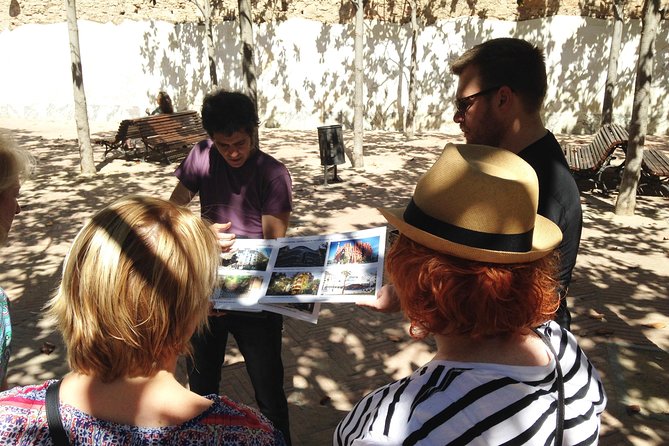
The walk begins at the Monument al Llibre on Gran Via de les Corts Catalanes, 634, in the Eixample, at 10:30 am. The meeting point is near public transportation, which makes the start practical if you are staying elsewhere in Barcelona.
I would arrive a little early. A city walk is easier when you are not trying to locate the group at the last moment, especially on a large avenue. The exact route moves through central Barcelona, and the experience returns to the same meeting point at the end.
The morning timing works well. You can take the walk before the strongest midday heat, then continue with lunch or a timed interior visit. Since the activity lasts about three hours, you still have room for another major sight later in the day. Just avoid stacking it too tightly with a booking across town, since the walk ends back at its starting point rather than at Sagrada Família or another major attraction.
Casa Milà, the stone wave of La Pedrera
Casa Milà, commonly called La Pedrera, is one of the tour’s listed stops. From the street, its uneven stone façade and flowing balconies show Gaudí turning an apartment building into something that seems to move.
Because you do not go inside, the guide’s explanation matters. Street-level viewing lets you focus on the exterior’s forms, surfaces, ironwork, and relationship to the block. An architect can help you see how the building challenges ordinary ideas of a straight wall and a tidy apartment façade.
This is also a useful place to discuss Gaudí’s later work. The tour connects his architectural development to a growing absorption with the divine, presenting him as a designer who eventually approached his work like a cathedral builder. That idea gives La Pedrera more meaning than its familiar photo angle.
The practical drawback is that Casa Milà’s exterior can be crowded and visually busy. You may need to shift position to see details or hear clearly. A group capped at 20 helps, but this is still a public sidewalk, not a quiet lecture room.
Casa Batlló and the drama of the block
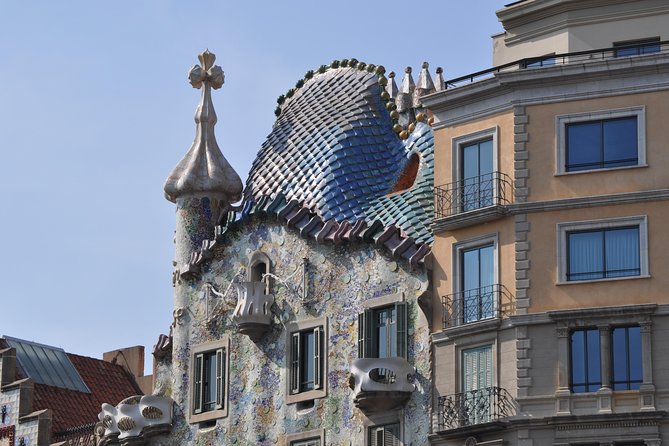
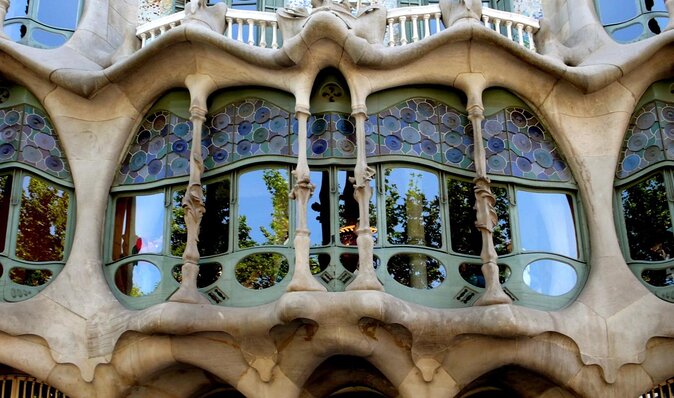
Casa Batlló brings a different mood. Its surface is more theatrical, with color, curves, and ornamental details that make the building look almost alive. The tour treats it as part of Gaudí’s larger design language rather than as a stand-alone oddity.
This is where the route’s comparisons become useful. Casa Batlló sits in La Mansana de la Discordia, the Block of Discord, alongside notable works by other Modernist architects. You can compare the façades directly instead of seeing each building on separate days and trying to remember the differences.
I like this stop for that reason. Architecture is easier to understand when you can place competing designs side by side. The block shows how Barcelona’s affluent citizens commissioned striking homes and how architects responded with different ideas about ornament, structure, color, and identity.
Again, the tour is exterior only. If you want the interiors, you will need a separate visit and separate admission. This walk can help you decide which building deserves that extra time, but it does not replace an interior tour.
More Architecture Tours around Barcelona:
- Barcelona: Sant Pau Recinte Modernista Entry Ticket
★ 4.6 · 2,567 reviews - Barcelona: Sagrada Familia, Modernism, and Old Town Tour
★ 4.7 · 1,621 reviews - Sagrada Familia & Gaudi Tour Private or Small Group with Tickets
★ 4.5 · 1,188 reviews - Complete Gaudi Tour: Casa Batllo, Park Guell & Sagrada Familia
★ 5.0 · 1,152 reviews
La Mansana de la Discordia and Barcelona’s architectural rivalry

La Mansana de la Discordia is not simply another photo stop. It is the point where the route’s wider story becomes especially clear. Several important Modernist buildings occupy the same stretch, allowing you to read Barcelona’s architecture as a friendly rivalry among major designers.
Casa Batlló is the Gaudí contribution, while Casa Amatller by Puig i Cadafalch and Casa Lleó Morera by Domènech i Montaner bring different answers to the same urban challenge. The guide helps you notice contrasts that are easy to miss when you are focused only on Gaudí’s most famous shapes.
This is one of the strongest reasons to choose an architect-led walk. A basic sightseeing route might identify each building and move on. Here, the goal is to explain why the façades differ and how the architects worked within the same city, period, and wealthy urban setting.
The street is also a reminder that these buildings were created for real urban life. They are not isolated museum objects. They face traffic, shops, pedestrians, and neighboring façades. Looking at them together gives you a better sense of Barcelona as a living city rather than a collection of monuments.
Casa Calvet and a quieter side of Gaudí
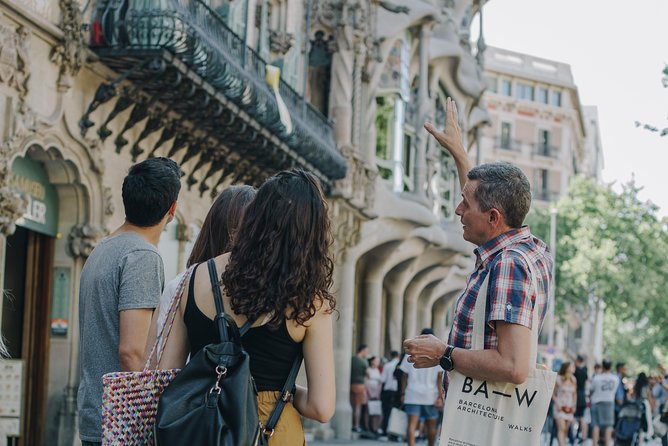
Casa Calvet is another listed stop, and it gives the tour a chance to show a less immediately flamboyant side of Gaudí. Compared with Casa Batlló or La Pedrera, it may appear more restrained at first glance.
That contrast is valuable. It helps you avoid reducing Gaudí to strange curves and fantasy surfaces. His work could respond to a client, a site, a building type, and a period in different ways. The route’s discussion of eclecticism and the end of Modernism fits well here, since Casa Calvet can prompt questions about how architects balance accepted forms with personal invention.
I would pay attention to the smaller details at this stop. The point is not only the broad shape of the building, but how ornament, materials, and entry elements work together. Since the walk stays outside, you will be looking closely at what the street gives you.
The Fundació Antoni Tàpies and Modernism’s wider reach
The Fundació Antoni Tàpies is the final listed stop. It broadens the walk beyond Gaudí and links Barcelona’s architectural story to a later artistic figure.
That change of focus matters. A good architecture tour should show that the city’s creative life did not end with the Modernist period. The foundation also gives the guide a chance to discuss the changing meaning of buildings, art, and public space in Barcelona.
The route includes Casa Lleó Morera by Domènech i Montaner and Casa Amatller by Puig i Cadafalch as part of this wider look at the city. You may find that these buildings sharpen your eye for craft and ornament, especially after seeing several works in a short distance.
The tour’s historical scope can feel ambitious. It covers architecture, urban growth, class, politics, religion, and conflict. If you prefer a narrow focus on construction methods or a single architect, the range may feel broad. I see that as a strength for most visitors, but you should expect ideas as well as sightseeing.
The Sagrada Família and Colònia Güell in the bigger story
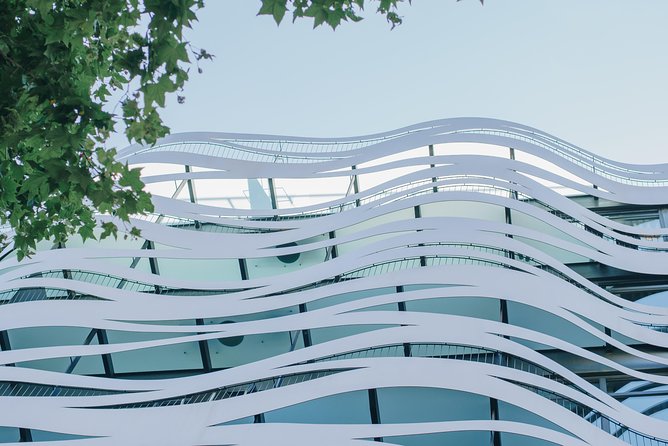
The route description connects Gaudí’s development to the Crypt of Colònia Güell and the Sagrada Família. These places help frame the shift from social concerns toward a more spiritual and cathedral-like vision.
They are not listed as stops on the three-hour itinerary, and no interior visits are included. Do not book this experience expecting to tour the Sagrada Família or Crypt of Colònia Güell. Instead, treat their role here as part of the story the guide tells about Gaudí’s changing goals.
That distinction is important when planning. If you want to enter the Sagrada Família, arrange a separate ticket and allow separate time. This walk can provide useful context before or after that visit, but it is not a substitute for seeing Gaudí’s basilica from inside.
What the architect-led format adds
The guide is a practicing architect, and that shapes the experience. You are not only given dates and names. You are encouraged to think about how buildings express ideas and how design reflects the city that produced it.
The strongest praise for this tour focuses on the guide’s ability to combine accurate information about Gaudí with warmth, compassion, kindness, and humor. Pia is specifically named in the feedback, and the comments describe her as passionate and able to make the material fun as well as informative.
That combination matters on a three-hour walk. Architecture can become dry when every façade turns into a list of dates. A guide who can explain difficult ideas in plain language keeps the pace human. The tour is also described as well organized and pleasant, which is useful reassurance for anyone who does not usually book specialist walks.
The group limit of 20 is another practical advantage. It is not a private tour, but it is small enough to feel more personal than a large city group. You should still expect occasional street noise and the need to gather around the guide at busy spots.
Price, pace, and who gets the best value
At $54.44 per person, this is not the cheapest way to look at Barcelona’s façades. It is a fair price if you want an informed architectural reading of the Eixample and prefer a small group over a basic orientation walk.
You are paying for about three hours with an architect, not for admission to multiple buildings. That distinction makes the value depend on your interests. If you plan to photograph the façades and move on, the price may feel high. If you want to understand Modernism, compare architects, and place Gaudí in social and religious context, the cost is easier to justify.
The tour is booked an average of 41 days ahead, so advance planning is sensible. It is offered in English, with a mobile ticket and confirmation at booking. Service animals are allowed, and most people can participate, but you should be prepared for a walking route and outdoor listening.
Good weather is required. If poor weather cancels the activity, you are offered another date or a full refund. You can also cancel for a full refund up to 24 hours before the 10:30 am start, while changes or cancellations inside that window are not accepted.
Who should book this Barcelona architecture walk?
I would choose this tour for someone who has already heard Gaudí’s name but wants the ideas behind the famous façades. It suits architecture students, design fans, curious first-time visitors, and anyone who enjoys history told through buildings.
It also works well for a repeat visitor. Barcelona can reveal more on a second trip when you stop chasing only the biggest sights and begin comparing streets, blocks, and architects.
I would hesitate if your priority is entering buildings. No interiors are included, and the walk cannot replace a timed visit to Casa Batlló, Casa Milà, or Sagrada Família. I would also think twice if you dislike long explanations or want a simple photo walk.
Should you book Barcelona & Gaudi?
Book it if you want meaning behind the façades, a practicing architect’s point of view, and a manageable three-hour route through central Barcelona. The strongest reasons are the comparisons among Gaudí, Domènech i Montaner, and Puig i Cadafalch, plus the social and spiritual context that gives the buildings greater force.
Skip it if you mainly want interior access or a quick list of famous sights. For everyone else, the small group, English format, 10:30 am start, and return to the original meeting point make this a practical way to sharpen your understanding of Barcelona’s Modernist core.
FAQ
How long is the Barcelona & Gaudi tour?
The tour lasts approximately three hours.
What time does the tour start?
The tour starts at 10:30 am.
Where does the tour begin?
It begins at the Monument al Llibre, Gran Via de les Corts Catalanes, 634, in Barcelona’s Eixample district.
Where does the tour end?
The activity ends back at the meeting point.
Is the tour offered in English?
Yes. The tour is offered in English.
Do I enter the buildings?
No. The tour discusses and views the buildings from outside, and interior entry is not included.
What buildings are included in the route?
The listed stops are Casa Milà, Casa Batlló, Casa Calvet, La Mansana de la Discordia, and the Fundació Antoni Tàpies. The route also includes or discusses Casa Lleó Morera, Casa Amatller, and Eixample courtyards.
How large is the group?
The tour has a maximum of 20 participants.
Can I cancel for a refund?
Yes. You can cancel at least 24 hours before the start time for a full refund. Cancellations or changes made less than 24 hours before the start are not accepted, and poor-weather cancellations offer a different date or a full refund.
New to the itinerary around Barcelona
- Roman & Gotic & Gaudi in Barcelona: private walking tour★ 4.5 · 2 reviews
- Visit to the Modernist houses of the Americans★ 5.0 · 2 reviews
- Barcelona Gaudi Tour: Sagrada Familia, Casa Batllo & Casa Mila★ 5.0 · 4 reviews
- Gaudí & Catalan Modernism Private Walking Tour★ 5.0 · 11 reviews
- Self-Guided Audio Tour-The Surrealist Barcelona of Dalí and Gaudí★ 3.5 · 8 reviews
- Barcelona Street Escape: Gaudi and the Hidden Treasure★ 5.0 · 17 reviews
- Gaudí and Barcelona Legends – Private Tour★ 5.0 · 4 reviews
- Gaudi’s Casa Batlló and La Pedrera with Chocolate Tasting★ 5.0 · 5 reviews
Gaudí Tours, compared.
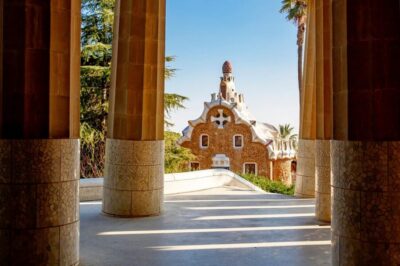
Park Güell and Gaudí House Museum Entry Ticket
Read our review →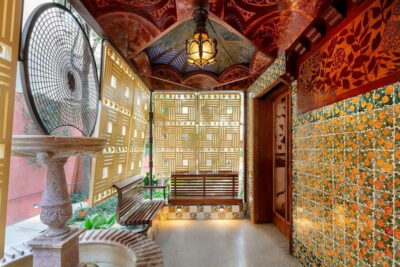
Gaudi’s Casa Vicens Skip-the-Line Entrance Ticket
Read our review →
Gaudí’s Park Güell Tour with Fast-Track Ticket
Read our review →
Sagrada Familia & Gaudi Tour Private or Small Group with Tickets
Read our review →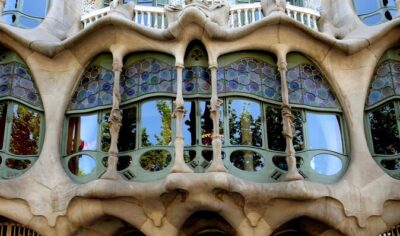
Complete Gaudi Tour: Casa Batllo, Park Guell & Sagrada Familia
Read our review →
Park Güell: Guided Tour with Optional Gaudí Experience Entry
Read our review →
Barcelona e-Bike Tour: Gaudí & Old Town Small Group
Read our review →
Ramblas, Old Town, Gothic and Gaudi Architecture Walking Tour
Read our review →Other lists with this tour