
Review · HUNGARY
Buda Castle Tour: History and Architecture
Buda Castle is far more than a palace. This 3.5-hour walk follows the hill’s medieval streets, ruined churches, noble houses, Jewish quarter, siege walls, and modern reconstructions. You get the story beneath the famous viewpoints, not just a quick look at the postcard landmarks.
I like the small maximum of 12 people, which leaves room for questions, and I like the guide’s focus on archaeology and architecture. Matthew, also called Máté, uses images on an iPad to show how lost buildings may have looked. The main drawback is clear: you do not tour inside the Royal Palace or Matthias Church, and the walk is not suitable for people with limited mobility.
Key points at a glance
- Medieval Buda beyond the palace: Explore Tárnok Street, Úri Street, Fortuna Street, and other lanes built over 14th- and 15th-century foundations.
- A guide with a strong history focus: Matthew, or Máté, explains architecture, archaeology, and political change with visual material on an iPad.
- Small-group format: The tour accepts no more than 12 people, a useful size for a long walking route and detailed questions.
- Rare Jewish heritage: Enter the excavated medieval Jewish prayer house, included in the tour price, except when it is closed on Saturday and Monday.
- Important limits on admission: The Royal Palace, Matthias Church interior, and upper Fisherman’s Bastion terrace require separate payment.
- A demanding hill walk: Good physical fitness is needed, and children under 10 are not permitted.
Why this Buda Castle walk is different
Many Budapest sightseeing walks stay close to Matthias Church and Fisherman’s Bastion. This one uses those famous places as only part of a much broader story.
You begin at the statue of Prince Eugene of Savoy and move through the former royal center, merchant streets, aristocratic quarters, religious sites, and defensive walls. The route ends at Szentháromság Square beside Matthias Church. Along the way, you see how Buda changed from medieval royal seat to Ottoman frontier city, Habsburg rebuilding project, wartime ruin, and modern historic district.
I especially like the attention given to ordinary buildings. Tárnok Street and Úri Street help you picture how merchants, craftsmen, nobles, and families lived behind thick stone walls. That makes the palace easier to understand. A royal court never existed alone. It needed shops, workshops, churches, printers, inns, archives, and homes.
The guide’s archaeology background adds useful depth. Rather than treating every old wall as a complete monument, Matthew explains how fragments were reused, rebuilt, covered, and sometimes lost. The iPad images are a practical touch because many medieval structures survive only as foundations or partial walls.
More History Walks around the world:
- Chicago in a Day: Food, History & Architecture Walking Tour
★ 5.0 · 1,153 reviews - Charleston’s Best Highlights: History, Culture & Architecture
★ 5.0 · 422 reviews - Palm Springs Modernism Architecture & History Bike Tour
★ 5.0 · 359 reviews
The Royal Palace and Sigismund’s chapel
The walk opens at Buda Castle, with about 20 minutes devoted to the Royal Palace. The palace has been built, destroyed, and rebuilt several times, so it is best understood as a stack of historical periods rather than one finished building.
You’ll hear how a medieval stronghold grew into a royal residence. Gothic, Baroque, and Neoclassical elements reflect different rulers, wars, and tastes. The palace also reflects Hungary’s political struggles, since each major period left its mark on the building.
The important practical point is that this is an exterior history tour. Admission to the Royal Palace interior is not included. If you want museum collections or a longer look inside, plan that as a separate visit after the walk.
A short stop at the remains of the medieval Sigismund Church follows. The foundations belong to a Gothic royal chapel built during King Sigismund’s expansion of the palace in the early 15th century. It is only a brief pause, but it helps show how the royal complex once extended beyond the surviving palace walls.
Tárnok Street and Úri Street, medieval Buda’s everyday life
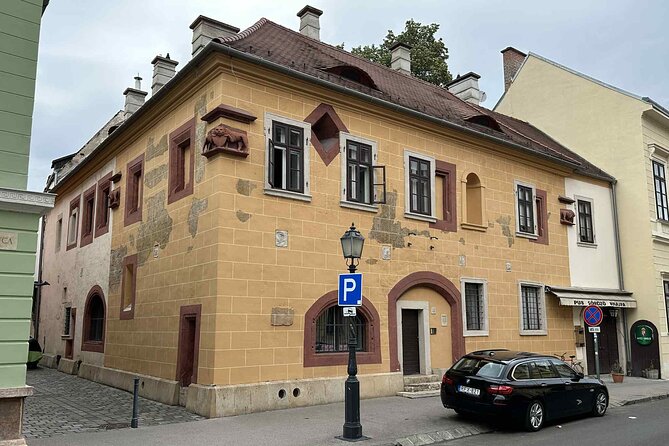
Tárnok Street was the main commercial lane of the medieval burgher town below the royal court. Its cobbled surface and old façades offer a useful change of scale after the palace.
Here, the subject shifts from rulers to trade. You’ll look at three authentic buildings that survived fire, siege, and later urban change. The key is to notice what the architecture tells you: storage areas, shop fronts, narrow plots, and sturdy lower walls built for long use.
The stop lasts about 15 minutes. That is enough for an explanation and a look at the buildings, but not a slow architectural survey of every doorway. If you enjoy old town houses and practical details, this may be one of the most rewarding parts of the route.
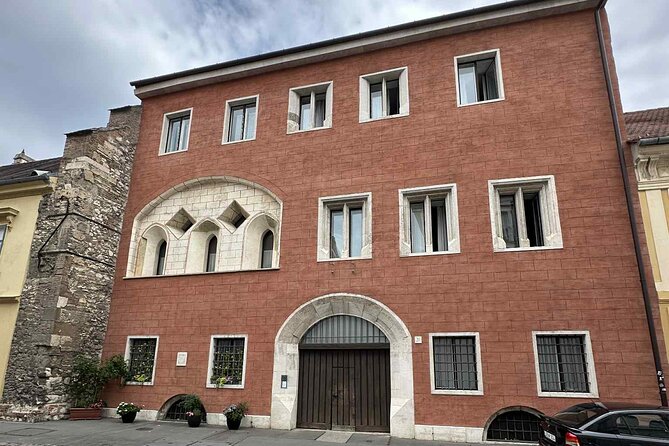
Úri Street was the noble residential quarter. Its homes and former palaces often rest on 14th- and 15th-century foundations, with thick walls and grand gateways showing the social rank of their owners.
I like the contrast between the two streets. Tárnok Street explains commerce. Úri Street explains status. Together, they give you a more complete picture of medieval Buda than a palace visit alone. The ornate gateways are a particular highlight, since they reveal how architecture welcomed merchants, craftsmen, and important households.
Saint Mary Magdalene and Országház Street
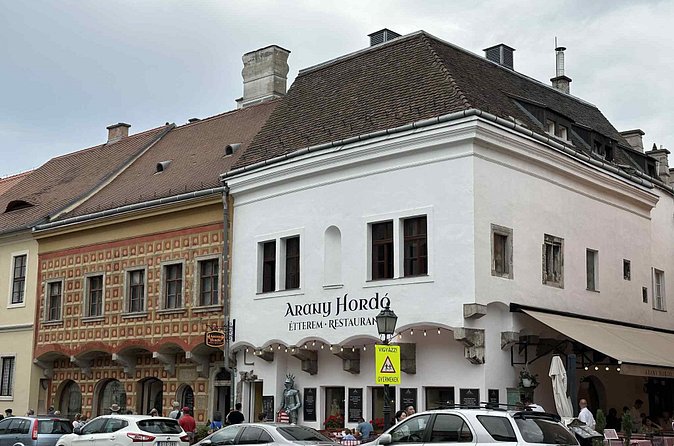
The Church of Saint Mary Magdalene has one of the most difficult stories on the route. Its foundations reach back to the 13th century, and it once served the Hungarian-speaking population of the Castle District.
The church was damaged during the 1686 siege of Buda. Much later, in the 1950s, the Communist government ordered the ruined structure demolished. Only the medieval tower survived through the efforts of archaeologists and preservationists.
You spend about eight minutes here. Admission is not included, so check the exact arrangement before setting out if entering the tower matters to you. Even from outside, the site is useful because it shows how political decisions continued to shape Buda long after the medieval period.
Országház Street, once called Italian Street, brings another side of the old city into view. Italian merchants lived and worked here during the 14th and 15th centuries, adding an international element to Buda’s commercial life.
The street also contains the only surviving 16th-century sgraffito decoration in the Castle District. Sgraffito uses layers of plaster to create a scraped or incised pattern. It is a small detail, but it gives you a rare glimpse of Renaissance design among older Gothic buildings.
More Architecture Tours around the world:
- Chicago Architecture River Cruise
★ 5.0 · 15,756 reviews - Chicago River 90-Minute Architecture Tour
★ 4.5 · 9,629 reviews - Chicago River: 1.5-Hour Guided Architecture Cruise
★ 4.8 · 8,046 reviews - Barcelona: Park Güell and Gaudí House Museum Entry Ticket
★ 4.5 · 6,326 reviews
From Neo-Gothic reconstruction to Matthias Church
The former Royal Hungarian Ministry of Finance is a sharp change from the medieval remains. The Neo-Gothic building was created in the early 20th century, and its construction required the demolition of several older structures.
World War II caused severe damage. After the war, the façade was simplified, removing much of its original ornament. In recent years, the exterior has been reconstructed, restoring much of its former appearance.
That work is not presented as a simple success story. Part of an original wing was demolished during the project, leading to debate about how historic buildings should be restored. I appreciate that this stop leaves room for that tension. Historic districts are not frozen scenes. They are shaped by choices made today.
The next stop is the Church of the Assumption of the Buda Castle, commonly called Matthias Church. The common name is not the official one. The church originally served Buda’s German-speaking community, another reminder that the medieval city was divided by language, trade, and social group.
The stop here is brief, about five minutes. Interior admission is not included. You can visit on your own after the tour, especially since the walk ends nearby at Szentháromság Square.
Fortuna Street and the first Hungarian printed book
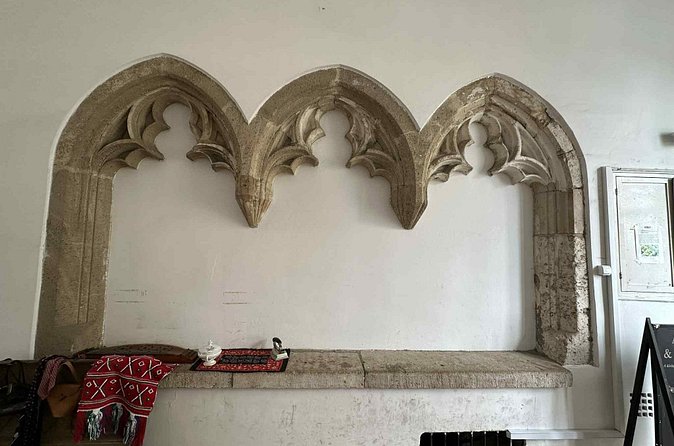
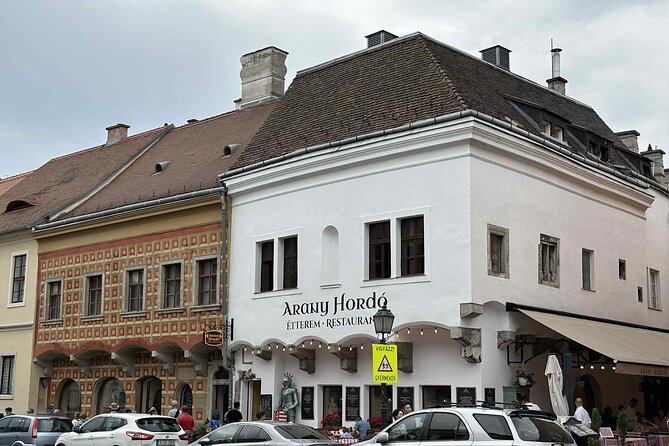
Fortuna Street now has restaurants, but its medieval story reaches into aristocratic life and early printing.
In the 1470s, Andreas Hess, a German-born printer, produced Hungary’s first printed book here, the Chronica Hungarorum. That fact gives the street a sense of movement and experiment. This was not merely a quiet residential lane. It was connected to new ideas, trade, and the spread of information.
The former Red Hedgehog Inn was also nearby. For centuries, inns served as meeting places for merchants, intellectuals, and people passing through the city. The modern restaurants may be pleasant places to stop later, but the older story gives the street more weight than its present-day appearance suggests.
Bécsi Kapu Square and the National Archives
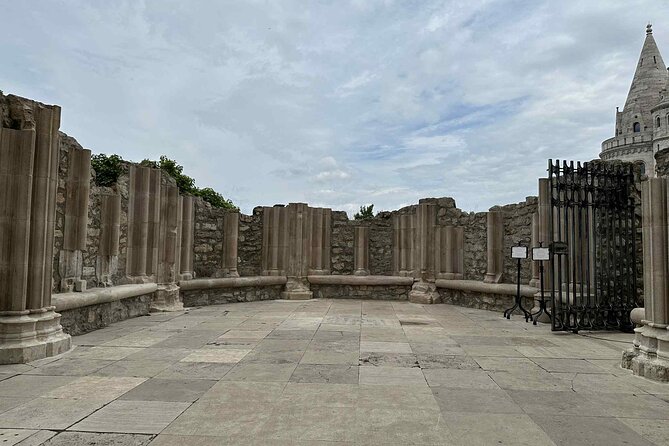
Bécsi Kapu Square once functioned as a marketplace and a major entrance to medieval Buda. The square brought together Hungarian townspeople and members of the local Jewish community for trade and daily business.
The stop is short, about five minutes, so expect a focused explanation rather than a long pause. It works well as a bridge to the later discussion of Buda’s Jewish quarter and the city’s changing communities.
Nearby, the National Archives of Hungary presents another example of historical design. Built in the early 20th century in a Neo-Romanesque style, it was designed to echo the medieval character of the Castle District.
Its heavy stonework, rounded arches, and large scale make it look older than it is. The building also has a clear purpose beyond appearance: it holds documents covering Hungary’s written past. That makes it a fitting place to discuss how a nation preserves memory through both buildings and records.
The 1686 siege and the medieval Jewish prayer house
Along the outer castle walls, the tour turns to the Siege of Buda in 1686. You’ll see the area where Christian allied forces first breached the walls, and you’ll learn about the death of Abdurrahman Abdi Pasha, the Ottoman Pasha of Buda.
A nearby memorial honors the multinational Christian soldiers who died during the liberation of the city. The site can feel solemn, and rightly so. Military history here is tied to real destruction, loss, and the rebuilding that followed.
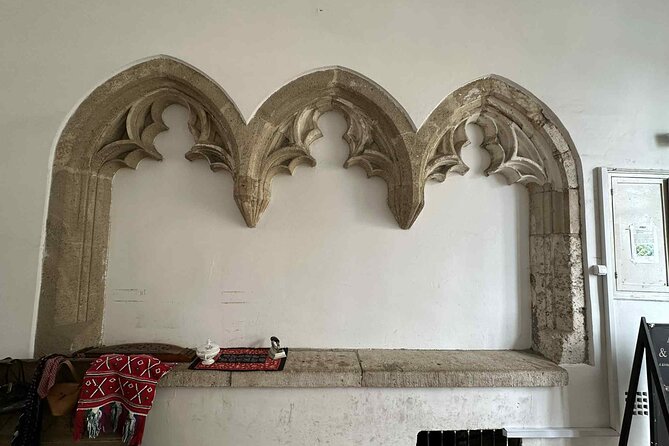
The medieval Jewish quarter provides one of the route’s most meaningful stops. The former Gothic synagogue once served as a center of worship for Buda’s Jewish community. Nearby, the excavated medieval Jewish prayer house offers a rare surviving example of Jewish religious architecture from medieval Hungary.
Admission to the prayer house is included. It is closed on Saturday and Monday, so those dates matter when you book. If the interior cannot be opened, the route may not offer the same experience, particularly for people interested in religious and community history.
This is not a grand monument. Its value comes from scale and survival. The modest space helps you think about ordinary worship, family life, and a community that was later silenced and displaced.
Reused ruins, the Dominican monastery, and Fisherman’s Bastion
Táncsics Mihály Street shows how later residents used the medieval city rather than clearing it away. Gothic walls and cellars were incorporated into Baroque and later homes during the 17th and 18th centuries.
Look for the layered effect: older stone below, later façades above, and centuries of repair in between. It is a good place to understand Buda as a living town, rebuilt over its own ruins.
At Dominikánus Udvar, you’ll see the remains of the Dominican monastery of Saint Nicholas. The site is linked to Friar Julianus, who set out on a notable 13th-century journey. The ruins later faced fire, siege, neglect, and modern redevelopment.
The Hilton Hotel now incorporates medieval stonework into a 20th-century structure. Some people may find the combination striking, while others may see it as a difficult compromise. Either way, the site raises a useful question: how should a modern city use important ruins without turning them into stage scenery?
The walk ends at Fisherman’s Bastion, with the equestrian statue of King Saint Stephen at its center. You’ll examine the monument and main level, but the upper lookout terrace requires a separate ticket.
This is a practical limitation, especially if panoramic views are your main goal. You can buy access afterward, but it is not part of the $43.25 tour price.
Price, pace, and who should book
At $43.25 per person, the tour offers good value if you want context rather than admission to a single attraction. The price covers an officially licensed English-speaking guide, the small-group format, and entry to the medieval Jewish prayer house when it is open.
It does not cover the palace interior, Matthias Church, Fisherman’s Bastion upper terrace, or the Buda Castle Garden Bazaar. Add those costs only if you plan to visit them separately.
The pace is steady. The route lasts about three and a half hours and includes many short stops, stairs or uneven surfaces may be part of moving around an old hilltop district. Good physical fitness is required, and the tour is not suitable for people with limited mobility. Children under 10 are not permitted because of the physical and thematic demands.
The meeting point is at the Statue of Prince Eugene of Savoy. The endpoint is beside Matthias Church at Szentháromság Square, which makes it easy to continue sightseeing afterward.
The experience is best for adults and older children who want architecture, archaeology, religious history, and political context. It suits a first visit if you want to understand what you are seeing, and it also suits repeat visitors who have already photographed the main landmarks.
Free cancellation is available up to 24 hours before the start time. The tour requires good weather and a minimum number of people. If poor weather or low enrollment forces cancellation, you receive a different date or a full refund.
Should you book this Buda Castle tour?
Book it if you want Buda Castle explained as a complete historic district, not just a palace and a viewpoint. The strongest parts are the medieval merchant and noble streets, the Jewish prayer house, the siege sites, and the guide’s use of archaeological detail and visual material.
Skip it if your priority is spending several hours inside the Royal Palace or Matthias Church. Those interiors are not included, and Fisherman’s Bastion’s upper terrace costs extra.
For most history-minded visitors, the price is fair because the tour connects small remains to a much larger story. Bring comfortable shoes, check the prayer house schedule, and save time afterward for the church interior or palace museums if those are high on your list.
FAQ
How long does the Buda Castle tour last?
The tour lasts approximately 3 hours and 30 minutes.
What language is the tour offered in?
The tour is offered in English.
What is the price of the tour?
The price is $43.25 per person.
Where does the tour begin?
It begins at the Statue of Prince Eugene of Savoy in Budapest, 1013 Hungary.
Where does the tour end?
It ends at Szentháromság Square beside Matthias Church.
Is the Royal Palace interior included?
No. Admission to the interior of the Royal Palace is not included, but you may visit independently after the tour.
Is admission to Matthias Church included?
No. Admission to the interior of Matthias Church is not included.
Is the upper terrace of Fisherman’s Bastion included?
No. The tour visits the main level. Access to the upper panoramic terrace requires a separate ticket.
Is the medieval Jewish prayer house open every day?
No. It is closed on Saturday and Monday. Admission is included when it is open.
New to the itinerary around the world
- Washington, DC: Georgetown Architecture Walking Tour★ 5.0 · 8 reviews
- Wilmington History and Architecture Tour★ 4.8 · 18 reviews
- Washington DC: Dupont Circle & Embassy Row Architecture Tour★ 5.0 · 6 reviews
- New Orleans : Garden District Architecture Walking tour★ 4.8 · 5 reviews
- Walk & Discover KL’s Architectural and Heritage Gems★ 5.0 · 7 reviews
- Unveiling Brno: History, Culture & Architectural Delights★ 5.0 · 2 reviews
- Vicenza: Palladian Architecture Private Walking Tour★ 3.3 · 3 reviews
- Private Colonial Williamsburg Architectural Tour★ 5.0 · 5 reviews