

Review · BRAZIL
Civic, Legal and Architectural Citytour
Brasília is a city built around a grand idea: government, housing, traffic, and public life arranged on a vast modernist plan. This four-hour private tour helps you make sense of that plan while taking you to Oscar Niemeyer’s most important buildings, from the soaring Cathedral to the National Congress and the Presidential residence. The private vehicle matters here. Brasília was designed for cars, not casual walking between sights.
I especially like the mix of architecture and civic history, and I like that the tour reaches far beyond the usual central monuments. The blue glass of the Dom Bosco Sanctuary, the JK Bridge over Lake Paranoá, the TV Tower, and the Army Headquarters give you a fuller picture of the city. The main drawback is pace: with 12 stops in about four hours, some visits are brief, and access to certain buildings can depend on the day.
Key points to know before booking
- A private four-hour route for up to four people: The $170 group price can be fair for a small party, especially when divided among four.
- A strong introduction to Brasília’s design: You see how Lucio Costa’s plan and Niemeyer’s buildings work together.
- Many stops are short: Expect photo stops and outside views alongside a few more substantial visits.
- The JK Memorial is the main museum visit: Allow 40 minutes for photos, films, exhibits, coffee, and souvenirs.
- Access can change: The Alvorada Palace offers guided tours on Wednesdays, and the TV Tower requires identification for elevator access.
- Timing affects comfort: An early start can help with Brasília’s strong sun and heat.
Why a car makes sense in Brasília
You can understand Brasília on foot in small sections, but not as one connected sightseeing walk. The city’s monumental axis is broad, open, and built around long distances. The residential superblocks and separated roads make a car especially useful when your goal is to see a dozen major sites in one morning.
This tour begins at 9:00 a.m. and lasts about four hours. Since it is private, only your group participates. That gives you more room to ask questions or adjust the emphasis, although the large number of planned stops means you should not expect a long architectural study at every building.
The guides named in the experience include Alberto, Michael, Anselmo, Flavio, Jose, Ambrosio, and others. Their strengths appear to vary, but the best praised guides, especially Alberto, Michael, Anselmo, and Ambrosio, are described as clear, friendly, and deeply familiar with Brasília. Alberto is also described as a lifelong resident who can explain the city’s history, architecture, politics, and daily life in good English.
I would confirm the guide’s language and the day’s route before setting out. One useful feature of a private tour is the ability to say what matters most to you. If you care more about Niemeyer’s interiors than quick photo stops, say so at the start.
More Architecture Tours around the world:
- Chicago Architecture River Cruise
★ 5.0 · 15,756 reviews - Chicago River 90-Minute Architecture Tour
★ 4.5 · 9,629 reviews - Chicago River: 1.5-Hour Guided Architecture Cruise
★ 4.8 · 8,046 reviews
Cathedral and Congress: Brasília’s bold civic face
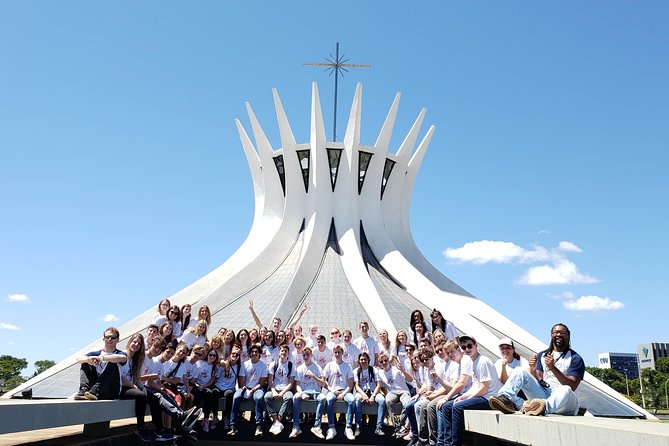
The Metropolitan Cathedral is one of the best first stops. Niemeyer designed it as a crown of curved concrete ribs, surrounded by a reflecting pool. The structure looks light and almost weightless from outside, even though its form depends on a massive concrete frame.
Inside, the light changes everything. Stained glass and suspended figures give the space a cool, open feeling. The stop is listed at 15 minutes, so you may have enough time to look around and take photographs, but not enough for a slow study of every artistic detail. Admission is free.
The National Congress follows with a short 20-minute visit. Its two contrasting bowl shapes and tall office towers are among the clearest examples of Niemeyer’s preference for simple forms with strong symbolic effect. This is also where architecture and present-day Brazil meet. The building houses the legislative branch, and guided tours are offered in English and Portuguese, with additional language information indicated in the tour details.
Access may vary, so do not assume that every interior area will be open. Even an outside explanation is useful here because the building makes more sense when your guide explains the Senate, Chamber, towers, and the way the complex anchors the Monumental Axis.
Dom Bosco Sanctuary and the blue light

The Sanctuary of Saint John Bosco is a smaller building, but it can leave a bigger visual impression than some of the government complexes. Its blue stained-glass windows fill the interior with a deep, cool glow. Works of art complete the effect, making this a welcome change after Brasília’s bright plazas and pale concrete.
The stop lasts about 20 minutes and admission is free. I would treat it as a quiet pause rather than simply another photograph. The sanctuary shows that Brasília’s modernism was not limited to ministries and official buildings. Religious architecture received the same bold treatment, but here the main material is colored light.
This stop also helps balance the tour. If you book mainly for Niemeyer, you still get the design story. If you care about atmosphere and religious art, the sanctuary gives you something more personal than a government façade.
JK Memorial: the clearest history stop
The Juscelino Kubitschek Memorial is the tour’s main museum visit, with about 40 minutes set aside. Kubitschek was the president who pushed Brasília forward and made the new capital a reality. The memorial presents his life along with photographs and films about the city’s construction.
This is where the grand plan becomes a human story. Brasília was not simply drawn on paper and completed overnight. The memorial helps you connect political ambition, construction, national identity, and the people who built the capital.
There is also a café, souvenir area, and art on display. The 40-minute visit is still fairly brisk, but it gives you more context than a quick stop outside a monument. If you have only one day in Brasília, I would pay close attention here because it explains why the city exists in its current form.
Admission is included, unlike the many free outdoor stops. That makes the memorial an important part of the tour’s value, not an optional add-on you need to arrange separately.
Same streets, read through a different style:
- Barcelona: Park Güell and Gaudí House Museum Entry Ticket
★ 4.5 · 6,326 reviews - Chicago Architecture Center River Cruise aboard First Lady
★ 5.0 · 5,536 reviews - Barcelona: Gaudi’s Casa Vicens Skip-the-Line Entrance Ticket
★ 4.7 · 4,541 reviews - Barcelona: Gaudí’s Park Güell Tour with Fast-Track Ticket
★ 4.8 · 4,512 reviews
Three Powers Square and the Presidential Palace
Praça dos Três Poderes is the political heart of Brasília. The square brings together Brazil’s three federal powers: the legislative, judicial, and executive branches. The Supreme Federal Court, National Congress, and Planalto Presidential Palace form the central civic group.
The scheduled stop is about 15 minutes, which is enough for an overview and photographs. It is not enough to examine every sculpture, façade, and inscription. Your guide’s explanation matters here because the open square can feel abstract without a clear account of how the buildings relate to Brazil’s government.
The Palácio da Alvorada, the official residence of the president, is a separate stop of about 15 minutes. It was the first building inaugurated in Brasília and is another Niemeyer design. The curved structure and setting near Lake Paranoá show a less formal side of the capital’s architecture.
Guided tours at the Alvorada Palace take place on Wednesdays. That does not mean every tour will enter the residence, so ask what access is available on your date. The road can also be closed, as happened to at least one tour group, and that is outside the guide’s control. Even when you cannot approach closely, the stop helps complete the story of Brasília’s political center.
Lake Paranoá and the JK Bridge
The viewpoint at the JK Bridge gives you a break from government buildings. The bridge crosses Lake Paranoá and is one of Brasília’s most recognizable modern works. From the lookout, you can see the sweeping structure, the water, and a broader view of the city.
The stop is only about 10 minutes, so consider it a photo stop rather than a lakeside visit. Restaurants are located near the bridge, but this itinerary does not include a meal. The value is visual: after seeing Brasília in close detail, you get a wider sense of its scale and open spaces.
The bridge also shows that Brasília’s design story continued beyond the original 1960 plan. The city is not only a collection of official buildings. Its bridges, neighborhoods, religious sites, stadium, and public spaces all contribute to the way it feels.
TV Tower and the city from above
The TV Tower was designed by Lucio Costa, the urban planner behind Brasília’s overall layout. Its 75-meter lookout offers a useful way to see the city plan from above. This is one of the stops I would prioritize if the elevator is operating.
You must present an identification document to use the lookout, and climbing the stairs is not allowed. That makes the elevator essential. The lift has broken down before, so access cannot be guaranteed. If the tower is closed, your guide can still explain the axis and point out the major zones, but you will lose one of the best views on the route.
The tower stop is listed at 15 minutes. That is enough for a quick look, but not a long wait if the elevator is busy or access is restricted. Bring your identification even though admission is free.
Army Headquarters and Praça dos Cristais
The Army Headquarters is another Niemeyer project, with an acoustic shell, theater, and Praça dos Cristais. The square was designed by Roberto Burle Marx, whose work gives the site a different visual language from the concrete buildings nearby.
The planned 20 minutes lets you see the group of structures and understand how architecture, public space, and military symbolism fit together. It is a worthwhile stop for design-minded visitors because it expands the tour beyond the famous central buildings.
The Crystal Square also gives your guide a chance to explain how Brasília uses open plazas. These spaces can look bare or oversized if you view them only as photographs. In person, their scale is part of the point. The city was designed to express a new national capital, not a traditional colonial center.
Igrejinha, stadium, and the city beyond the axis
The Little Church of Our Lady of Fatima, known as Igrejinha, was designed by Niemeyer at the request of Sarah Kubitschek. It was built beside Brasília’s model superblock, a residential unit intended to serve as a pattern for the rest of the city.
This 15-minute stop is valuable because it connects the monumental plan with ordinary housing. Brasília was meant to be a functioning city, not just a showcase for ministries and palaces. The small church’s curved form feels friendly and intimate after the huge scale of the civic buildings.
The National Stadium Mané Garrincha is a five-minute photo stop. Do not expect a stadium tour. It is simply a quick chance to see one of the city’s major sports venues and add a contemporary landmark to the route.
The final stop, the Temple of Good Will, takes about 30 minutes. This ecumenical temple welcomes all religions and has a pyramid form with a crystal at the top. Visitors walk a spiral inside the nave, a design intended to create a reflective experience.
The temple is different from the cathedral and sanctuary. It is not tied to one traditional denomination, and its interior movement gives the stop a more personal rhythm. Admission is free, and it provides another example of Brasília’s willingness to express spiritual ideas through unusual modern forms.
How much does $170 represent?
The price is $170 per group of up to four people, not per person. For four people, that works out to $42.50 each. For two people, it becomes $85 each, and a solo participant pays the full group rate.
That price can make sense if you want private transport, a local guide, and a route that covers most of Brasília’s main sights in one morning. Hiring separate rides to reach the Cathedral, Congress, JK Memorial, TV Tower, bridge, palace, church, stadium, and Army Headquarters would take planning and coordination. The tour also saves you from trying to interpret a car-oriented city on your own.
The value is weaker if you want long visits inside each building. This is an overview tour, not a specialist architecture seminar. It is also less attractive if you are comfortable arranging transport yourself and prefer to spend an hour or two at only three or four sites.
The experience has a strong average rating of 4.7 from 81 published ratings, with 90 percent recommending it. The highest praise centers on clear explanations, excellent English from certain guides, punctual pickup, comfortable vehicles, and the ability to understand Brasília’s unusual plan. The main complaints concern a delayed operator response, a guide who seemed less engaged, limited water or air conditioning on a hot day, and closures outside the guide’s control.
Those points give you a useful checklist. Confirm the pickup time. Ask whether the car’s air conditioning is working. Bring water, sunscreen, and identification for the TV Tower. Starting earlier is wise, since one guide recommended an early departure to avoid the strongest afternoon heat.
Who will get the most from this tour?
I would choose this tour if you have one full day in Brasília and want an organized introduction to the city’s architecture and political history. It also suits families and small groups who want a private vehicle instead of managing several rides.
Architecture fans will appreciate the range of Niemeyer buildings, especially if they ask the guide to explain structure, materials, purpose, and interior access. History-minded visitors will get the most from the JK Memorial, Three Powers Square, Congress, and Alvorada Palace.
This is also a good choice if you are unsure how Brasília works as a city. The route links the monumental axis, residential planning, religious buildings, transport landmarks, and lakefront development. You leave with a map in your head, not just a folder of photographs.
I would think twice if your main goal is slow photography or detailed interior access. The route is fast, and some sites may be viewed only from outside. A private tour gives you flexibility, but 12 planned stops still require discipline.
Cancellation is free up to 24 hours before the start time. Changes or cancellations made less than 24 hours ahead are not accepted for a refund. The experience requires good weather, and a weather cancellation brings either another date or a full refund. Service animals are allowed, public transport is nearby, and most people can participate.
Should you book the Brasília city tour?
Yes, if you want to understand Brasília quickly and see its major buildings without wrestling with the city’s huge distances. The strongest reason to book is the combination of private transport and explanation. A guide such as Alberto, Michael, Anselmo, Flavio, Jose, or Ambrosio can turn a strange collection of concrete forms into a story about politics, planning, faith, and national ambition.
Book it with realistic expectations. You will see a lot, but you will not linger everywhere. Ask for an early start, confirm the language, bring identification and water, and state your priorities before leaving.
For first-time visitors with only a short stay, this is one of the most efficient ways to get your bearings. For specialists who want extended time inside Niemeyer’s buildings, use the tour as an introduction, then return on your own to the places that deserve a closer look.
FAQ
How long is the tour?
The tour lasts approximately four hours and starts at 9:00 a.m.
How many people can join the private tour?
The price covers one private group of up to four people.
What is the price?
The price is $170 per group of up to four people.
Is admission included at every stop?
Admission is free at most stops. Admission to the JK Memorial is included in the tour price.
Does the tour include the inside of the National Congress?
The National Congress offers guided tours in English and Portuguese, but the exact access during your tour should be confirmed.
Can I visit the Alvorada Palace?
The Alvorada Palace receives guided tours on Wednesdays. Access can depend on the day, and the road may sometimes be closed.
What do I need for the TV Tower?
You must present an identification document to access the TV Tower lookout. Stairs are not permitted, so the lookout is reached by elevator.
Is the tour suitable for people using public transportation?
The tour itself is private, but the meeting area is near public transportation.
What happens if bad weather cancels the tour?
You will be offered another date or a full refund. Free cancellation for other reasons is available up to 24 hours before the start time.
New to the itinerary around the world
- Washington, DC: Georgetown Architecture Walking Tour★ 5.0 · 8 reviews
- Wilmington History and Architecture Tour★ 4.8 · 18 reviews
- Washington DC: Dupont Circle & Embassy Row Architecture Tour★ 5.0 · 6 reviews
- New Orleans : Garden District Architecture Walking tour★ 4.8 · 5 reviews
- Walk & Discover KL’s Architectural and Heritage Gems★ 5.0 · 7 reviews
- Unveiling Brno: History, Culture & Architectural Delights★ 5.0 · 2 reviews
- Vicenza: Palladian Architecture Private Walking Tour★ 3.3 · 3 reviews
- Private Colonial Williamsburg Architectural Tour★ 5.0 · 5 reviews