
Review · NEW ZEALAND
Explore the legacy of artist, ecologist, architect, visionary
Whangarei’s most unusual building is also its boldest cultural attraction. The Hundertwasser Art Centre brings together the work of Austrian artist Friedensreich Hundertwasser, his time in New Zealand, and his ideas about architecture, nature, and daily life. Beside it, the Wairau Māori Art Gallery presents changing exhibitions by contemporary Māori artists.
I like the freedom to explore at your own speed, with full-day access rather than a rushed entry slot. I also like the building itself: colourful tiles, curved forms, spiral stairs, artful railings, and the planted Afforested Roof make the visit feel larger than a standard gallery stop. The main drawback is value. At $18.62 per person, some people may find the indoor display smaller than expected, especially if their main interest is Hundertwasser’s architecture rather than his art and ideas.
Key points to know before you go
- Largest Hundertwasser collection outside Vienna: See artworks, building models, and examples of his approach to living with nature.
- Two different cultural experiences: The ticket includes both the Hundertwasser exhibition and the changing Wairau Māori Art Gallery.
- Full-day admission: You can spend one to three hours, leave time for lunch, and return to the displays during the same day.
- The Afforested Roof is part of the visit: Climb to the top for broad views over Whangarei and the Hātea River.
- Guided or self-guided: Explore alone, or arrange an additional one-hour interactive guided tour.
- Good central pairing: The centre sits by the Town Basin, close to riverside walks, restaurants, and other downtown sights.
Why Hundertwasser matters in Whangarei
Friedensreich Hundertwasser was more than a painter. He worked as an architect, ecologist, and advocate for a different way of building cities. His central idea was simple but demanding: people should live with nature, not push it out.
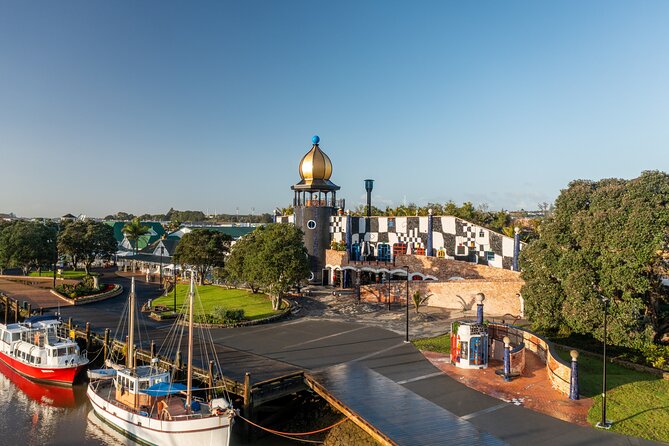
That belief comes through in the building. You see uneven lines, strong colour, rounded shapes, planted areas, and a golden cupola rather than the neat, glassy style used by many modern cultural centres. The building is meant to feel handmade and alive. It does not ask you to admire art from a distance only. It asks you to notice how walls, roofs, windows, plants, and people can share one place.
I find that this makes the visit useful even if you do not already know Hundertwasser’s paintings. The building gives you a quick visual introduction before you enter the exhibition. It also helps explain why his work remains relevant. His concern for trees, green roofs, and less rigid cities feels very current.
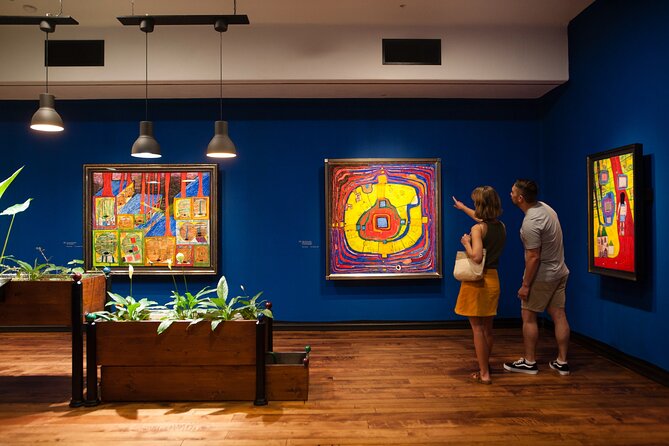
The centre presents Hundertwasser in New Zealand from 1973 to 2000, connecting his work to the country where he spent part of his life. You get more than isolated pictures on a white wall. The display also includes living examples of his ecological practices and models of other buildings.
More Architecture Tours around the world:
- Chicago Architecture River Cruise
★ 5.0 · 15,756 reviews - Chicago River 90-Minute Architecture Tour
★ 4.5 · 9,629 reviews - Chicago River: 1.5-Hour Guided Architecture Cruise
★ 4.8 · 8,046 reviews
Starting with the colourful exterior
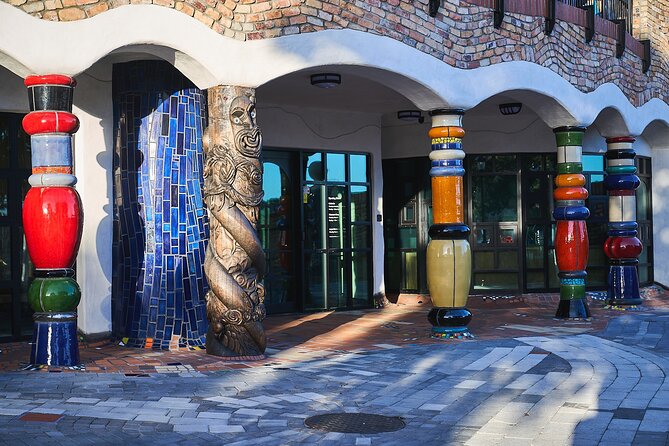
Give yourself a few minutes outside before heading indoors. The exterior is one of the strongest parts of the experience, especially if your first interest is architecture.
Look for the bright tiles, flowing stairs, unusual railings, and swooping brickwork. The forms are playful, but they are not random decoration. They reflect Hundertwasser’s dislike of straight, uniform buildings and his belief that architecture should give people a closer relationship with plants and the ground.
This is a useful stop for families and mixed-age groups because everyone can find something to notice. Children may respond to the colours and odd shapes first. Adults may focus on the ecological message or the way the building interrupts the usual downtown lines.
You can also see why some people may prefer an exterior visit. If your main goal is to photograph the building and enjoy its design, the outside gives you a strong impression quickly. The indoor rooms are more traditional in function, and the amount of original material may feel limited for the admission price.
The Hundertwasser in New Zealand exhibition
Inside, the main exhibition places Hundertwasser’s art beside the story of his connection with New Zealand. The collection is described as the largest group of his work outside Vienna, which gives the centre real importance for anyone interested in his career.
Expect paintings and applied art, along with models that show how his buildings worked in three dimensions. The models are particularly helpful because Hundertwasser’s ideas are not limited to flat images. His windows, irregular floors, plantings, and roof forms make more sense when you can view them as buildings.
I would allow at least an hour for the main exhibition if you want to read the material and watch the film. A quicker visit is possible, but it may leave you with only the surface impression of colour and shape. The supplied admission gives you all-day access, so there is no need to race through the rooms.
A small film theatre runs documentaries on a loop. This can add context to the artist’s life and ideas, though the film may not provide a strong narrative for every visitor. If you prefer a clear, guided explanation, the optional one-hour interactive tour may be the better choice. The guided tour costs extra, so check that arrangement before booking if you want more interpretation.
The exhibition also gives you a chance to consider the difference between seeing Hundertwasser’s work in a book and seeing it in a building designed around his principles. The colours are immediate, but the environmental message takes longer. I would pay attention to the way the displays connect creative work with practical choices about trees, roofs, and urban space.
The Afforested Roof and the golden cupola
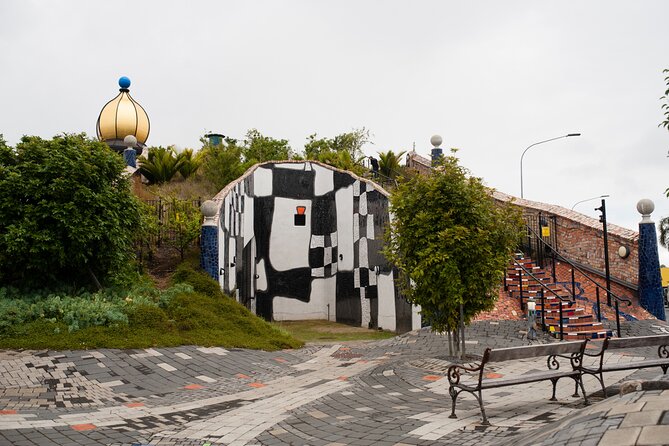
Do not leave without going up to the Afforested Roof. It is one of the clearest reasons to visit the centre in person rather than simply looking at photographs online.
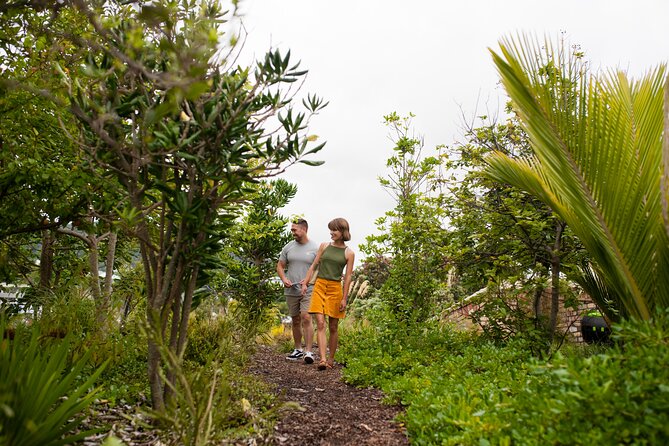
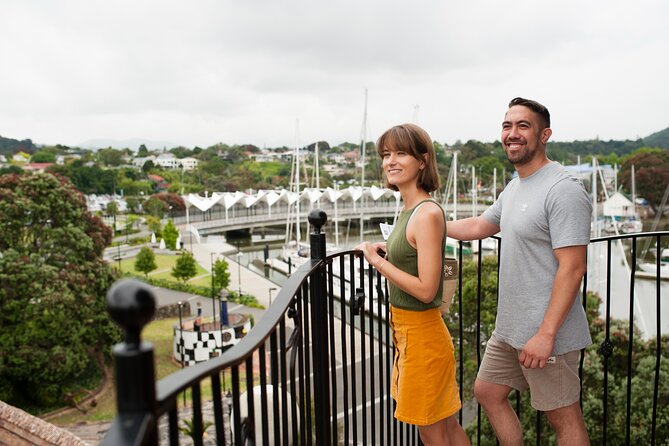
The roof combines planted space with Hundertwasser’s architectural style, topped by a golden cupola. From here, you get 360-degree views across Whangarei, including the Hātea River and the city. The view is not just an extra lookout. It completes the building’s argument that a city can include nature rather than treating greenery as an afterthought.
This is also a good place to pause after the indoor displays. The museum asks you to think about the relationship between buildings and the natural world, then gives you a practical view of the city from above. You can look back at the roof itself and see how vegetation has been made part of the architecture.
The roof is a highlight for photographers, but take time to look beyond the close-up details. The wide view helps you get your bearings in Whangarei, and the Hātea River gives the scene a strong sense of place.
Same streets, read through a different style:
- Barcelona: Park Güell and Gaudí House Museum Entry Ticket
★ 4.5 · 6,326 reviews - Chicago Architecture Center River Cruise aboard First Lady
★ 5.0 · 5,536 reviews - Barcelona: Gaudi’s Casa Vicens Skip-the-Line Entrance Ticket
★ 4.7 · 4,541 reviews - Barcelona: Gaudí’s Park Güell Tour with Fast-Track Ticket
★ 4.8 · 4,512 reviews
Wairau Māori Art Gallery
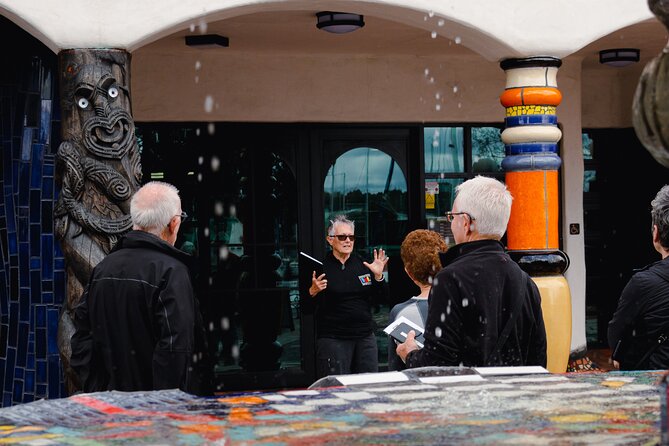
The same admission includes the Wairau Māori Art Gallery, described as the world’s first dedicated Māori public art gallery. Its exhibitions change, so the exact works on display will depend on when you visit.
This part of the centre adds an important second focus. Hundertwasser’s work deals with nature, architecture, and his experience in New Zealand. The Wairau gallery presents contemporary Māori artists exploring indigenous themes and Aotearoa’s history. You are not looking at two versions of the same artistic tradition. You are seeing two distinct perspectives brought together in one cultural centre.
I would avoid rushing through this gallery just because you came for Hundertwasser. The changing exhibitions mean the Māori art may be the part of your visit that feels most different from one trip to the next. It also gives the centre a stronger connection to New Zealand rather than making it only an outpost for a European artist.
The displays may suit you best if you like contemporary art that raises questions about identity, place, culture, and history. If your preference is only for architecture, this section may require a little more patience. Read the labels and give yourself time to consider the ideas behind the work.
A visit that works at your own pace
The experience is sold as a one to three-hour visit, but your ticket provides access for the whole day. That flexibility is valuable in Whangarei because you can fit the centre around lunch, a walk, or other time in the Town Basin.
A focused visit might look like this:
- Spend 15 to 20 minutes examining the outside of the building.
- Allow 45 to 60 minutes for the Hundertwasser exhibition.
- Watch part of the documentary in the small film theatre.
- Visit the Wairau Māori Art Gallery.
- Finish on the Afforested Roof for the city and river views.
- Browse the MuseumShop before leaving.
You do not need to complete everything in a single continuous stretch. The full-day access lets you take a break if the visual material becomes too much, then return later. That is especially useful if you are travelling with children or combining the visit with food and walking nearby.
An optional one-hour interactive guided tour may suit you if you want help connecting the exhibits. The basic admission does not include the guide, so plan for an extra charge. No guide names are provided for this experience, and the tour is an option rather than a requirement.
MuseumShop, films, and the practical extras
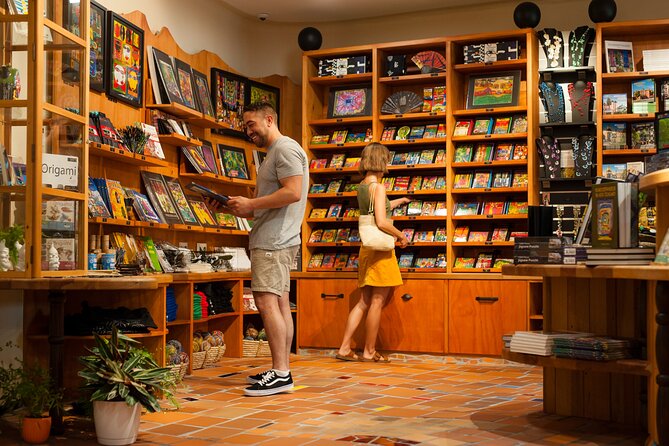
The MuseumShop has a large selection of Hundertwasser applied art, distinctive objects, gifts, and Wairau Māori items. Even if you do not plan to buy anything, it is worth allowing a few minutes here because applied art was an important part of Hundertwasser’s wider practice.
The shop can also help you decide what you actually liked. You may discover that you prefer his posters, small objects, or ecological writing to the larger exhibition. Prices will vary, and the ticket does not include purchases.
The documentary theatre offers a quiet change of pace. Some people will appreciate seeing the artist speak or learning more about his ideas. Others may find the film less satisfying because it does not always provide a strong narrative. Treat it as an optional layer rather than the main reason to enter.
The centre is near public transportation and the Town Basin. It is a practical stop in a day spent around downtown Whangarei, and nearby restaurants make it easy to extend the visit with a meal. One on-site restaurant is also associated with the centre, with food choices including sashimi and chowder, along with views from the area. The meal is separate from the admission ticket.
Is $18.62 good value?
At $18.62 per person, the ticket is reasonably priced if you use the full package: the main exhibition, Wairau Māori Art Gallery, roof, film theatre, and MuseumShop. The full-day access improves the value because you are not forced to see everything in one short session.
The price is harder to justify if you only want to look at the building from outside. It is also worth thinking about your expectations. This is not a huge museum packed with hundreds of major works. The collection has strong significance because of its size outside Vienna, but the indoor display may feel compact to someone expecting a large international art museum.
I would book it if you enjoy architecture, design, environmental ideas, or contemporary Māori art. I would be more cautious if you want only a short architectural photo stop. In that case, the outside may deliver most of what you seek without the admission cost.
Who will enjoy this visit most?
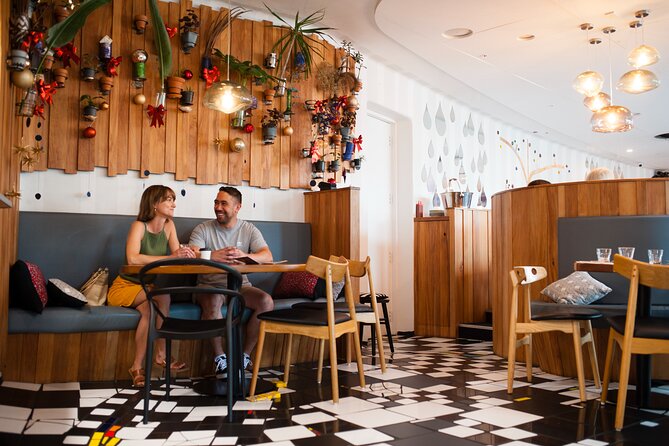
I think the centre works best for visitors who like to combine art with ideas. You do not need specialist knowledge, but curiosity helps. The visit rewards you for asking why the building looks the way it does and how its design relates to nature.
It is also a good choice for:
- Families looking for colourful, unusual architecture.
- Art fans who want to compare European and contemporary Māori perspectives.
- People interested in green buildings and ecological design.
- Visitors with an open hour or two in downtown Whangarei.
- Anyone who appreciates a museum that includes views and outdoor space.
You may enjoy it less if you prefer large collections, conventional galleries, or detailed historical displays. The centre is distinctive, but its appeal depends on your response to Hundertwasser’s playful forms and strong opinions about modern life.
Should you book the Hundertwasser Art Centre?
I would book this experience if you are spending time in Whangarei and want something more memorable than a standard gallery. The building, the Afforested Roof, and the combination with Wairau Māori Art Gallery give you several different reasons to visit.
Go with realistic expectations. The architecture may be the star, the indoor collection may feel limited to some people, and the optional tour costs extra. Still, at $18.62, the full-day ticket offers fair value when you include the two galleries, film theatre, ecological displays, MuseumShop, and city views.
For the best use of your time, see the outside first, explore the Hundertwasser exhibition slowly, give the Māori gallery proper attention, and save the roof for last. The centre is easy to pair with the Town Basin, so it fits neatly into a larger Whangarei day.
FAQ
How much does admission cost?
Admission costs $18.62 per person.
How long does the experience take?
The visit is expected to take approximately one to three hours, but admission provides access for the entire day.
Is a guided tour included?
No. Admission is self-guided. An optional one-hour interactive guided tour can be arranged for an additional cost.
What does the ticket include?
The ticket includes full-day access to the Hundertwasser Art Centre, the Wairau Māori Art Gallery, the Afforested Roof, the small film theatre, and the centre’s other admission areas.
Is the experience suitable for people using public transportation?
Yes. The centre is near public transportation and is located by the Town Basin in Whangarei.
Can I cancel for a refund?
Yes. You can cancel at least 24 hours before the experience start time for a full refund. Cancellations or changes made less than 24 hours in advance are not accepted for a refund.
New to the itinerary around the world
- Washington, DC: Georgetown Architecture Walking Tour★ 5.0 · 8 reviews
- Wilmington History and Architecture Tour★ 4.8 · 18 reviews
- Walk & Discover KL’s Architectural and Heritage Gems★ 5.0 · 7 reviews
- Washington DC: Dupont Circle & Embassy Row Architecture Tour★ 5.0 · 6 reviews
- New Orleans : Garden District Architecture Walking tour★ 4.8 · 5 reviews
- Unveiling Brno: History, Culture & Architectural Delights★ 5.0 · 2 reviews
- Vicenza: Palladian Architecture Private Walking Tour★ 3.3 · 3 reviews
- Private Colonial Williamsburg Architectural Tour★ 5.0 · 5 reviews
New Zealand Architecture Tours, compared.

Guided 10am Morning Art Deco Walk From Napier Art Deco Trust
Read our review →
Guided 2pm Afternoon Art Deco Walk from Napier Art Deco Trust
Read our review →
Shore Excursion: 4 Hour Premium Hawke’s Bay, Napier Art deco Tour
Read our review →
Napier and Hawkes Bay Scenic and Art Deco Tour by VW Kombi
Read our review →
Small group – Napier City & Art Deco Tour, 2 hours
Read our review →
Napier Cruise Excursion Art Deco Tour and Wine Tasting
Read our review →Other lists with this tour